Overview
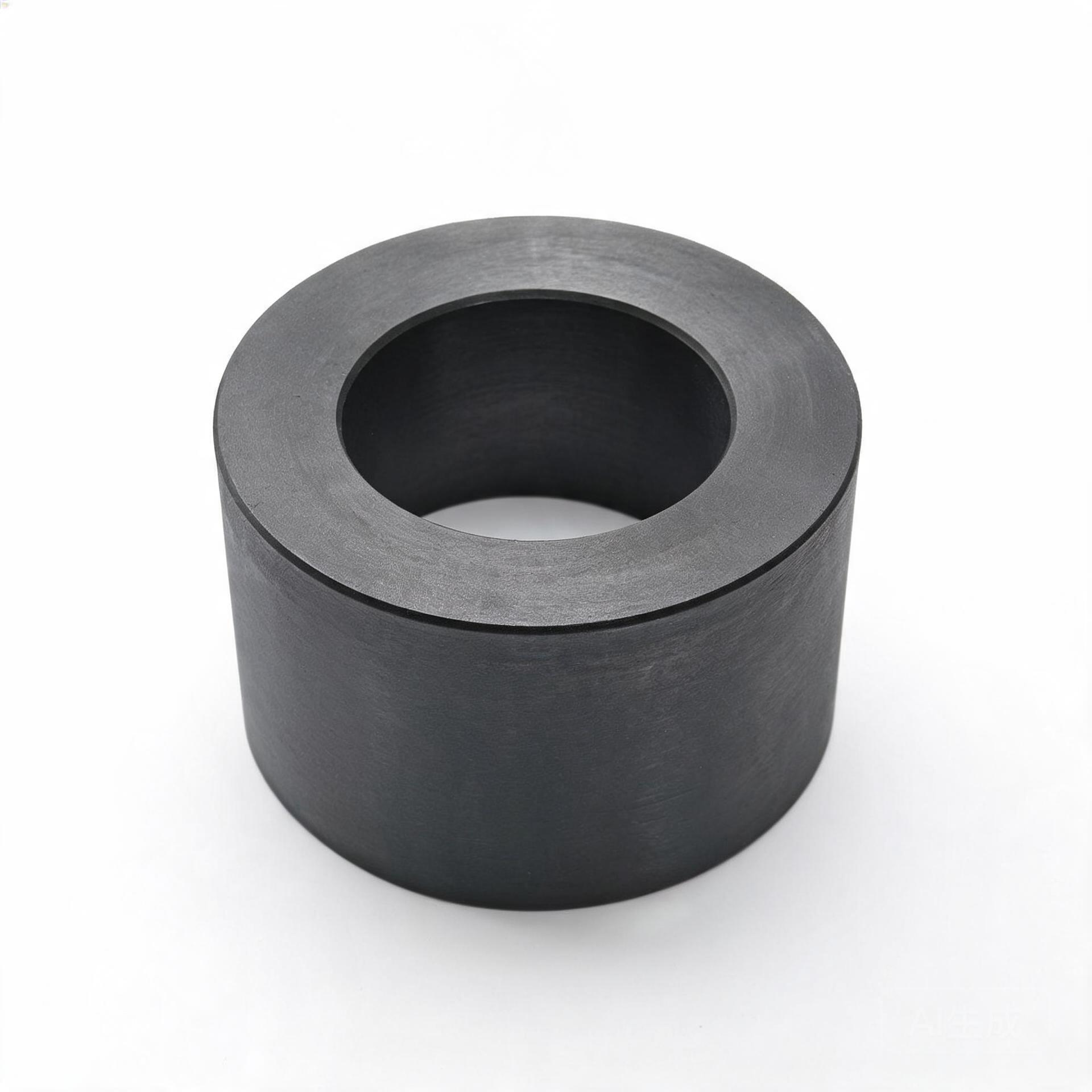
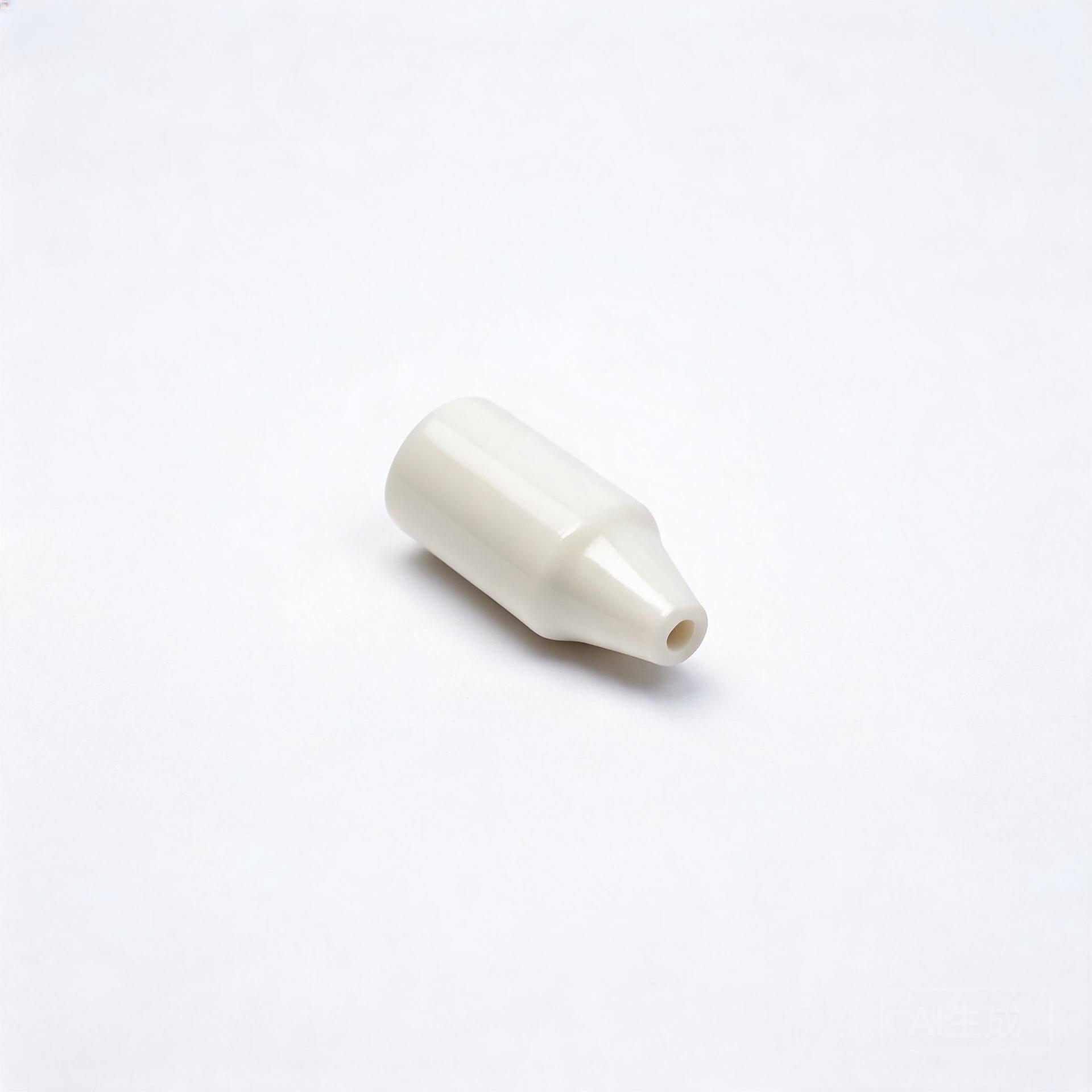
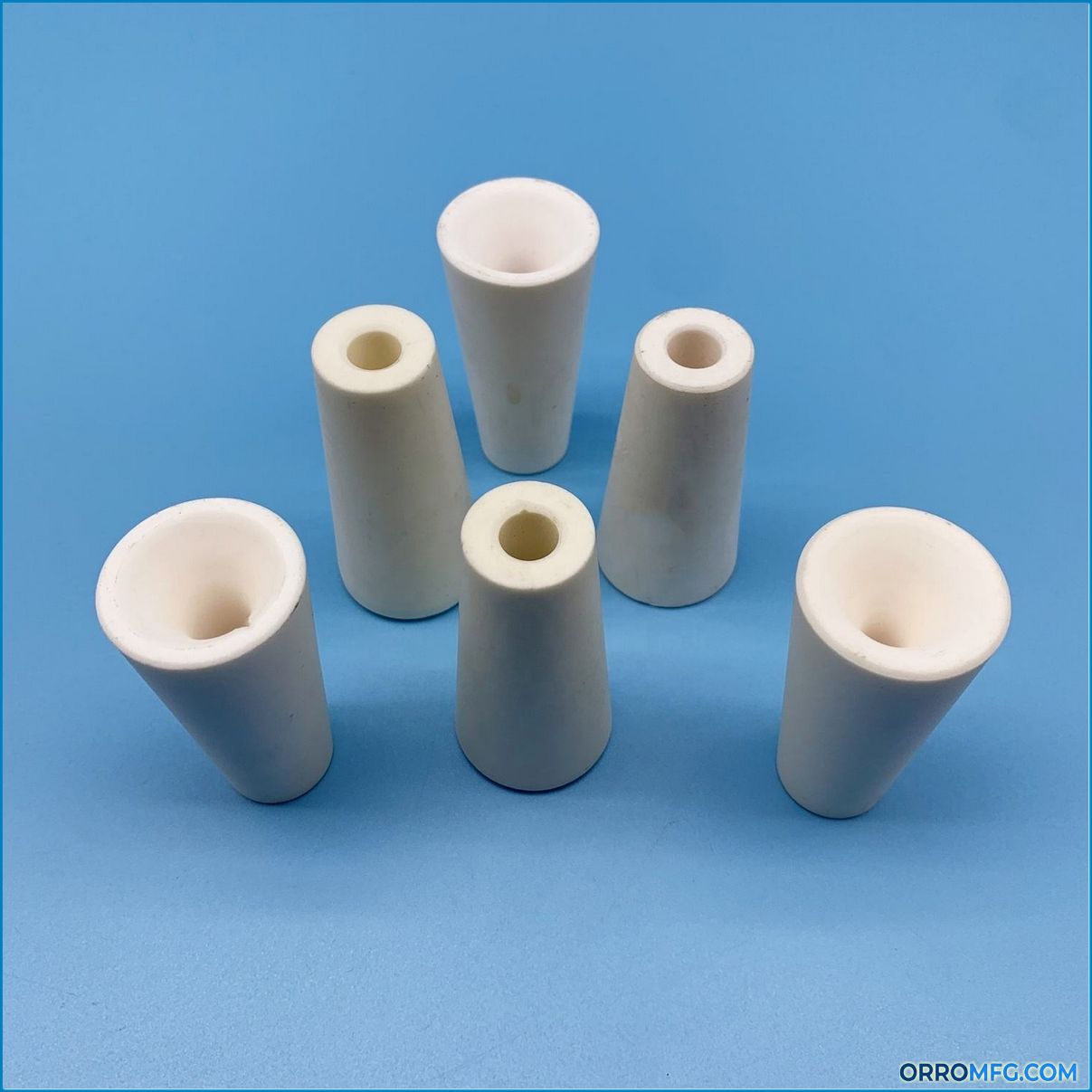
Ceramic nozzles are precision-engineered flow control components manufactured from advanced engineering ceramics such as alumina (Al₂O₃), zirconia (ZrO₂), silicon carbide (SiC), and silicon nitride (Si₃N₄). These high-performance nozzles are designed for applications involving abrasive media, high temperatures, corrosive chemicals, and precision fluid delivery where metal or plastic nozzles would experience rapid wear or degradation. OrroMFG produces precision ceramic nozzles using advanced powder metallurgy, sintering, and precision grinding techniques to deliver extreme hardness, dimensional accuracy, and long-lasting performance in the most demanding applications.
Our ceramic nozzle product range includes sandblasting nozzles, waterjet cutting nozzles, spray nozzles, dispensing nozzles, and custom-designed ceramic nozzle components for specialized industrial applications. Alumina ceramic nozzles offer excellent wear resistance and cost-effectiveness for general abrasive applications, while zirconia ceramic nozzles provide superior toughness and impact resistance for high-pressure or high-impact service. Silicon carbide and silicon nitride nozzles offer extreme thermal shock resistance and high-temperature capability for the most severe operating conditions. All our ceramic nozzles are precision ground and lapped to achieve tight dimensional tolerances and superior surface finishes, ensuring precise flow characteristics and consistent performance. The extreme hardness of engineering ceramics (up to Mohs 9) provides wear resistance many times that of hardened steel, dramatically extending nozzle service life and reducing maintenance downtime.
Key Features
- Exceptional Wear Resistance: Extreme hardness (up to 2000 HV) provides 10-100 times the wear life of steel nozzles when handling abrasive media.
- High Temperature Resistance: Continuous operating temperatures from 1000°C to 1700°C depending on ceramic material, far exceeding any metal or polymer alternative.
- Excellent Chemical Resistance: Resistant to most acids, alkalis, solvents, and corrosive chemicals; inert to most process media.
- Superior Dimensional Stability: Low thermal expansion and high stiffness maintain precise nozzle geometry under varying temperature and pressure conditions.
- High Hardness and Strength: Exceptional compressive strength and hardness resist deformation and erosion even under extreme conditions.
- Smooth Surface Finish: Precision lapped surfaces provide optimal flow characteristics and minimize material buildup.
Material Specifications
| Property | 99% Alumina (Al₂O₃) | 95% Alumina (Al₂O₃) | Yttria-Stabilized Zirconia (YSZ) | Silicon Carbide (SiC) | Silicon Nitride (Si₃N₄) |
|---|---|---|---|---|---|
| Density (g/cm³) | 3.90 | 3.65 | 6.00 - 6.10 | 3.10 - 3.20 | 3.20 - 3.30 |
| Hardness (HV10) | 1600 | 1350 | 1200 - 1400 | 2200 - 2500 | 1500 - 1800 |
| Hardness (Mohs) | 9 | 8.5 | 8 | 9.5 | 9 |
| Flexural Strength (MPa) | 379 | 310 | 800 - 1200 | 350 - 500 | 600 - 900 |
| Compressive Strength (MPa) | 2240 | 1827 | 1800 - 2200 | 3000 - 3800 | 2500 - 3500 |
| Fracture Toughness (MPa·m¹/²) | 5.0 | 3.9 | 8 - 12 | 3 - 4 | 5 - 7 |
| Max Service Temp (°C) | 1650 | 1600 | 1000 - 1200 | 1400 - 1600 | 1200 - 1400 |
| Thermal Conductivity (W/m·K) | 30 | 19 | 2 - 3 | 120 - 150 | 20 - 30 |
| CTE (10⁻⁶/°C) | 8.1 | 7.0 | 10 - 11 | 4 - 5 | 2.5 - 3.5 |
| Thermal Shock Resistance | Fair | Fair | Good | Excellent | Excellent |
| Chemical Resistance | Excellent | Good | Good | Excellent | Excellent |
Alumina Grades
| Property | Unit | 95% | 97% | 99% | 99.7% |
|---|---|---|---|---|---|
| Density | g/cm³ | 3.65 | 3.71 | 3.90 | 3.95 |
| Flexural strength | MPa | 310 | 358 | 379 | 395 |
| Compressive strength | MPa | 1827 | 2068 | 2240 | 2500 |
| Elastic modulus | GPa | 303 | 345 | 379 | 393 |
| Fracture toughness (K₁C) | MPa·m¹/² | 3.9 | 4.0 | 5.0 | 5.0 |
| Vickers hardness (HV10) | — | 1350 | 1500 | 1600 | 1800 |
| CTE | 10⁻⁶/K | 7.0 | 7.6 | 8.1 | 8.2 |
| Thermal conductivity | W/m·K | 19 | 29 | 30 | 30 |
| Thermal shock resistance (ΔT) | °C | 250 | 200 | 200 | 200 |
| Max service temperature | °C | 1600 | 1600 | 1650 | 1650 |
| Volume resistivity at 20 °C | Ω·cm | ≥10¹⁴ | ≥10¹⁴ | ≥10¹⁴ | ≥10¹⁴ |
| Dielectric strength | kV/mm | 20 | 20 | 25 | 25 |
| Dielectric constant (εr at 1 MHz) | — | 9.0 | 9.1 | 9.5 | 9.8 |
95% is the grade used for most welding cups and blasting inserts, because the wear surface is the bore and the extra purity adds nothing to it. Going from 99% to 99.7% raises dielectric strength and lowers the impurity content, which matters in semiconductor and high-voltage parts; strength and toughness barely move. Between 97% and 99%, the difference a machinist notices is in the fired shrinkage — 99% shrinks more, so the green part has to be sized for it.
Applications
Sandblasting and Surface Treatment
Ceramic nozzles are the industry standard for sandblasting, shot blasting, and surface preparation equipment. Alumina and silicon carbide nozzles provide exceptional wear resistance when directing high-velocity abrasive media (sand, steel shot, glass beads, aluminum oxide) onto workpieces for cleaning, deburring, peening, or surface profiling applications. Their extended service life compared to steel or carbide nozzles reduces downtime and replacement costs in high-volume blasting operations.
Waterjet Cutting
In abrasive waterjet cutting systems, ceramic nozzles (typically sapphire, ruby, or diamond for orifice; alumina/ceramic for mixing tubes) focus and direct high-velocity abrasive water streams for precision cutting of metals, composites, stone, and other materials. The extreme hardness and wear resistance of ceramic materials enable precise, consistent cutting performance over extended operating periods.
TIG and Plasma Welding
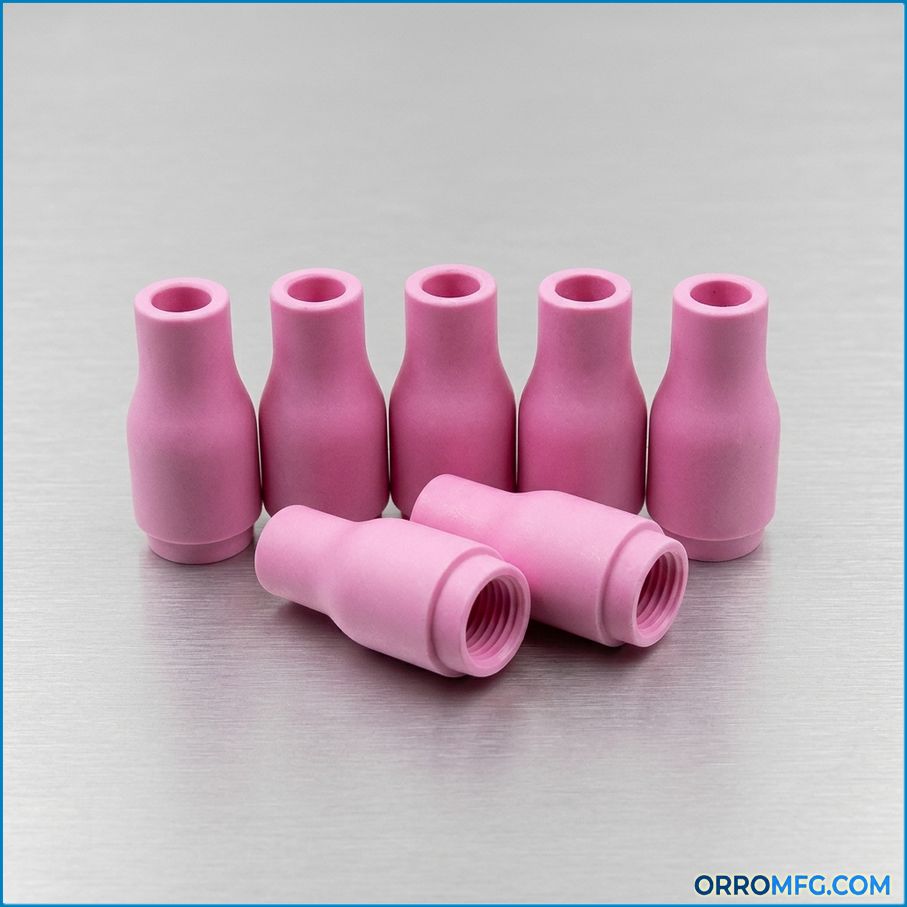
Alumina shielding cups are consumables on every TIG torch: they hold the argon around the pool, insulate the tungsten from the cup body and take the spatter that would otherwise reach the collet. On plasma torches the ceramic parts are the shield cup and the swirl ring — the nozzle itself is copper — and they fail the same way, by spatter adhesion and thermal cracking rather than by wear. Both are replaced on condition, not on a schedule, which is why they are bought in packs of ten or twenty rather than singly.
Semiconductor Manufacturing
High-purity alumina and silicon carbide ceramic nozzles are critical components in semiconductor wafer processing equipment including plasma etchers, deposition systems, and wafer cleaning tools. They are used for gas distribution, chemical dispensing, and plasma confinement applications where ultra-high purity, corrosion resistance, and plasma resistance are essential.
Medical and Dental Equipment
Zirconia and alumina ceramic nozzles are used in medical and dental equipment including dental sandblasters, surgical instruments, drug delivery systems, and diagnostic devices. Their biocompatibility, corrosion resistance, and ability to be sterilized by autoclaving or gamma irradiation make them suitable for medical applications.
Industrial Spray and Coating Systems
Ceramic nozzles are widely used in industrial spray applications including paint spraying, coating systems, chemical spraying, and agricultural sprayers. Their wear resistance ensures consistent spray patterns and droplet sizes over extended service life, even when spraying abrasive or corrosive materials.
Operating Conditions
- Temperature Range: Up to 1700°C (3092°F) for high-purity alumina; 1200-1600°C for other ceramics depending on grade
- Pressure Rating: Up to 500 bar (7250 psi) depending on nozzle design, material, and wall thickness
- Abrasive Media Compatibility: Sand, steel shot, glass beads, aluminum oxide, silicon carbide, garnet, and other abrasive materials
- Chemical Compatibility: Resistant to most acids (except HF), alkalis, solvents, salts, and corrosive chemicals; excellent resistance to oxidation and corrosion
- Thermal Shock Resistance: Excellent for silicon carbide and silicon nitride; good for zirconia; fair for alumina
- Sterilization Compatibility: Autoclave, gamma irradiation, ethylene oxide, and dry heat sterilization
- Wear Life: 10-100 times longer than hardened steel nozzles depending on application conditions
Material Comparison
| Material | Wear Resistance | Impact Toughness | Temp Range | Chemical Resistance | Cost | Best For |
|---|---|---|---|---|---|---|
| Alumina (99%) | Excellent | Fair | Up to 1700°C | Excellent | Medium | General abrasive apps, high temp, chemical service |
| Zirconia (YSZ) | Very Good | Excellent | Up to 1200°C | Good | High | High-impact, thermal shock, medical/dental |
| Silicon Carbide | Outstanding | Fair | Up to 1600°C | Excellent | Very High | Extreme wear, high temp, thermal shock |
| Tungsten Carbide | Very Good | Good | Up to 600°C | Good | High | General abrasive, moderate temp |
| Hardened Steel | Poor | Good | Up to 200°C | Poor | Low | Light-duty, low-abrasion, low-cost apps |
| Stainless Steel | Very Poor | Excellent | Up to 800°C | Good | Medium | Low-abrasion, corrosive, low-pressure apps |
Choose ceramic nozzles when:
- Extreme wear resistance for abrasive media applications is required
- Operating temperatures exceed metal or polymer limits
- Chemical resistance to corrosive media is essential
- Long service life and reduced maintenance are priorities
- The application involves sandblasting, waterjet cutting, or semiconductor processing
- High dimensional stability and consistent performance are critical
Nozzle Types and Bores
| Type | Typical bore / ID | Where it is used |
|---|---|---|
| Straight bore (blasting) | 3.2–12.7 mm (#4–#8, in 1/16" steps) | General sandblasting and shot blasting where a tight pattern matters less than reach |
| Venturi (blasting) | Same bores with a 20–30° internal taper | Higher exit velocity at the same air pressure, so faster stripping and less media per square metre |
| Fan / flat spray | 0.2–2.0 mm slot, 15–110° fan angle | Washing, coating, descaling and any line-shaped application |
| Full cone | 1–10 mm | Tank cleaning, cooling, dust suppression |
| Hollow cone | 0.5–6 mm | Spray drying, gas scrubbing, where fine atomisation matters |
| Waterjet orifice | 0.10–0.40 mm (0.004"–0.016") | Sapphire, ruby or diamond; the hole that forms the jet |
| Waterjet mixing tube | 0.76–1.02 mm ID × 76–102 mm | Alumina or SiC; where abrasive is drawn into the stream |
| Dispensing tip | 0.05–1.0 mm | Adhesives, solder paste, reagents |
A waterjet head uses both of the last two: the orifice sets the stream and the mixing tube adds the abrasive. They wear at different rates, which is why they are ordered as separate consumables rather than as a set.
TIG Welding Ceramic Cups
The other half of this product family is the shielding cup on a TIG torch — the alumina cup that surrounds the tungsten and holds the argon around the weld pool. It is a different part from a nozzle insert: open at the top, threaded or push-fit at the base, and judged by how well it keeps gas where the arc is.
| Cup size | Bore ID | Where it is used |
|---|---|---|
| #4 | 6.4 mm (1/4") | Tight joints, thin sheet, restricted access |
| #5 | 7.9 mm (5/16") | Thin to medium sheet |
| #6 | 9.5 mm (3/8") | The default in most welding shops |
| #7 | 11.1 mm (7/16") | Stainless and thicker sections |
| #8 | 12.7 mm (1/2") | Titanium and other gas-sensitive alloys |
| #10 | 15.9 mm (5/8") | Large gas lens setups |
| #12 | 19.0 mm (3/4") | Heavy sections and wide shielding |
The cup number is the bore in sixteenths of an inch, so #6 is 6/16" = 3/8". A larger cup covers more of the pool with gas but needs more flow, and it blocks the view of the joint — most welding is done with a #5 to #7 for that reason.
| Type | What differs |
|---|---|
| Standard cup | Short body, screws straight onto the torch, cheapest |
| Gas lens cup | Straight bore that fits over a gas lens collet body; laminar flow, and the tungsten can be extended further out |
| Stubby cup | Shorter body for getting into corners; same thread |
| Long / extra-long | Reaches into recessed joints at the cost of visibility |
| Large diameter | Wider shield for titanium and stainless; needs more argon |
Cups are not universal across torches: 9/20, 17/18/26 and 24 series torches each take a different cup body. Send the torch model, or send the cup you are replacing, and the thread and length are matched from that.
Alumina is used because it does not conduct, does not spatter-slag the way metal does, and survives the radiant heat a few millimetres from the arc. Clear cups are quartz — better visibility, but they crack from spatter and cost more. Pink cups are the same alumina family with a colourant; the colour is a brand convention, not a grade.
The full cup range, fitment by torch series, and the failure modes that decide when a cup is scrapped are on the TIG welding ceramic cups page.
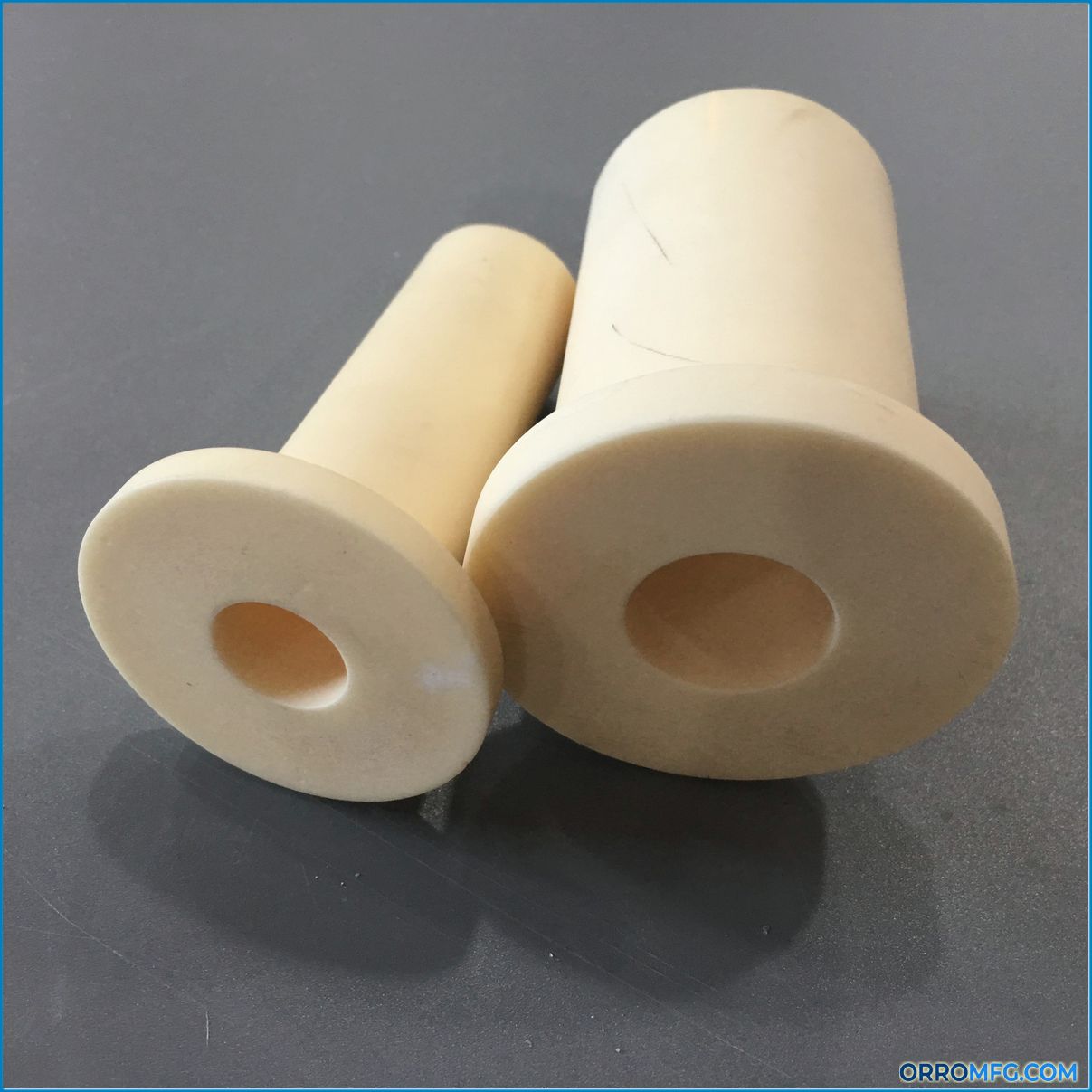
Flanged Nozzle Inserts
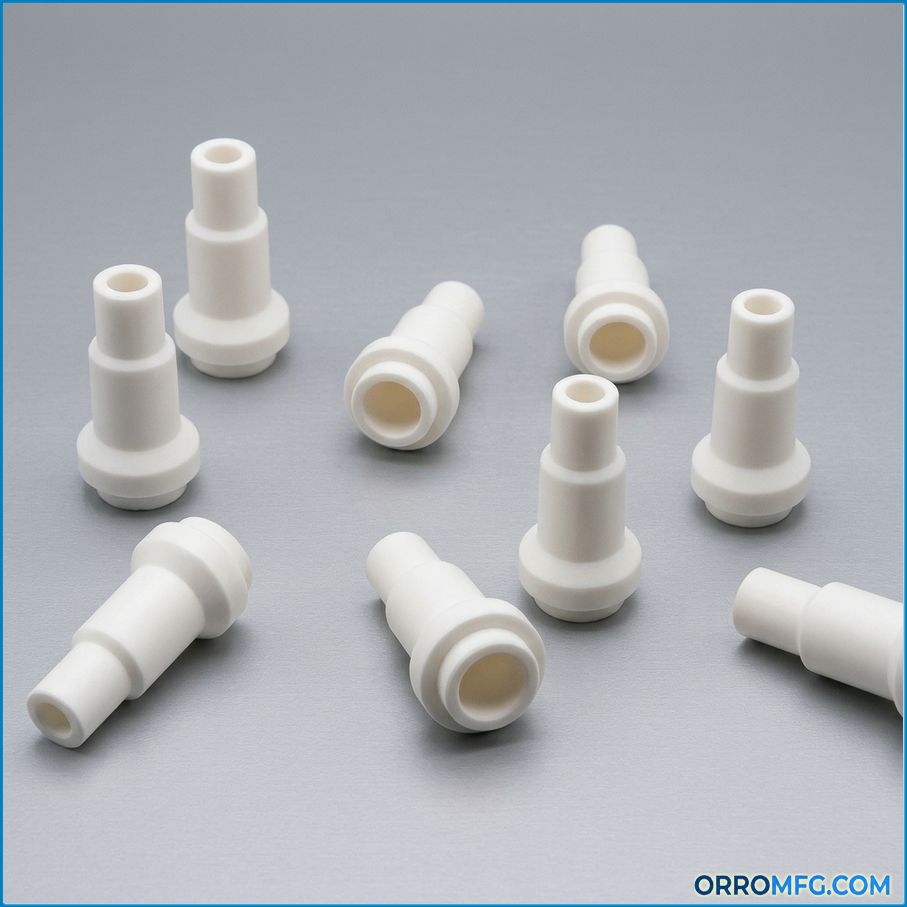
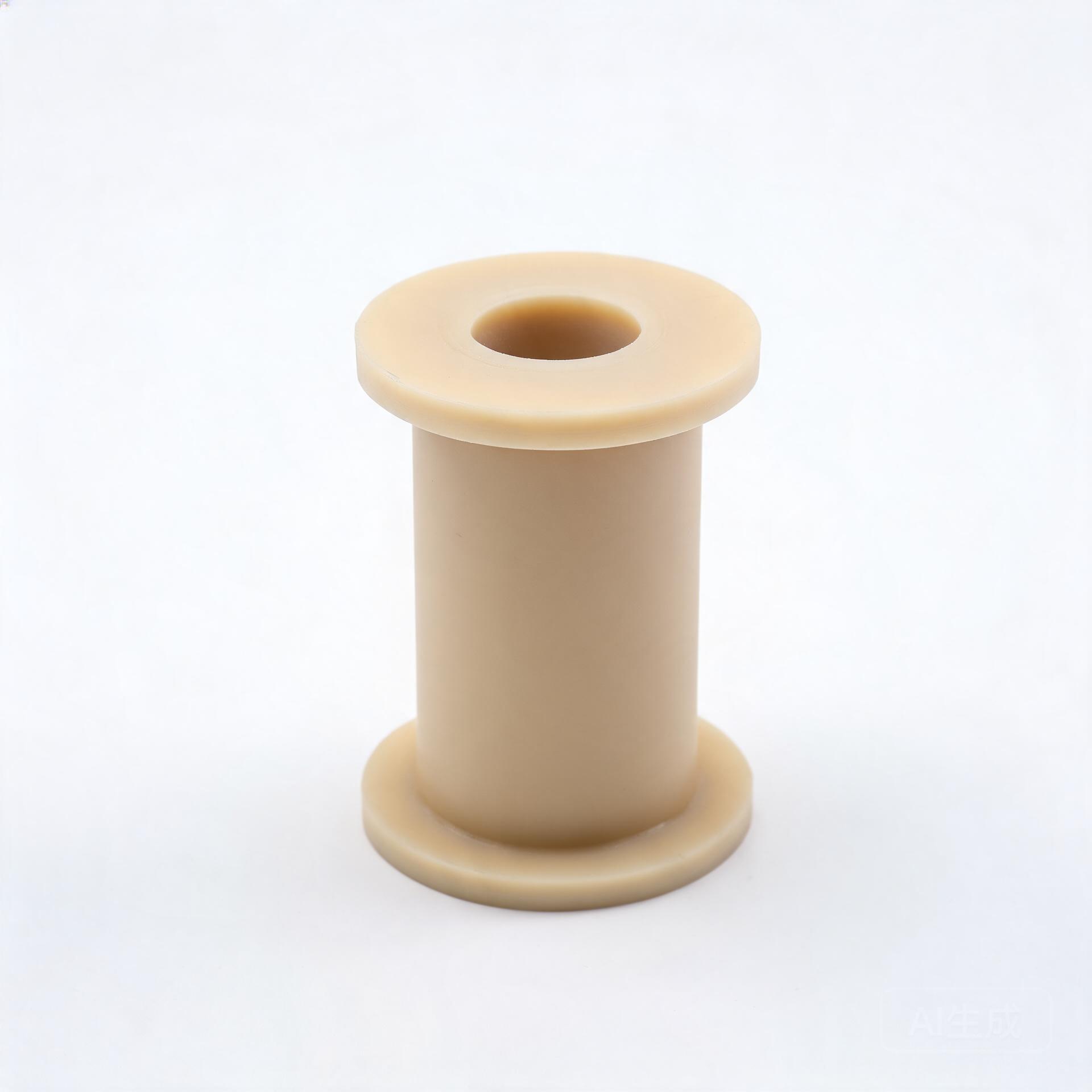
The inserts in the photographs are the other common form: a machined alumina body with a neck, a shoulder, a flat seating face and a flange, and a ground bore through the centre. The flange is what holds the part in the housing — it seats against the metal body and stops the insert being pushed through or pulled out by the flow, so no thread is needed and nothing wears at the fixing.
What to specify for one of these:
- Bore diameter and its tolerance, and whether the bore is straight, tapered or stepped
- Flange OD, thickness and the seat face that it registers on
- Neck diameter and the housing bore it presses into
- Overall length and the concentricity between bore and OD
- Surface finish on the bore — Ra 0.8 µm is the usual call-out for a seating or metering bore
They are machined after sintering, not moulded, so a bore can be held to ±0.005 mm and a flange face flat to 0.02 mm without tooling.
The insert form has its own page — dimensions, fits, tolerances and how the flange is retained: flanged ceramic nozzle inserts.
Customization Options
- Material Grades: 95% alumina, 99% alumina, 99.7% high-purity alumina, yttria-stabilized zirconia (YSZ), silicon carbide (SiC), silicon nitride (Si₃N₄), sapphire/ruby
- Nozzle Types: Straight bore, converging, diverging, Venturi, fan spray, full cone, hollow cone, flat spray, flanged inserts, and TIG shielding cups (#4–#12, standard, gas lens, stubby and long bodies)
- Size Range: Orifice diameter 0.1mm to 100mm; overall length 5mm to 500mm; custom sizes available
- Tolerance Grades: IT3-IT7 precision grades; orifice tolerances as tight as ±0.005mm
- Surface Finishes: As-fired, ground, lapped, and polished surfaces with Ra down to 0.05 μm
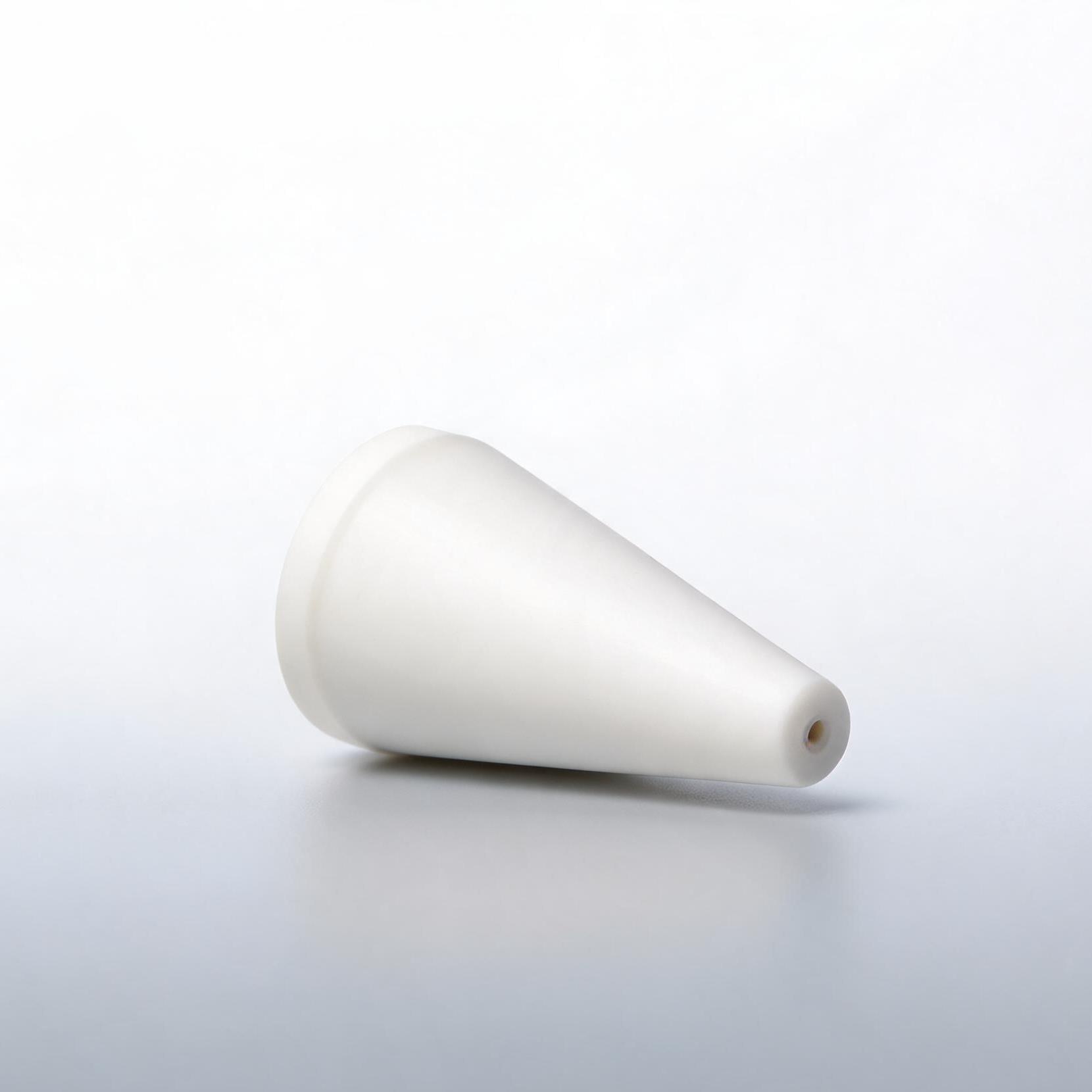
- Internal Geometry: Precision-machined internal profiles including Venturi shapes, step bores, and custom flow passages
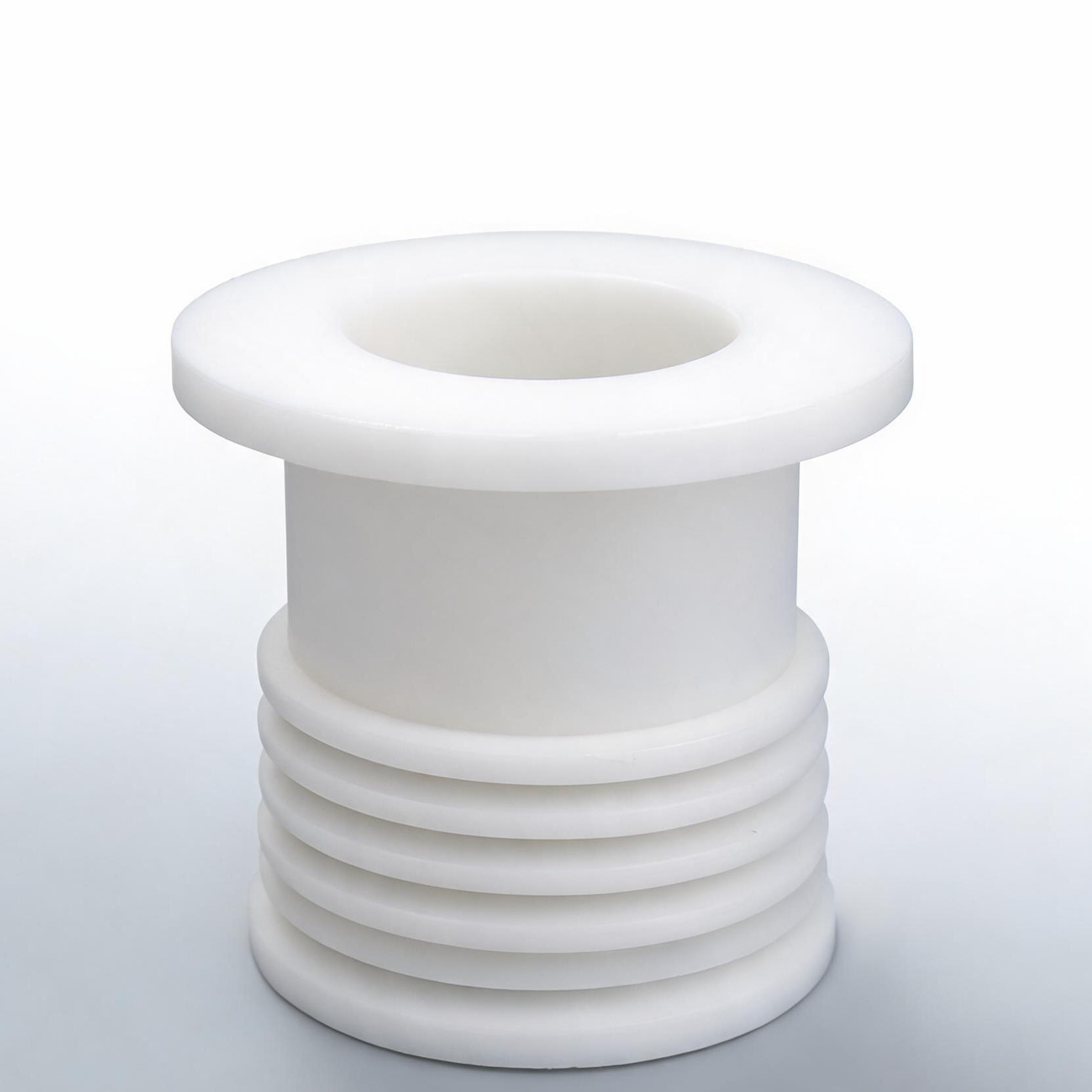
- Mounting Options: Threaded, flanged, press-fit, clamped, and custom mounting configurations
- Assembly Options: Ceramic-to-metal assemblies with stainless steel or aluminum housings
- Coating Options: Glazed surfaces, PTFE coating, and diamond-like carbon (DLC) coatings
- Secondary Operations: Drilling, slotting, notching, and custom machining features
Made to drawing. Send a PDF, DWG or STEP file and the quote is against your bore, taper and thread rather than a catalogue size. Drawings are reviewed before quoting, and anything that will not hold is raised rather than quietly priced — a 0.3 mm bore 10 mm deep is quoted as EDM, not as drilling. Samples take 7–10 working days; production MOQ is 100 pcs per size.
Quality Assurance
OrroMFG maintains the highest standards of quality control throughout ceramic nozzle manufacturing. Our ISO 9001:2015 certified quality management system ensures consistent product quality from raw powder selection through final inspection and packaging. We source high-purity ceramic powders from leading global suppliers and verify powder properties including particle size distribution, purity, and sintering characteristics.
Manufacturing processes including isostatic pressing, sintering, precision grinding, and lapping are carefully controlled with documented process parameters and statistical process control. Quality control inspections include dimensional verification using coordinate measuring machines (CMM), optical comparators, and specialized gauging for critical bore dimensions. We perform material testing including density measurement, hardness testing, flexural strength testing, and microstructure analysis to confirm material properties and structural integrity. Surface roughness is measured using profilometers to verify surface finish specifications. For critical applications, we conduct functional testing including pressure testing, flow rate verification, and wear testing under simulated operating conditions. All ceramic nozzles are supplied with detailed material certificates, inspection reports, and full batch traceability documentation. Our commitment to quality ensures that every ceramic nozzle delivers exceptional performance, extended service life, and consistent reliability in the most demanding industrial applications.
Frequently Asked Questions
Alumina or silicon carbide for sandblasting?
Silicon carbide holds its bore longer and is the right choice for a gun that runs all day on aluminium oxide or garnet. 99% alumina is roughly half the cost and still outlasts tungsten carbide several times over, which makes it the sensible choice for intermittent use, fine media or a mixed workload. Zirconia is not a blasting material — its advantage is impact toughness, and a blasting nozzle rarely sees impact.
Why has my nozzle worn oval?
Three causes, in order of frequency: the gun is not square to the work, the media feed is uneven around the bore, or a worn housing lets the nozzle sit off-axis. An oval bore widens the blast pattern and drops exit velocity before it fails outright. Check with a pin gauge — replace when the bore has grown 20–30% over nominal, which is well before the pattern becomes visibly wrong.
What tolerance can you hold on the orifice?
±0.005 mm on a lapped bore up to 2 mm, with the entry radius controlled as well as the diameter. We also verify flow rate on critical parts, because two nozzles at the same bore can deliver different flow once the inlet chamfer differs.
Can I get a sample before ordering production?
Yes. A ground alumina or zirconia sample takes 7–10 working days. Production MOQ is 100 pcs per size, and the sample is quoted separately from the production run so you are not paying tooling twice.
In waterjet, what wears out first — the orifice or the mixing tube?
The orifice. Sapphire and ruby typically give 50–100 hours, diamond several times that, and an alumina mixing tube around 80–150 hours, all depending on abrasive type and pressure. Judge by cut quality rather than the hour meter: a widening orifice shows as a wider kerf and a rougher edge before it stops cutting.
Will an alumina cup fit my TIG torch?
Not by size number alone. A #6 cup for a 17-series torch and a #6 for a 9-series torch are the same bore and a different body, so the cup number tells you the shielding width and nothing about the thread. Send the torch model or the cup you are replacing and we match the thread, length and bore from it. If you are moving to a gas lens, say so — the cup bore is different from a standard cup of the same number.
Why do my ceramic cups keep cracking?
Three causes, and the third is the one people miss. Spatter sticking to the cup and then cooling unevenly cracks it; overtightening the cup onto the torch body cracks it at the thread; and quenching a hot cup, or knocking it against the workpiece while the arc is still running, cracks it from thermal shock. Hand-tight is enough, keep the cup out of the spatter path, and let it cool before you change it.
Do you supply the cups in packs, or only by the hundred?
Standard sizes are quoted from 100 pcs, and mixed-size packs of ten or twenty are possible within that. Custom threads, lengths or bore profiles are machined to drawing and carry the same 100 pc minimum per size.