Overview
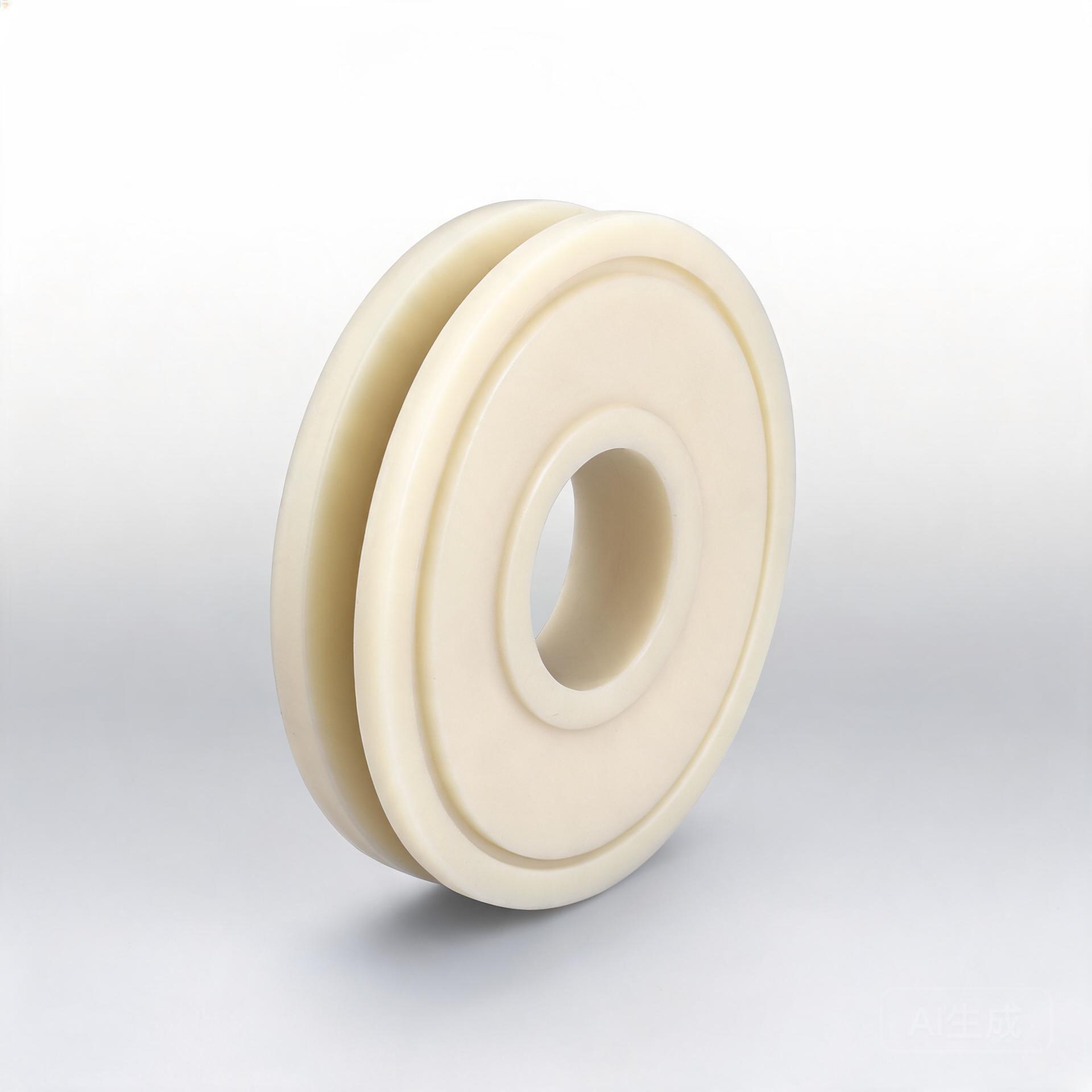
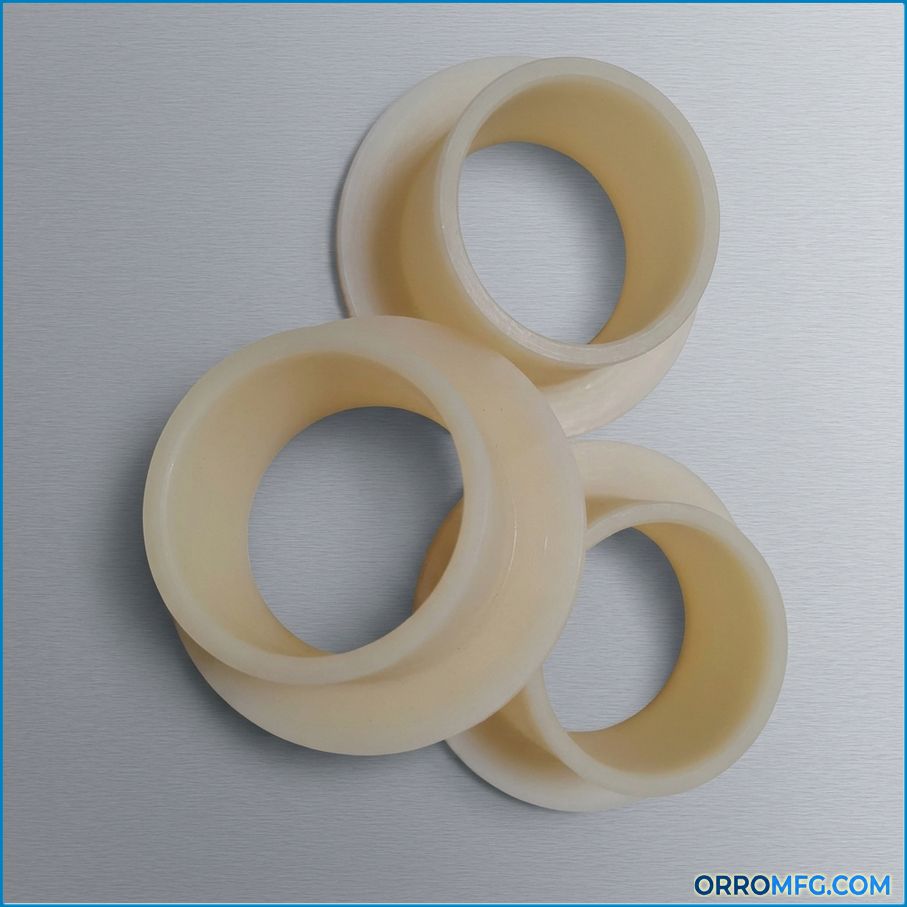
Nylon bushings are cylindrical plain bearing components made from polyamide (nylon) resin, most commonly PA66, used to support rotating, sliding or oscillating shafts and pins. The flanged version adds a shoulder that seats the bushing against a housing face: the flange fixes the axial position, takes up thrust in one direction and prevents the sleeve from being pushed through the bore. OrroMFG produces flanged, plain sleeve and insulating bushings to drawing, in metric and inch sizes, machined from rod and tube or injection moulded for volume.
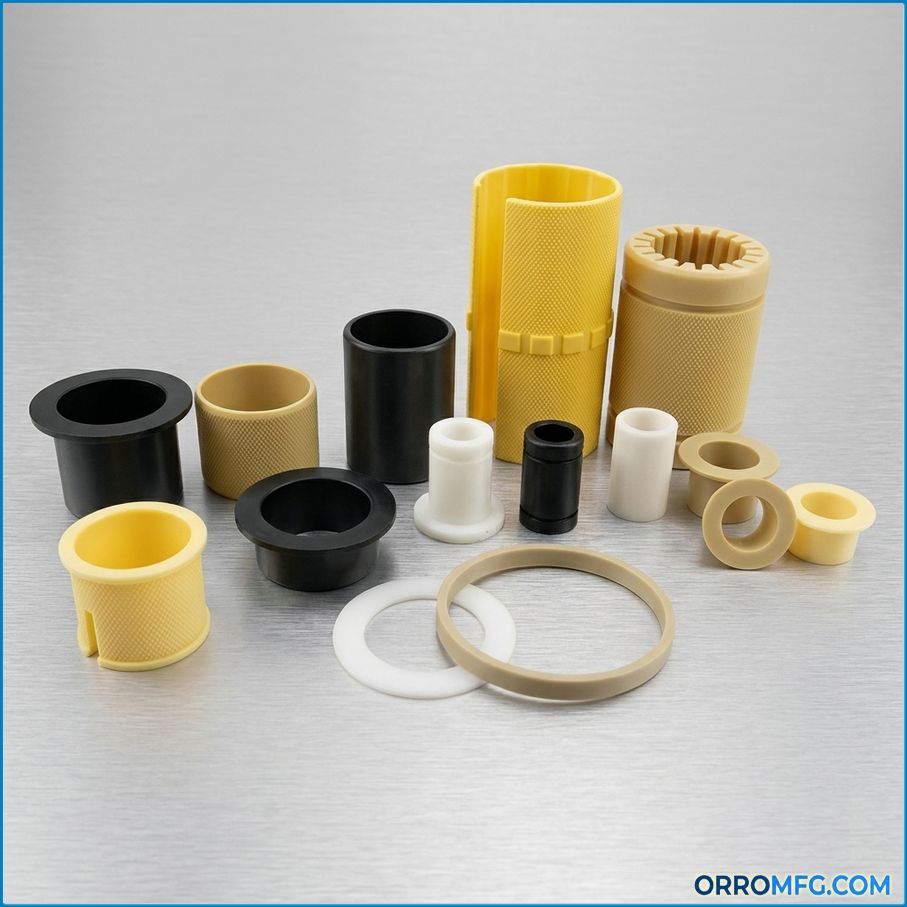
Typical parts are black, natural, green or yellow, from 5 mm bore upwards, with a flange diameter, flange thickness and bore tolerance chosen by the customer. Because nylon is tough, corrosion-resistant and electrically insulating, the same bushing design is used for mechanical pivots, for locating shafts in sheet-metal and die-cast housings, and for insulating a conductor or screw from a metal chassis.
Bushing Types
- Flange bushing (single flange) — the standard fixing for a shaft passing through a plate or casting; the flange sets the axial position and can carry light thrust.
- Double-flange bushing — flanges at both ends for a bushing clamped between two faces or used as a spacer.
- Plain sleeve — no shoulder, for bores where the axial position is set by other components.
- Insulating bushing — a nylon sleeve or flanged bush used to isolate a screw, pin or conductor from a metal panel, commonly in switchgear, control boxes and electronic assemblies.
- Step and shouldered bushings — two or more bores or diameters in one part, replacing a stack of separate sleeves.
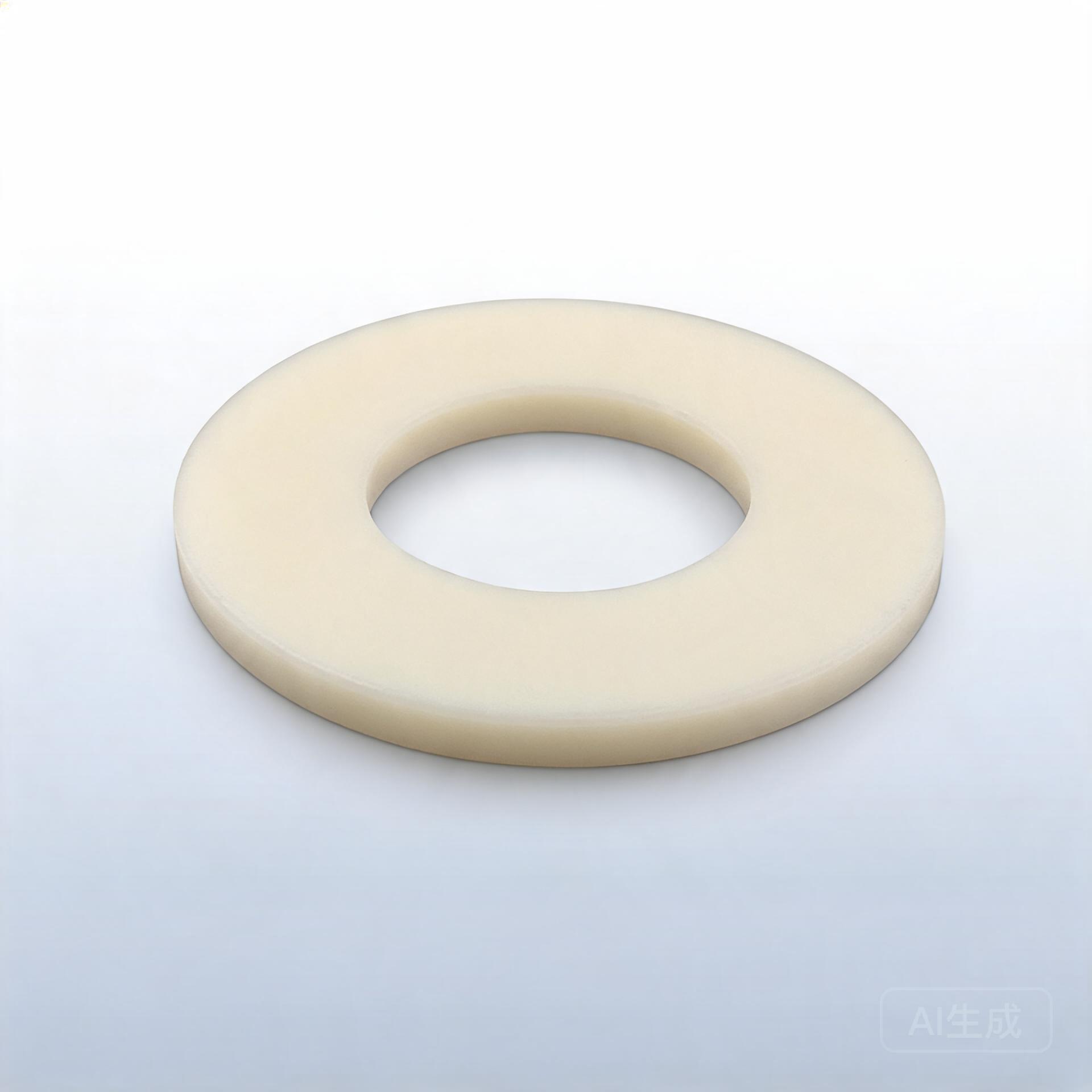
- Thrust washers and spacers — flat rings supplied with the same bushings to set axial clearance, see Nylon Thrust Washer.
Key Features
- Wear resistance — good sliding behaviour against steel, aluminium and die-cast surfaces, especially when greased or compounded with MoS2 or PTFE.
- Self-lubricating — inherent lubricity allows dry running in low-load, low-speed pivots and reduces relubrication on equipment that is hard to service.
- Fatigue and impact strength — nylon absorbs shock and keeps its mechanical strength in long-term cyclic service, which suits linkages, hinges, cams and pivot pins.
- Corrosion resistance — does not rust in moisture, washdown or chemical environments; used in chemical and pharmaceutical equipment for that reason.
- Electrical insulation — good dielectric strength in both dry and humid conditions, so the same part can act as a mechanical bush and an insulator.
- Low noise — damping behaviour reduces rattle and vibration compared with metal-on-metal contact.
- Light weight and recyclability — roughly one-seventh the weight of a steel bush of the same size, and nylon regrind is recyclable.
Material Specifications
| Property | Nylon PA66 | MoS2-Filled PA66 | 30% Glass-Filled PA66 | PTFE-Filled PA66 |
|---|---|---|---|---|
| Density (g/cm³) | 1.13 - 1.15 | 1.14 - 1.18 | 1.35 - 1.40 | 1.15 - 1.25 |
| Tensile Strength (MPa) | 75 - 85 | 70 - 80 | 150 - 180 | 55 - 65 |
| Tensile Modulus (GPa) | 2.8 - 3.2 | 2.6 - 3.0 | 7.0 - 9.0 | 2.2 - 2.8 |
| Compressive Strength (MPa) | 90 - 110 | 85 - 100 | 180 - 220 | 70 - 85 |
| HDT at 1.8 MPa (°C) | 70 - 80 | 70 - 80 | 200 - 220 | 70 - 80 |
| Continuous Service Temp (°C) | 80 - 120 | 80 - 120 | 120 - 150 | 80 - 120 |
| Hardness (Rockwell M) | 70 - 80 | 70 - 80 | 95 - 105 | 65 - 75 |
| Coefficient of Friction (dry) | 0.20 - 0.35 | 0.10 - 0.20 | 0.25 - 0.40 | 0.08 - 0.15 |
| PV Limit (bar·m/s, dry) | 500 - 1,000 | 1,000 - 2,000 | 800 - 1,500 | 1,500 - 2,500 |
| Izod Impact (kJ/m²) | 50 - 80 | 40 - 70 | 10 - 15 | 30 - 50 |
| Water Absorption (24h, %) | 1.0 - 1.5 | 0.8 - 1.3 | 0.5 - 1.0 | 0.8 - 1.2 |
Values are typical for unfilled and modified PA66 compounds; confirm against the grade data sheet for your order.
Colour and Grade Options
Bushings are coloured for grade identification, for matching an existing assembly or simply for appearance. Standard colours are natural (cream), black, green, yellow and blue; custom colours are matched to a sample or a colour code, and glass-filled grades carry their own characteristic tone.
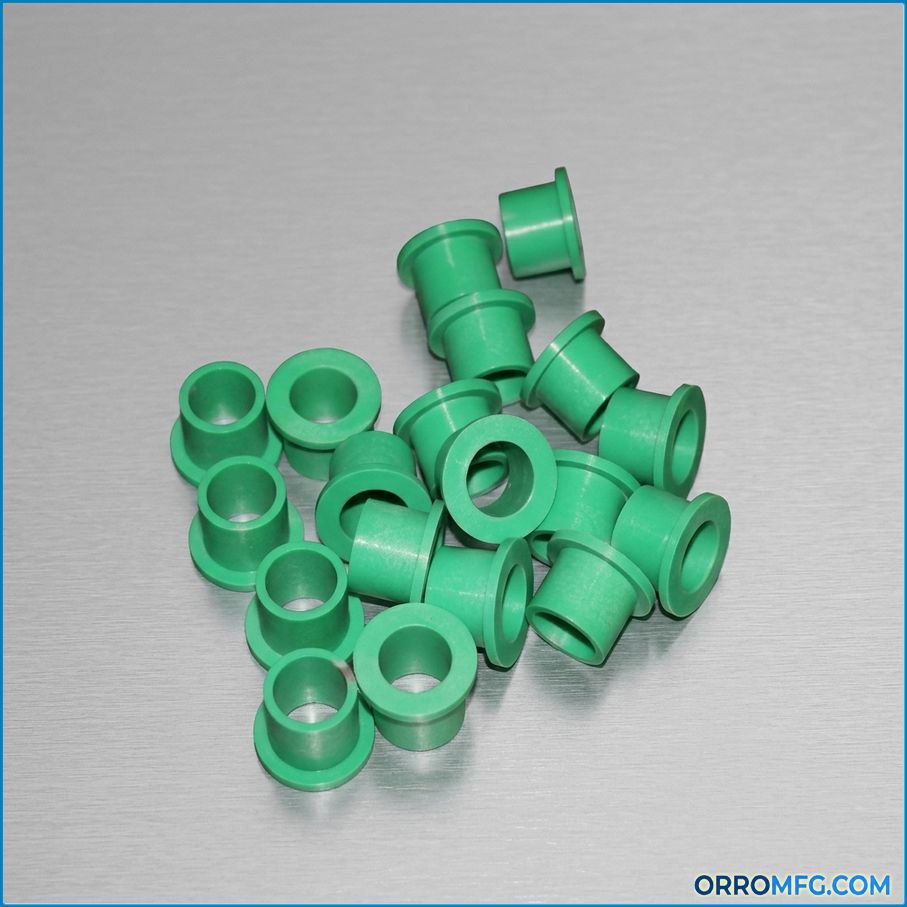
- Natural / cream — unfilled PA66, the general-purpose machining and moulding grade.
- Black — carbon-pigmented or UV-stabilised, the usual choice for outdoor and visible parts.
- Green, yellow, blue and custom — colour-matched to a sample, RAL or Pantone reference; minimum quantities apply to custom colour batches.
- MoS2-filled — dark grey to black, for dry-running and higher PV duty.
- Glass-filled — natural to grey, for higher strength and stiffness where the extra brittleness is acceptable.
Machined or Moulded
Both routes produce the same geometry, and the choice is driven by quantity, tolerance and how often the design will change.
CNC turning from rod and tube suits prototypes, low and medium volumes and any custom size. There is no tooling cost, the bore and flange are turned and bored in one set-up so concentricity is held, and secondary operations such as cross-holes, keyways, chamfers and threads can be added without a new mould. Typical lead time for a machined bushing is a few working days after drawing approval.
Injection moulding suits repeat volumes where the tooling cost is amortised. We build the mould, run the samples for approval, then mould in the specified colour with consistent bore and flange dimensions. Moulding also allows inserts, ribs, snap features and multiple cavities that would be expensive to machine one by one.
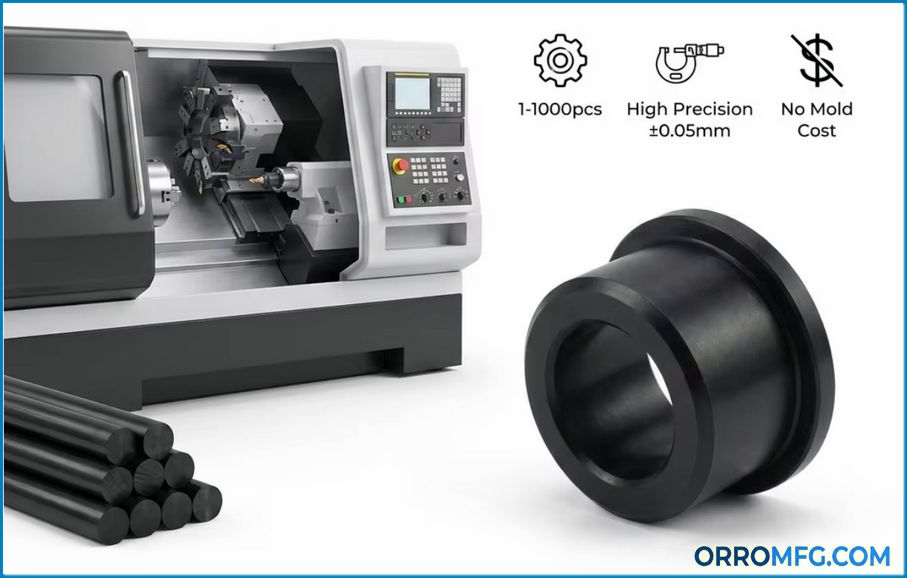
We also provide mould making and cutting as part of the order: tool design for moulded bushings, and saw cutting or water-jet cutting of sheet and tube where a flat part such as a thrust washer is required.
Electrical Insulation and Chemical Service
Nylon’s dielectric strength and volume resistivity make it a practical insulator for low and medium-voltage assemblies, and it keeps those properties in humid conditions better than many commodity plastics. Typical uses are insulating bushings through metal panels, screw isolators in control boxes, spacers between a live terminal and a chassis, and sleeves that keep a conductor clear of a metal edge.
Two design points matter. Nylon absorbs moisture, which slightly lowers dielectric strength and changes dimensions, so electrical parts that must stay within tolerance should be specified in the conditioned state or allowed a moisture allowance. And nylon is not a substitute for a high-temperature insulator: continuous service above 120°C, or exposure to strong acids, phenols and oxidizing agents, calls for a different material. For chemical equipment, nylon handles oils, fuels, hydraulic fluids, alkalis, salt solutions and most common solvents, which is why it is used in pumps, valves, dosing equipment and pharmaceutical machinery.
Applications
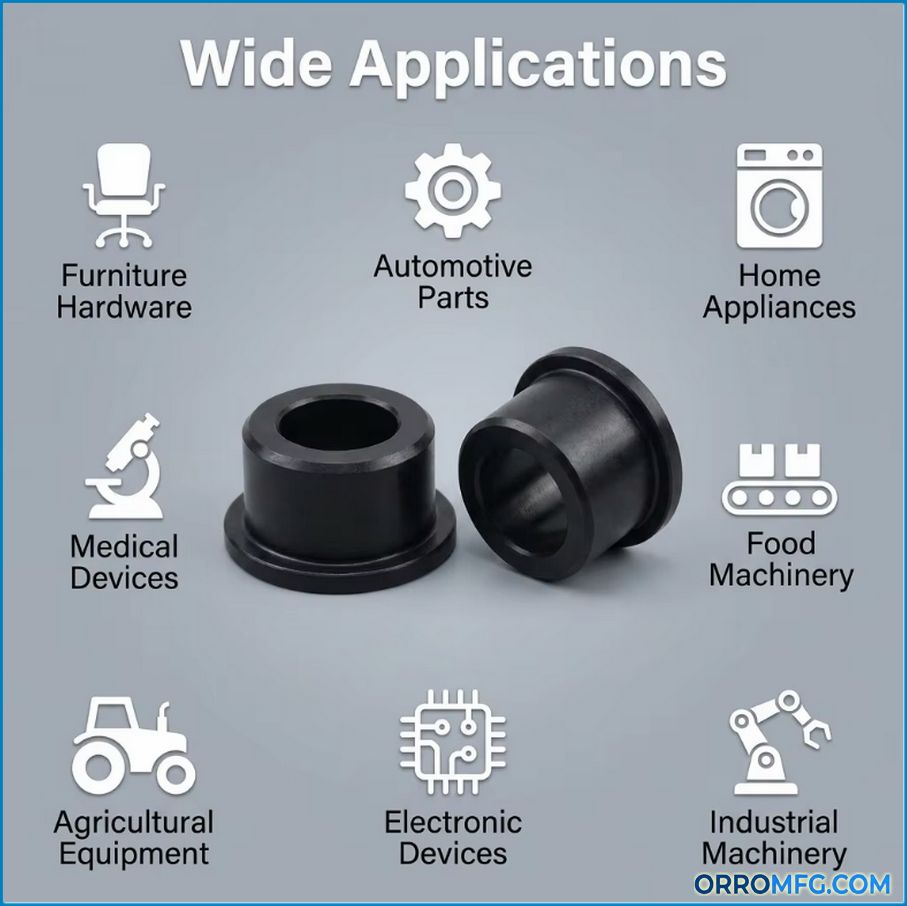
Industrial Automation and Robotics
Flanged bushings locate and support guide rods, pivot pins and linkages in pick-and-place units, assembly machines, packaging lines and conveyor modules. The flange takes the axial load from a cam or a return spring, and self-lubrication removes the need to relubricate points that are buried inside a machine guard.
Material Handling and Conveyor Systems
Nylon bushings support rollers, pulleys, idlers and belt components in warehouse automation, distribution centres and baggage handling. They resist washdown and corrosion in bottling and food lines where metal bearings would seize or rust, and they run quietly against steel.
Automotive and Transport
Door hinges, pedal assemblies, seat mechanisms, steering linkages and interior mechanisms use nylon bushings for quiet, low-friction pivots. Glass-filled grades suit under-bonnet points that see higher temperature, and the low weight helps where mass matters.
Agricultural and Construction Equipment
Loader arms, bucket linkages, tillage tools and cylinder mounts use nylon bushings because they tolerate dirt, dust and moisture with minimal lubrication. Nylon also protects the mating pin from wear, so the cheaper part is the one that wears first.
Furniture, Appliances and Consumer Products
Office chair mechanisms, cabinet hinges, drawer slides, washing-machine drum supports, dishwasher arms and refrigerator hinge points all use flanged nylon bushings for silent, maintenance-free movement over a long service life.
Electrical and Electronic Devices
Insulating bushings and sleeves isolate screws, terminals and conductors from metal enclosures in control panels, switchgear, instruments and electronic chassis. The mechanical and electrical functions are combined in a single moulded or machined part.
Medical, Laboratory and Food Equipment
Nylon bushings are used in laboratory instrument mechanisms, medical device housings and non-food-contact positions on food machinery. Where the part touches product, we supply food-grade grades and can discuss the declaration you need for your market.
Operating Conditions
- Temperature range — -40°C to +120°C for unfilled nylon; up to 150°C for glass-filled grades, with continuous ratings below the short-term peak.
- PV limit — 500-2,500 bar·m/s depending on grade and lubrication.
- Load capacity — up to 100 MPa static compressive load; up to 30 MPa dynamic load depending on speed.
- Sliding speed — up to 3 m/s with lubrication; up to 1 m/s dry-running with MoS2 or PTFE-filled grades.
- Chemical compatibility — resistant to hydrocarbons, fuels, lubricants, hydraulic fluids, alkalis, salt solutions and most industrial chemicals.
- Not recommended for — strong mineral acids, oxidizing agents, phenols and prolonged immersion in hot water above 80°C.
- Moisture effects — absorbs ambient moisture, which swells the part and slightly reduces strength while improving impact resistance; allow for it in the bore clearance.
- Lubrication — performs best with grease or oil; MoS2 and PTFE-filled grades suit dry or marginally lubricated service.
Material Comparison
| Material | Load Capacity | Wear Resistance | Temp Range | Corrosion Resistance | Cost | Best For |
|---|---|---|---|---|---|---|
| Nylon PA66 | Medium | Good | -40 to +120°C | Good | Low-Medium | General industrial, automation, automotive, insulation |
| Bronze | High | Good | -40 to +200°C | Fair | Medium-High | Heavy-duty, high-load, lubricated service |
| PTFE | Low-Medium | Excellent | -200 to +260°C | Excellent | Medium-High | Chemical service, low-load, wide temperature range |
| PEEK | High | Excellent | -40 to +260°C | Very Good | Very High | High temperature, high load, medical/semiconductor |
| Graphite | Low-Medium | Excellent | up to 500°C | Good | Medium | High-temperature, self-lubricating, dry service |
| Steel (hardened) | Very High | Good | -40 to +200°C+ | Poor | Medium | Heavy-duty, high-load, lubricated precision |
Choose nylon bushings when self-lubrication, impact resistance, corrosion resistance or electrical insulation matter more than ultimate load capacity; choose bronze, PEEK or hardened steel when the load, temperature or precision requirement is beyond what a polymer bush can hold.
Customization Options
- Material grades — PA66, PA6, PA12 and PA46; MoS2-filled, PTFE-filled, glass-filled (10-50%), oil-filled, heat-stabilised, UV-stabilised and food-grade nylon.
- Other resins for the same design — POM, ABS, PC, PP, PSU, PCTG, TPE/TPU and PBT, where nylon’s moisture growth, cost or colour range does not fit the application. POM is the usual alternative when dimensional stability in humidity is the deciding factor.
- Bushing types — sleeve, single flange, double flange, step, shouldered, split and insulating bushings, plus thrust washers and spacers.
- Size range — bore from 3 mm; outside diameter to 200 mm; length to 300 mm; flange diameter to 300 mm. Metric and inch drawings are both accepted.
- Tolerance — ±0.05 mm typical on bore, outside diameter and flange; tighter on selected features after feasibility review, and bore fits such as H7/H8 available.
- Surface — as-moulded, turned, reamed or honed bore with Ra 0.8-3.2 µm.
- Features — cross-holes, keyways, threads, chamfers, grooves, grease pockets and assembly with mating pins or screws.
- Colour — natural, black, green, yellow, blue and custom matched.
- Marking and packing — part number marking on request; PE bag per piece and export carton as standard, with custom labels and kits available.
Samples, Packing and Lead Times
Samples are available before production: typically 1-3 pieces in the quoted material and finish, machined from stock so no tooling is needed, and usually dispatched within a few working days. For moulded parts, a first-article sample is produced from the tool and held for your approval before the production run.
Bushings ship in PE bags inside an export carton, with the quantity, part number, material and batch on the label. Small parts are packed by weight and count; large flanged bushings are packed individually to protect the flange face. Air freight is available for urgent samples and pilot batches.
Ordering Information
- Send a drawing or sample, or specify bore, outside diameter, length, flange diameter and flange thickness.
- Tell us the shaft or pin material, load, speed, duty cycle and whether the part also insulates, and state the temperature and chemical exposure.
- We confirm material grade, colour, tolerance and process route (machined or moulded), and return a matched drawing for approval.
- Quote within one working day, with sample and production lead times stated separately.
Quality Assurance
OrroMFG manufactures nylon bushings within an ISO 9001:2015 certified quality management system, with incoming verification of resin grade, density and moisture content, and documented process parameters for both turning and moulding. Bore diameter, outside diameter, flange thickness, concentricity and runout are checked with calibrated gauges and air gauges; surface finish and colour are checked against the approved sample. Moulded parts are inspected against a first-article report at start-up and to a sampling plan through the run.
Finished bushings are supplied with material certificates and inspection reports, with batch traceability on the label. For programmes that require it, we issue first-article inspection reports and PPAP-style documentation on request.
Frequently Asked Questions
What is a nylon flange bushing used for?
A flanged nylon bushing supports a rotating or sliding shaft and uses its shoulder to hold the part in position against a housing face. It is the usual fixing for a shaft passing through a plate, casting or sheet-metal bracket, and it can also take light thrust in one direction.
Which nylon grade should I choose — PA66, PA6, MoS2 or glass-filled?
PA66 for the best balance of strength, temperature and cost in general pivots. PA6 where toughness and cost matter more than stiffness. MoS2-filled for dry running and higher PV. Glass-filled where strength and stiffness at temperature are required and some loss of impact resistance is acceptable.
What tolerance can you hold on the bore and flange?
±0.05 mm is our standard on bore, outside diameter and flange thickness, which covers most pivot and locating duties. Tighter limits are possible on selected features after a feasibility review, and bore fits such as H7 or H8 can be supplied. Because nylon grows with moisture, the fitted condition should be stated on the drawing.
Can you make metric and inch sizes?
Yes. We work from metric or inch drawings, and can convert one to the other and return the matched drawing for approval before production.
Do nylon bushings work as electrical insulators?
Yes. Nylon has good dielectric strength and volume resistivity, so a flanged bushing can both locate a screw or pin and isolate it from a metal panel. It performs in dry and humid conditions, provided the moisture-related dimensional change is allowed for and the service temperature stays within the material limit.
Are nylon bushings suitable for wet or humid environments?
They do not rust or corrode, and they are used in washdown and humid service. The limitation is dimensional: nylon absorbs moisture and swells, so clearance and tolerance should be specified for the actual humidity the part will see. For parts that must stay stable in water, POM or PEEK is usually the better choice.
Should I order machined or injection-moulded bushings?
Machined bushings for prototypes, small and medium batches, large sizes and any design that may change — there is no tooling cost. Injection moulding once the design is fixed and the annual volume justifies a mould, especially where colour, inserts or complex features repeat.
Can you match a specific colour?
Yes. Natural, black, green, yellow and blue are standard, and custom colours are matched to a sample or a colour code. Colour is held consistent within a batch, and a minimum quantity applies to custom colour runs.
What is the minimum order and lead time?
100 pieces per size for a trial order; smaller prototype quantities are possible for machined bushings. Machined parts typically ship within 5-10 working days after drawing approval, moulded parts 15-25 working days after tooling, and samples within a few working days.
Related Products
- Nylon Gear — wear-resistant gears for light-to-medium duty
- Nylon Sprocket — chain sprockets for conveying and drive systems
- Nylon Thrust Washer — axial washers to pair with flanged bushings
- Nylon Guide Wheel — quiet guide wheels for automation rails
- Nylon Conveyor Roller — rollers for material handling lines
- Bushing material guide — compare nylon, POM, bronze, PTFE and PEEK bushes
- Nylon material guide — grades, moisture behaviour and machining notes
Send your bushing drawing or sample for a same-day quote. Tell us the shaft material, load, speed, temperature and whether the part must insulate, and our engineering team will confirm the grade, colour, tolerance and process route.