Overview
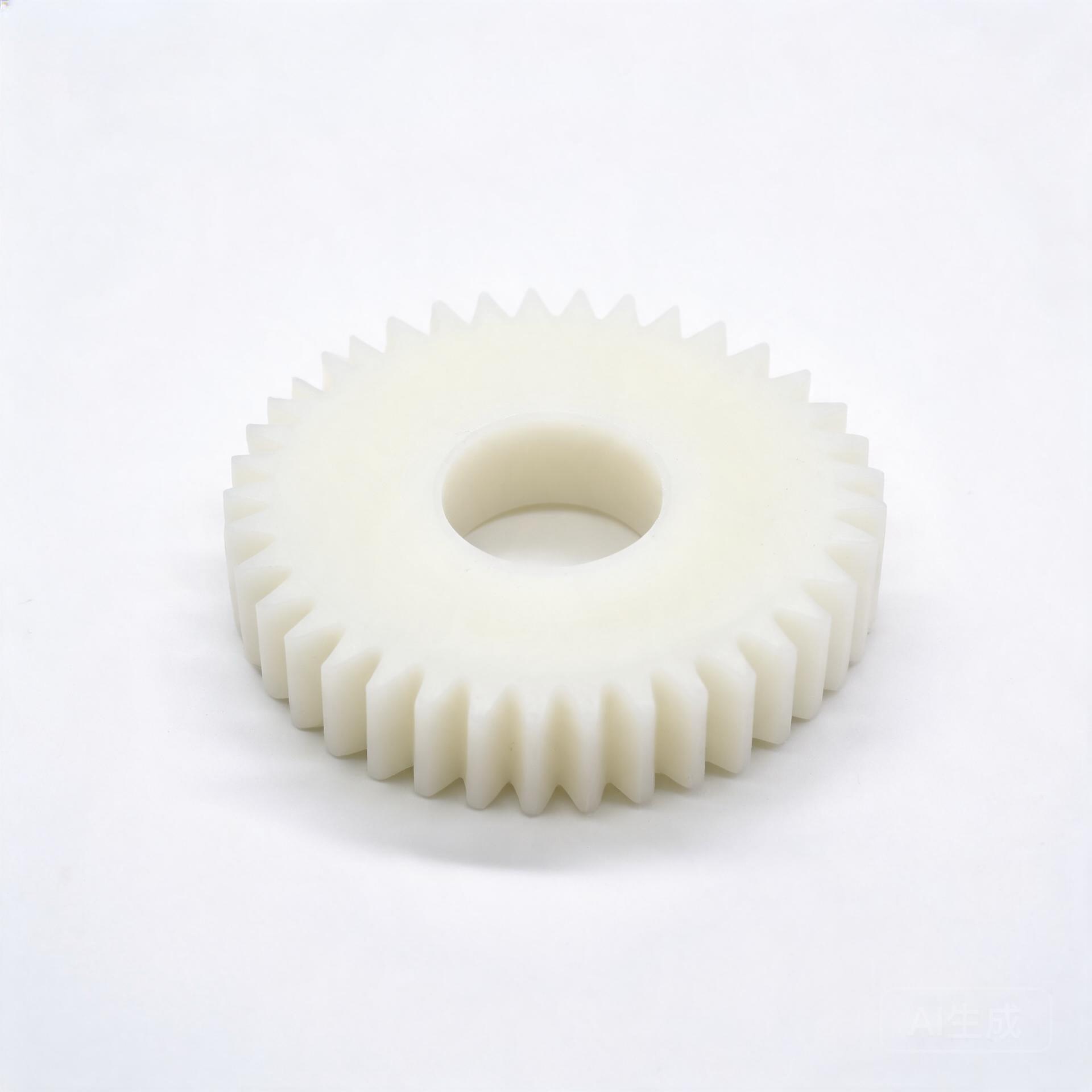
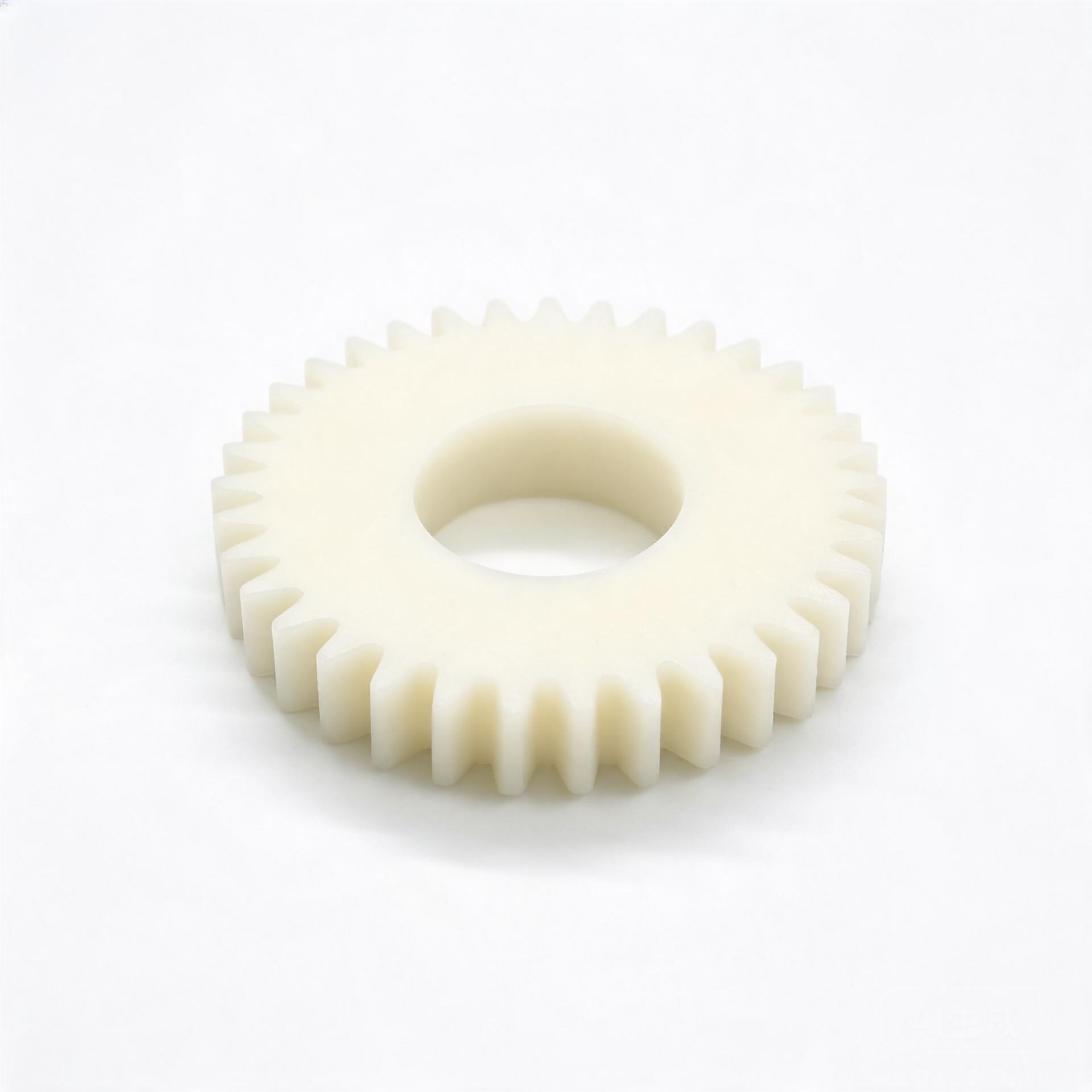
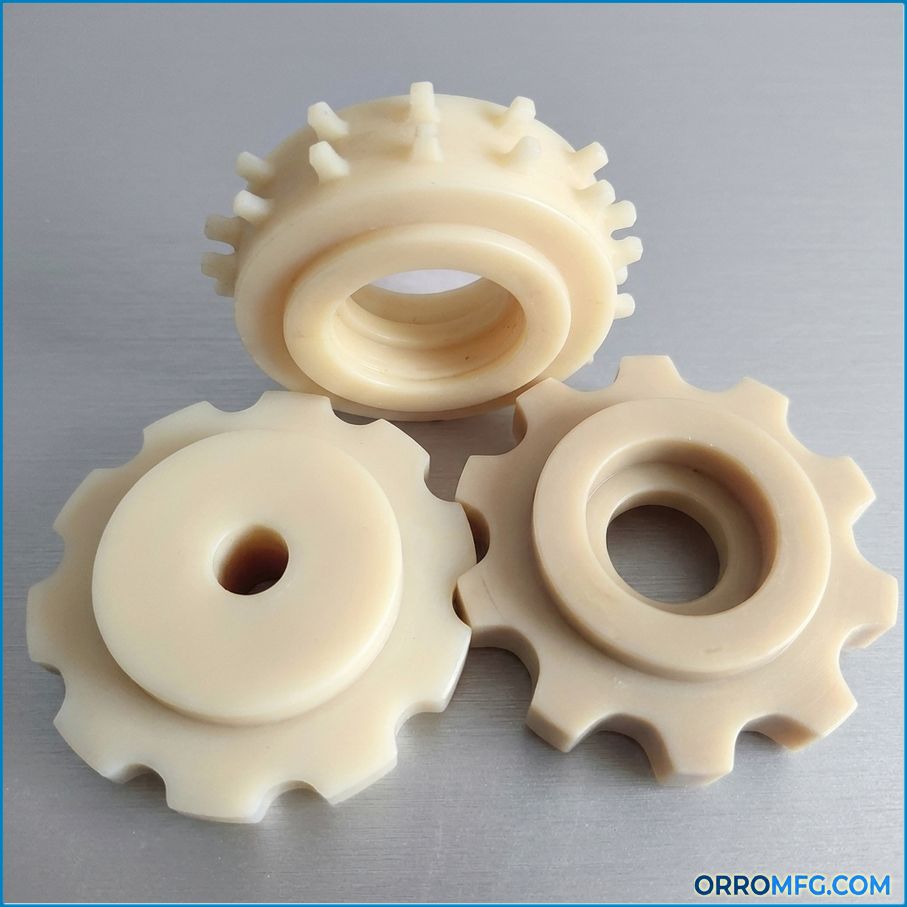
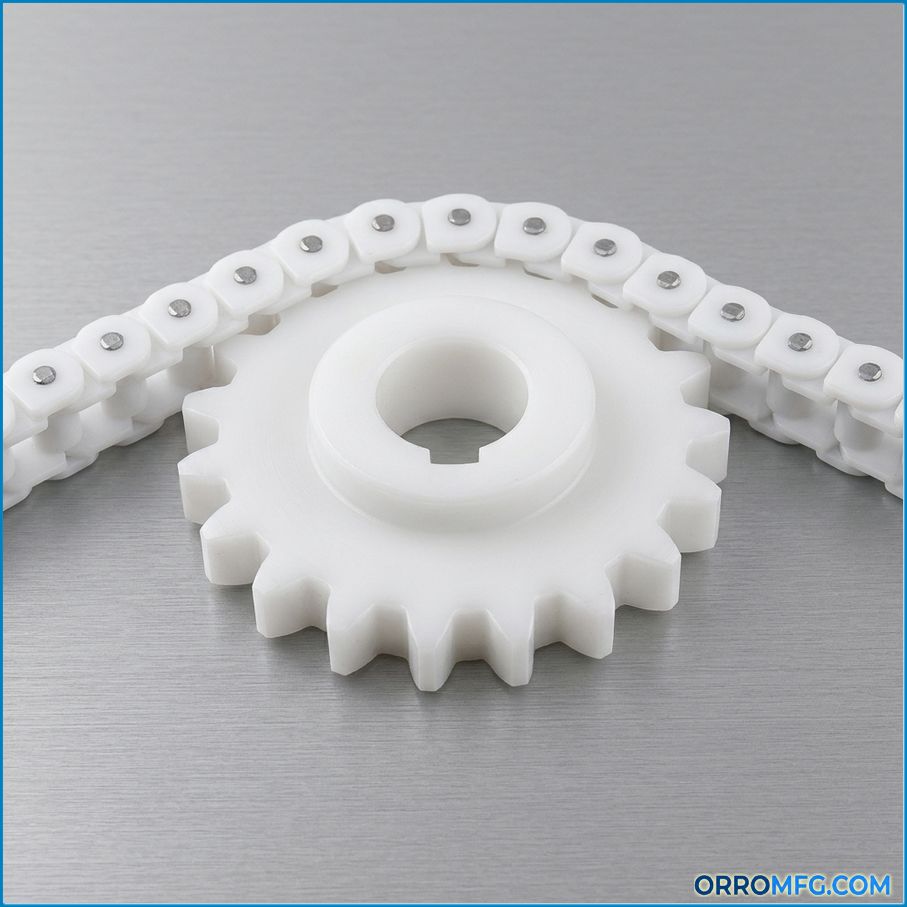
A POM sprocket is the drive wheel that engages a flat-top or modular plastic conveyor chain. The teeth sit in the gaps between the chain links, so each revolution pulls the belt forward by exactly one pitch per tooth — which is why the tooth count sets the speed ratio and the pitch must match the chain. POM (polyoxymethylene, also sold as acetal or Delrin) is the usual choice: it is stiff enough to transmit torque without the tooth deflecting, it machines to a clean finish, it absorbs moisture far less than nylon, and it runs against a plastic chain without lubrication and without wear particles contaminating the line.
This page covers the three families we make most often: 40P (12.7 mm pitch), 60P (19.05 mm pitch) and 80 series (30 mm pitch). Each is available machined from POM rod or plate, or injection moulded where the volume justifies a tool. Bores can be round, square or keyed, with single or double hubs.
Why POM for Conveyor Sprockets
| Property | POM | Nylon (PA) | PP |
|---|---|---|---|
| Stiffness | High — tooth holds shape under load | Medium, softer when warm | Low |
| Moisture absorption | Very low, dimensions stay put | Higher, bore and pitch can grow | Very low |
| Friction against plastic chain | Low, self-lubricating | Low | Medium |
| Wear resistance | Good | Very good | Moderate |
| Chemical resistance | Good against greases, mild cleaners | Good | Good, best against many acids |
| Temperature | Up to about 90 °C continuous | Up to about 100 °C | Up to about 90 °C |
| Machining | Excellent finish, holds tolerance | Good, can be gummy | Soft, tends to burr |
| Relative cost | Medium | Medium-high | Low |
POM wins on two counts that matter for a drive sprocket: dimensional stability (a nylon sprocket can grow enough in a humid bottling hall to change the chain tension) and stiffness (the tooth does not bend away from the chain under load). Nylon is preferred where impact and wear dominate, and PP where cost and chemical resistance matter more than precision — for example on light idler sprockets in a washdown line.
Series and Dimensions
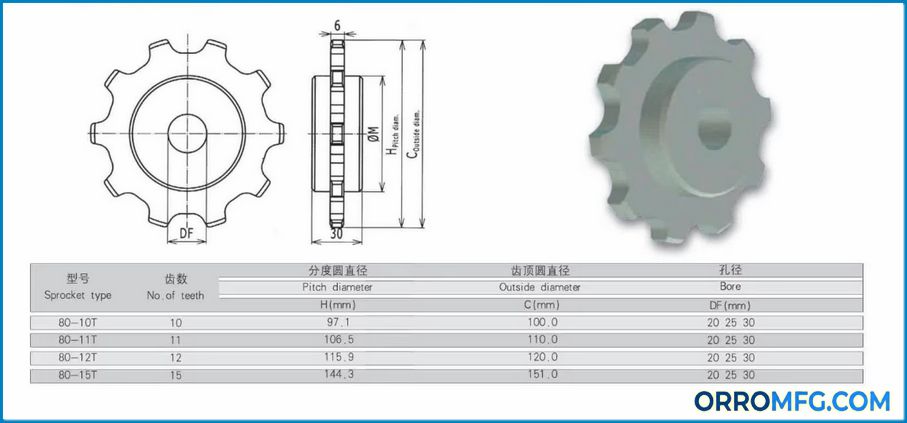
All dimensions below are in millimetres. “Pitch diameter” is the diameter at which the chain actually runs; “outside diameter” is the tip of the teeth. Use the pitch diameter when calculating belt speed and torque, and the outside diameter when checking clearance to a frame or guard.
80 Series — 30 mm Pitch
| Sprocket | Teeth | Pitch diameter | Outside diameter | Bore |
|---|---|---|---|---|
| 80-10T | 10 | 97.1 | 100.0 | 20 / 25 / 30 |
| 80-11T | 11 | 106.5 | 110.0 | 20 / 25 / 30 |
| 80-12T | 12 | 115.9 | 120.0 | 20 / 25 / 30 |
| 80-15T | 15 | 144.3 | 151.0 | 20 / 25 / 30 |
Hub height 30 mm, tooth width 6 mm at the rim. Machined from POM, single hub.
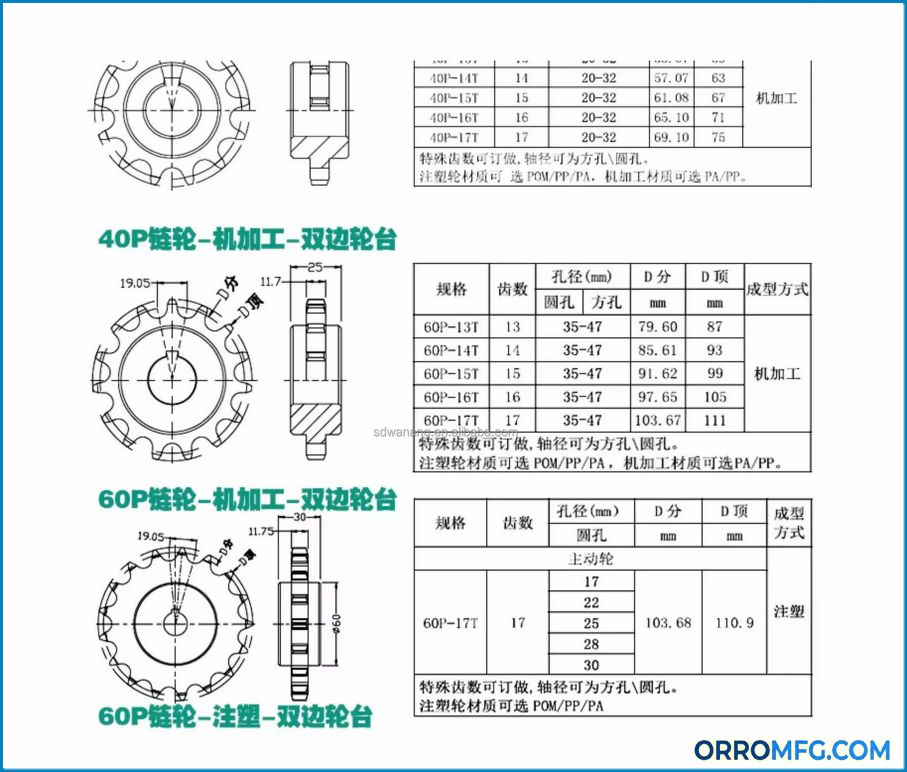
40P — 12.7 mm (1/2") Pitch, Machined, Double Hub
| Sprocket | Teeth | Pitch diameter | Outside diameter | Bore |
|---|---|---|---|---|
| 40P-14T | 14 | 57.07 | 63 | 20-32 |
| 40P-15T | 15 | 61.08 | 67 | 20-32 |
| 40P-16T | 16 | 65.10 | 71 | 20-32 |
| 40P-17T | 17 | 69.10 | 75 | 20-32 |
60P — 19.05 mm (3/4") Pitch
| Sprocket | Teeth | Pitch diameter | Outside diameter | Bore | Method |
|---|---|---|---|---|---|
| 60P-13T | 13 | 79.60 | 87 | 35-47 | Machined |
| 60P-14T | 14 | 85.61 | 93 | 35-47 | Machined |
| 60P-15T | 15 | 91.62 | 99 | 35-47 | Machined |
| 60P-16T | 16 | 97.65 | 105 | 35-47 | Machined |
| 60P-17T | 17 | 103.67 | 111 | 35-47 | Machined |
| 60P-17T | 17 | 103.68 | 110.9 | 17 / 22 / 25 / 28 / 30 | Moulded |
The moulded 17T version is the volume part: one tool, a choice of five bore sizes, and a lower unit cost than machining once the quantity passes a few hundred pieces.
Bore and Hub Options
- Round bore — the standard, bored to H7 or to your shaft tolerance. A grub screw flat can be added.
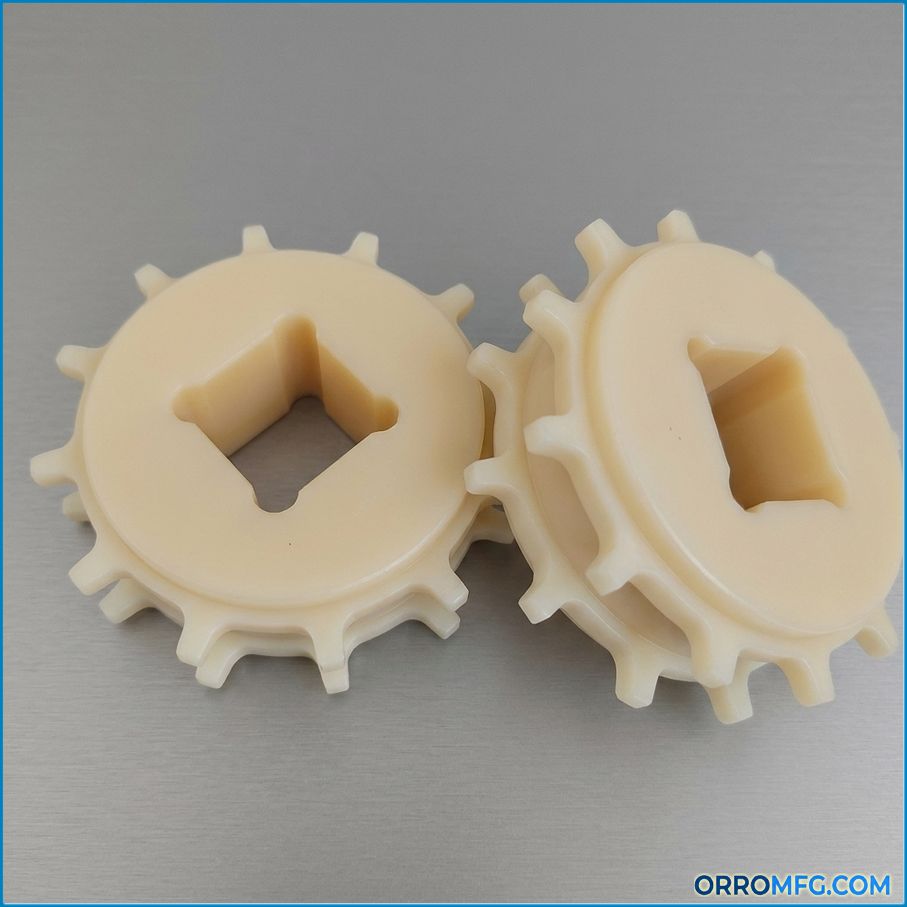
- Square bore — drives a square shaft without a key, common on small conveyor drive shafts and on hand-adjusted assemblies.
- Keyed bore — a standard keyway cut to DIN 6885 or ANSI, for higher torque.
- Single or double hub — a double hub puts bearing surface on both sides of the tooth row, which keeps the sprocket square on the shaft and is the usual arrangement on wide belts.
- Set screw, clamp or pin fixing — specified with the bore.
Machined or Moulded?
| Machined from POM | Injection moulded | |
|---|---|---|
| Tooling | None | One-off tool cost |
| Minimum quantity | From 1 piece | Economical from a few hundred |
| Tooth accuracy | Good, held by the CNC program | Good, set by the tool |
| Design changes | Edit the program | Modify or remake the tool |
| Lead time | Days | Weeks for the first run |
| Best for | Replacement parts, low volume, unusual teeth counts | Standard sizes in repeat production |
Special tooth counts are available in both routes — machined sprockets can be produced to any tooth count and any bore, and moulded sprockets can be tooled for a new count when the volume supports it.
How to Specify a Sprocket
- Identify the chain. Measure the pitch — the centre-to-centre distance between two adjacent link pins. 12.7 mm is 40P, 19.05 mm is 60P, 30 mm is the 80 series. A sprocket of the wrong pitch will climb out of the chain under load.
- Choose the tooth count for speed. Belt speed = pitch × teeth × rpm. More teeth means a smoother, quieter drive and less chordal action, but a larger sprocket and a slower ratio for the same motor speed.
- Measure the shaft and the space. Bore diameter, key or square, and the distance from the shaft to the frame — the outside diameter has to clear it.
- Check the hub. A double hub needs room on both sides; a single hub only one.
- Decide the material. POM for precision and stability, nylon for impact and wear, PP for cost and chemical exposure.
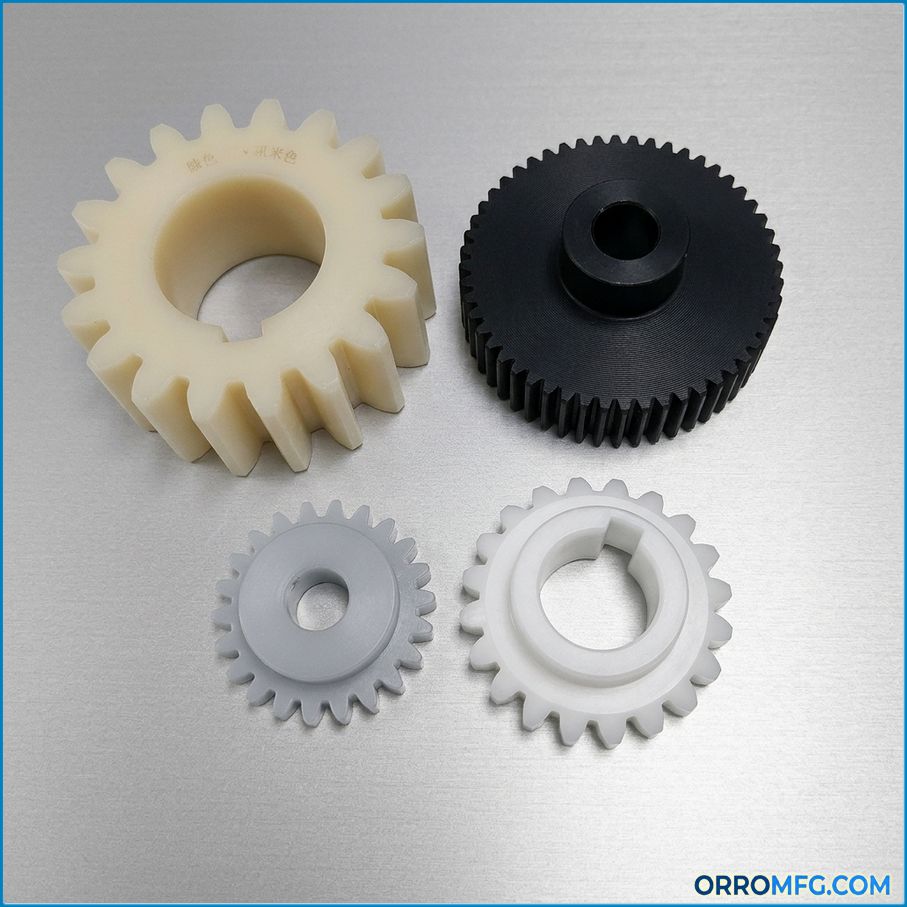
Sprocket or Gear?
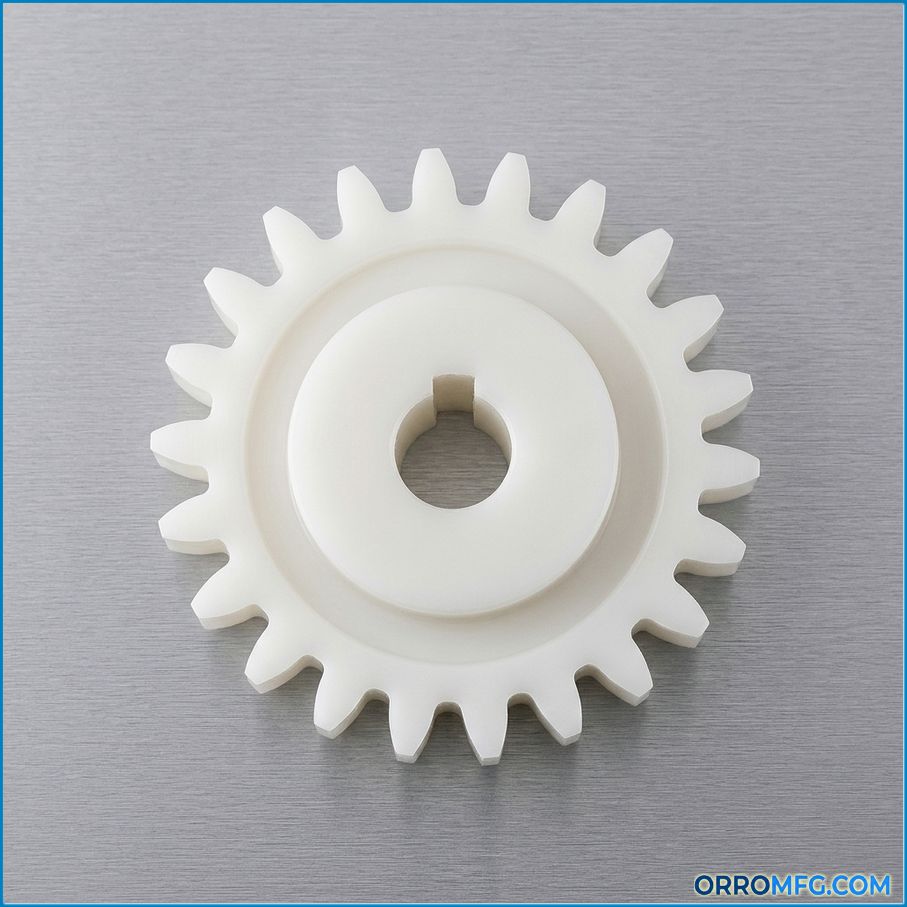
They look similar and are often confused. A sprocket engages a chain: the tooth profile is designed to seat a roller or a link gap, and the pitch is set by the chain. A gear meshes with another gear: the profile is an involute, and the pitch is set by the module or diametral pitch. A sprocket cannot drive a gear, and a gear cannot drive a chain. If you are replacing a worn part, count the teeth and measure the pitch — that is enough to tell which one you have.
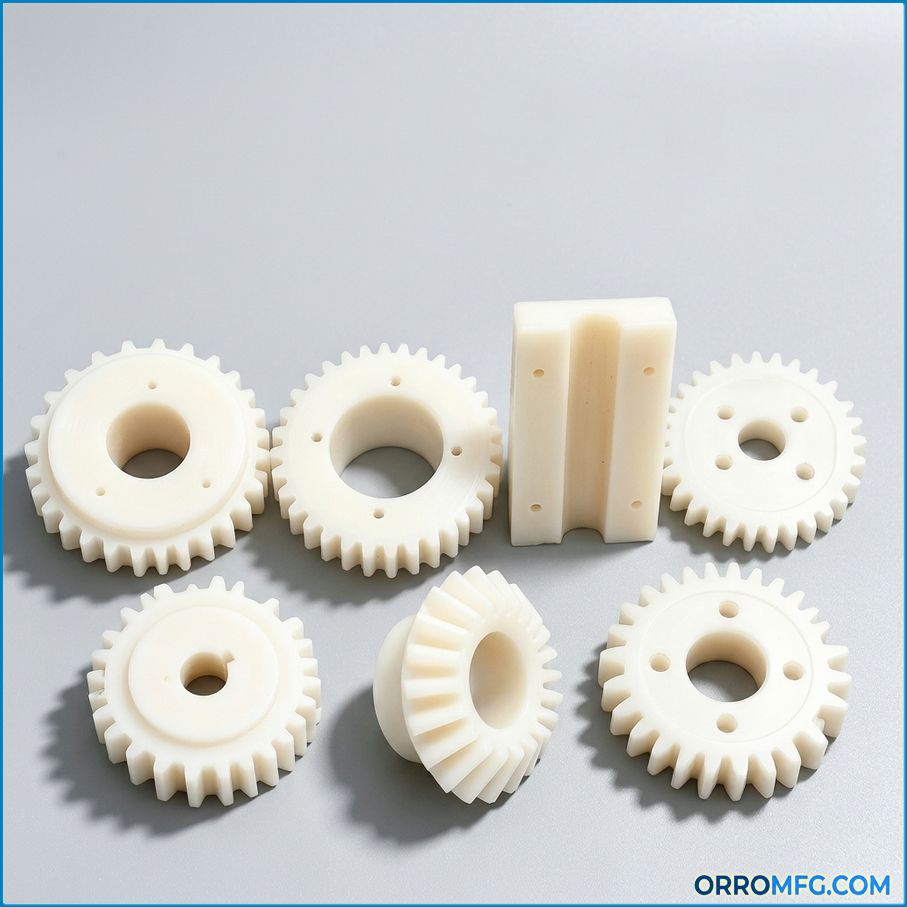
Applications
- Food and beverage conveyors — bottle and can lines, where POM runs dry against the chain and does not shed wear debris into the product area.
- Packaging machinery — case packers, labellers and shrink tunnels, where the sprocket sets the belt speed.
- Material handling — accumulation tables, transfer units and incline conveyors.
- Bottling and filling plants — washdown areas, with PP or nylon specified where chemical exposure is high.
- General machinery — any flat-top chain drive where a metal sprocket would be too heavy, too noisy or would corrode.
Customization
- Tooth count — any number from 8 upward, machined; standard counts tooled for moulding.
- Bore — round, square or keyed, from 6 mm to 47 mm depending on the series, with set screw flats and clamp fixings.
- Hub — single, double, or a custom hub length and diameter to suit a bearing or a drive coupling.
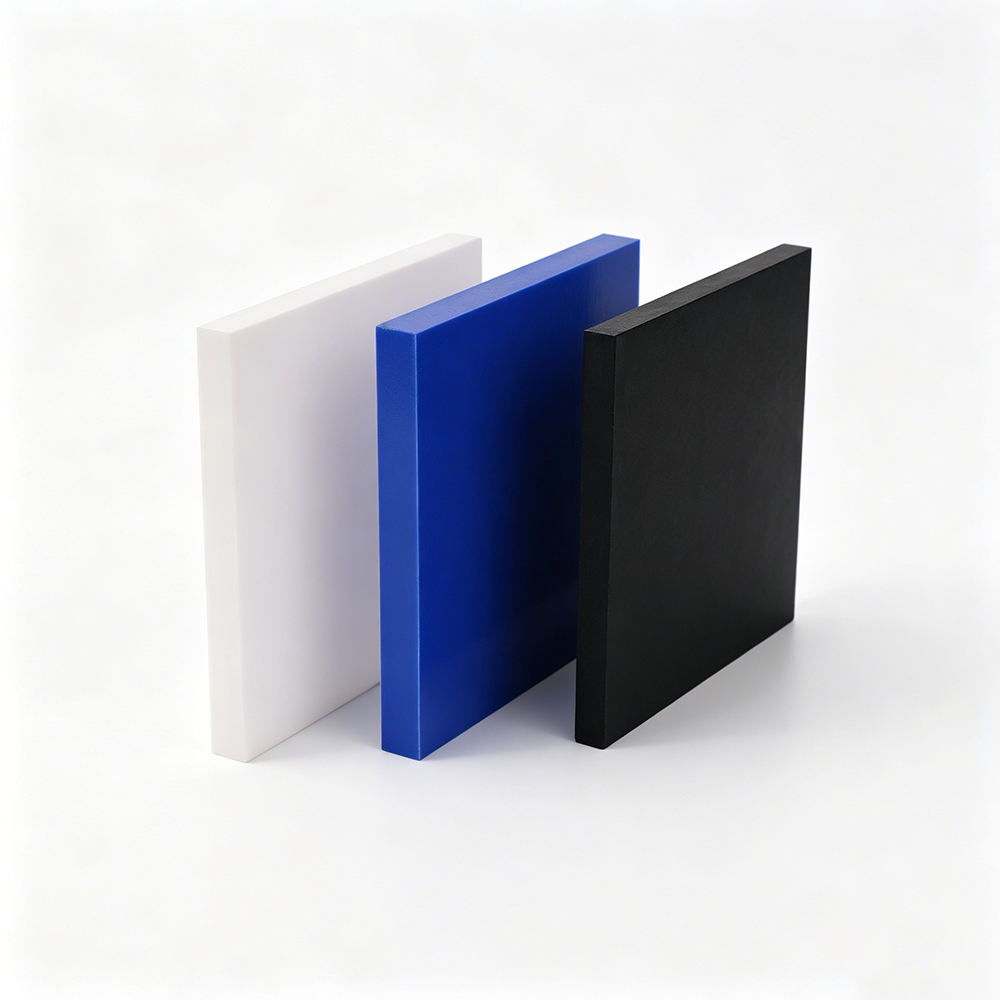
- Material — POM-C, POM-H, glass-filled POM for higher strength, nylon or PP.
- Colour — natural, black, grey, or a custom colour to match an existing line.
- Marking — part number, tooth count and batch code laser-marked or moulded in.
Packing and Lead Times
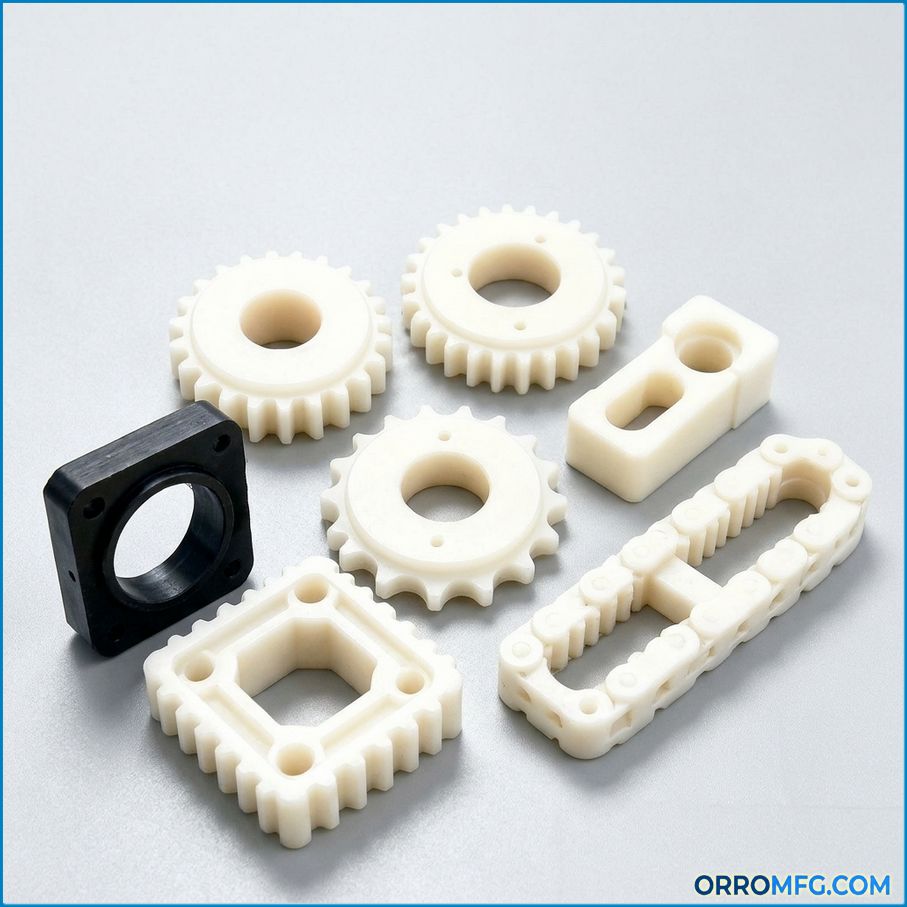
Sprockets are packed individually in bags and cartons, with bore and tooth count labelled on each bag. Machined parts usually ship in 7-15 working days; moulded parts depend on the tool, typically 25-35 days for a first run and 15-20 days for repeat orders. Samples can be machined quickly for fit checks before a production order.
Quality Assurance
OrroMFG produces POM sprockets within an ISO 9001:2015 certified quality management system. Pitch diameter and outside diameter are checked against the drawing, bore diameter and keyway position are gauged, and tooth form is inspected on a profile projector. Each batch carries the part number, material grade and production date for traceability.
Frequently Asked Questions
What does 40P and 60P mean on a sprocket?
The number is the chain pitch in eighths of an inch. 40P is 4/8" = 12.7 mm and 60P is 6/8" = 19.05 mm. The letter P stands for pitch, so the chain and the sprocket must carry the same number.
How do I know which sprocket fits my chain?
Measure the distance between the centres of two adjacent pins on the chain. That is the pitch, and it must match the sprocket series. Then count the teeth on the old sprocket and measure the bore.
Can I replace a metal sprocket with a POM one?
Usually yes, provided the load and speed are within the plastic’s limits. POM is used on most plastic-chain conveyors precisely because it is lighter, quieter and does not corrode. For high torque or high temperature, check with us before substituting.
What is the difference between pitch diameter and outside diameter?
Pitch diameter is the circle on which the chain actually runs and is what you use for speed and torque calculations. Outside diameter is the tip of the teeth and is what you check for clearance. The outside diameter is always larger.
Do you make sprockets with a square bore?
Yes. Square bores are standard on the smaller sprockets and avoid the need for a key. Send the square size and the shaft tolerance.
Can you make a sprocket with a tooth count that is not in the table?
Yes — machined sprockets can be produced to any tooth count. For moulded sprockets a new tool is needed, which is economic at higher volumes.
What tolerance do you hold on the bore?
Bores are machined to H7 unless you specify otherwise. Keyways are cut to DIN 6885 or ANSI, and concentricity between bore and pitch circle is checked on every batch.
Will POM sprockets work in a washdown area?
They resist water and most cleaning chemicals, but check the cleaning agents and temperature. For aggressive washdown, PP or a specific grade may be the better choice — tell us the chemical and the temperature.
What is the minimum order?
100 pieces per size for production. Machined samples can be supplied in smaller quantities for a fit check.
Related Products
- POM Gear — spur, helical and worm gears in POM
- POM Spur Gear — involute spur gears
- POM CNC Machined Parts — custom parts to drawing
- POM Bearing Sleeve — bushings and sleeves
- UHMWPE Chain Guide Rail — the rail that carries the same chain
- Gears, Bushings & Bearings — the full transmission range
Send the chain pitch, tooth count, bore size and hub type for a same-day quote. A photo of the old sprocket beside a ruler is usually enough for us to identify the series.