Overview
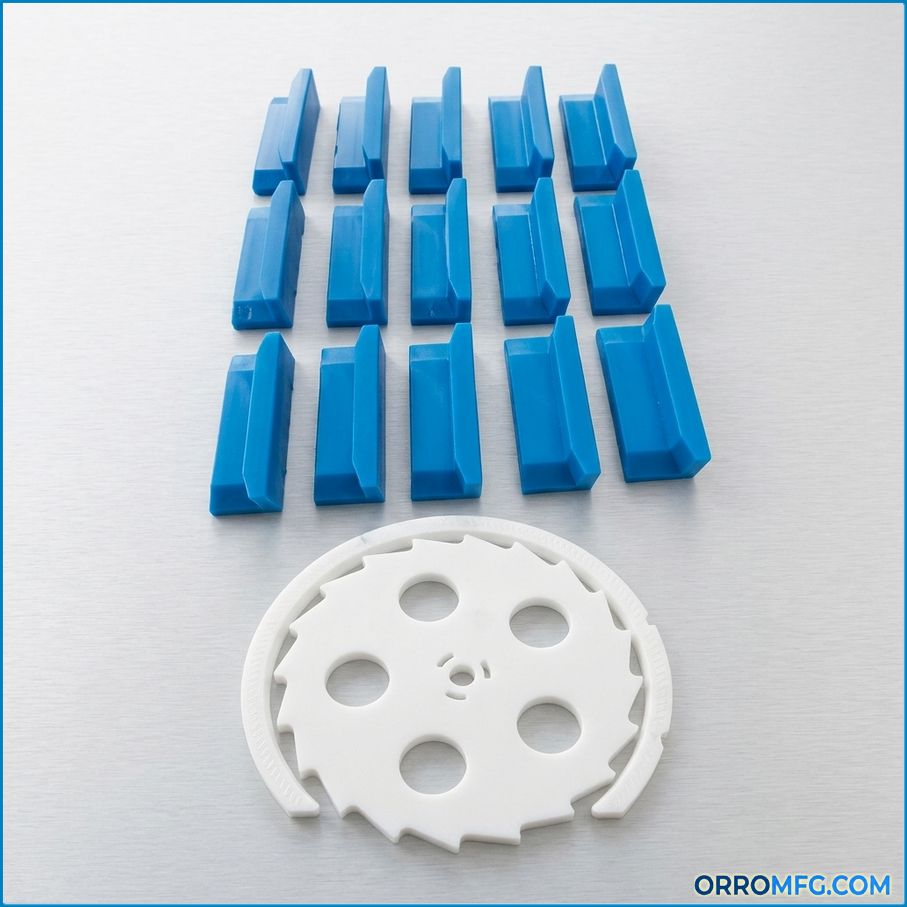
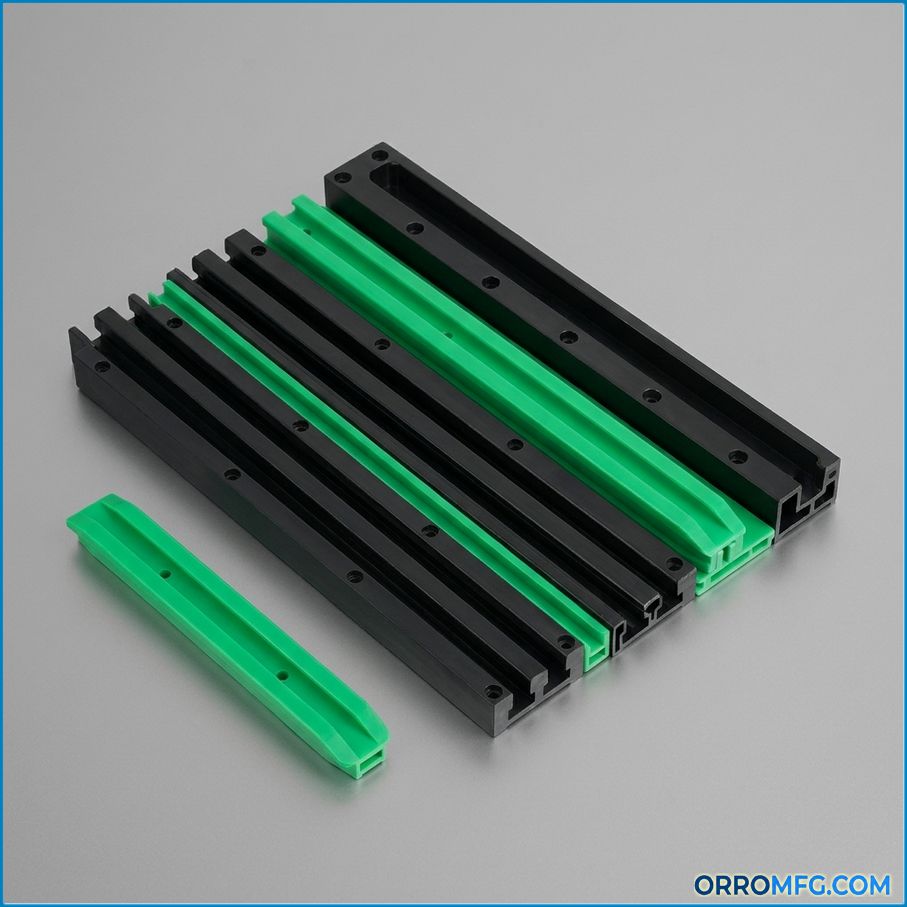
UHMWPE chain guide rails are the plastic tracks that carry, centre and return a roller chain on conveyors, filling lines and industrial machinery. Instead of letting a steel chain slide directly on a steel frame, the chain runs on an ultra-high molecular weight polyethylene profile: friction drops, the chain and frame stop wearing against each other, and the line runs without lubrication. OrroMFG supplies these rails as straight lengths cut to order, as machined or thermoformed radius sections for bends, and as complete assemblies with the mounting holes already in place.
The range covers two related jobs. Chain guide rails are the profiled sections — T, CT, TU, TS, CTS, U, CU, K, CK and the CKG variants — where the chain is supported on its rollers and held laterally by the profile. Linear guide rails and wear strips are the flatter or T-slot sections that carry a sliding shoe, a guide block or a belt rather than a chain. Both are normally made from UHMWPE; both can be supplied in POM or nylon where a stiffer or stronger section is needed.
Why UHMWPE for Chain Guide Rails
- Abrasion resistance — in sliding wear UHMWPE outlasts steel, nylon and POM by a wide margin, so a rail that would be a wear item in metal becomes a long-life component.
- Low friction — coefficient of friction against steel is around 0.08-0.15, close to PTFE, which cuts chain pull, motor load and noise.
- Self-lubricating — no grease or oil on the rail, so there is no lubricant to drip onto product or to attract dust in a clean line.
- Impact strength — the highest of any engineering plastic; the rail absorbs chain slap and jams without cracking.
- Chemical and moisture resistance — will not rust or corrode in washdown, and resists most acids, alkalis and salt solutions.
- Light weight — roughly one-eighth the weight of a steel rail, which matters on long overhead and return runs.
Profile Range
| Profile family | Section | Typical duty |
|---|---|---|
| T | T-section rail | General straight run; chain rollers ride on the top face, the stem locates in a slot or channel |
| CT | T-section with side location | Straight run where the chain also needs lateral guidance |
| TU / TS / CTS | U and asymmetric U sections | Top-running and side-running chain where the profile wraps the roller |
| U / CU | U-channel | Chain supported on both sides, with a centre rib on the CU variant |
| K / CK | K-section | Centre-guided chain on a raised rib, for higher loads and tighter tracking |
| CKG 14H / 15V / 16H | K-section variants | Sized to the corresponding chain width and height for a direct retrofit |
| ETA / R / CRG | Radius and return sections | Bend transitions, return runs and curved guide tracks |
Profile codes follow the families used in chain conveyor practice. We confirm the exact section against your chain, existing rail or a sample before production, so a retrofit matches the original track rather than a nominal size.
Chain Types and Rail Layout
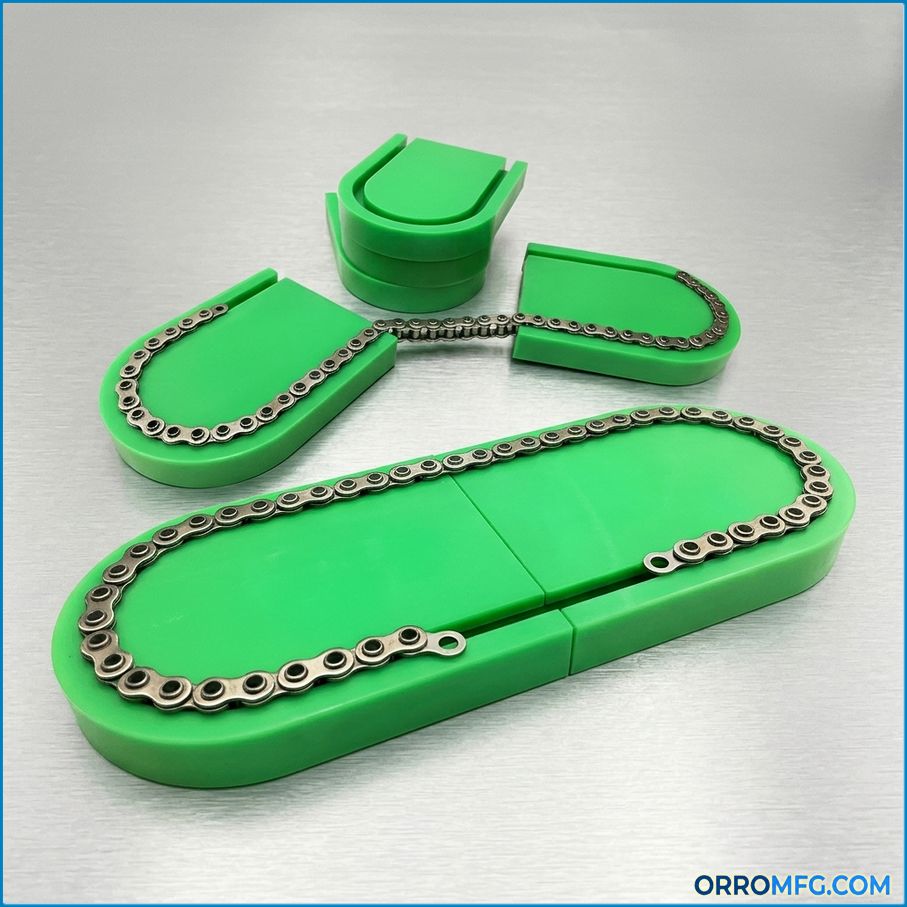
Rails are supplied for simplex, duplex and triplex roller chains, and for the common metric and inch chain pitches. A typical line uses four rail positions: a carry rail under the chain on the loaded side, a return rail under the chain on the empty side, and side rails or a K-section where the chain must stay centred through a curve.
- Carry rail — takes the weight of the chain and product; the section is chosen by chain width and the load per metre.
- Return rail — guides the slack side; often a smaller U or T section, with a slight fall to keep the chain draining.
- Side or centre guide — controls lateral position; K and CK sections do this with a raised rib that runs inside the chain.
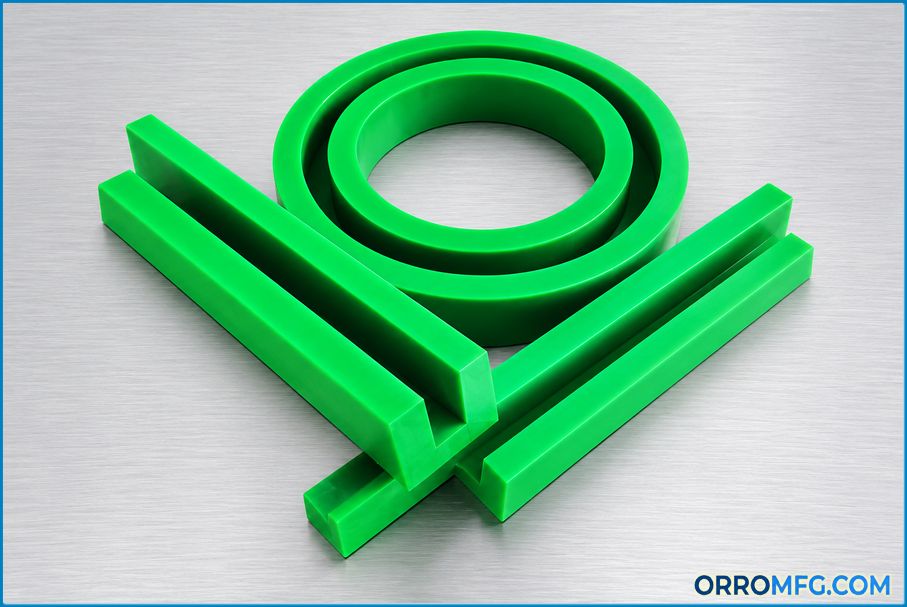
- Radius section — machined or thermoformed to the bend radius, with the profile continuous through the arc so the chain does not step at a joint.
- Guide shoe and entry section — a short, chamfered piece at the infeed that catches a misaligned chain and steers it onto the rail.
Linear Guide Rails and Wear Strips
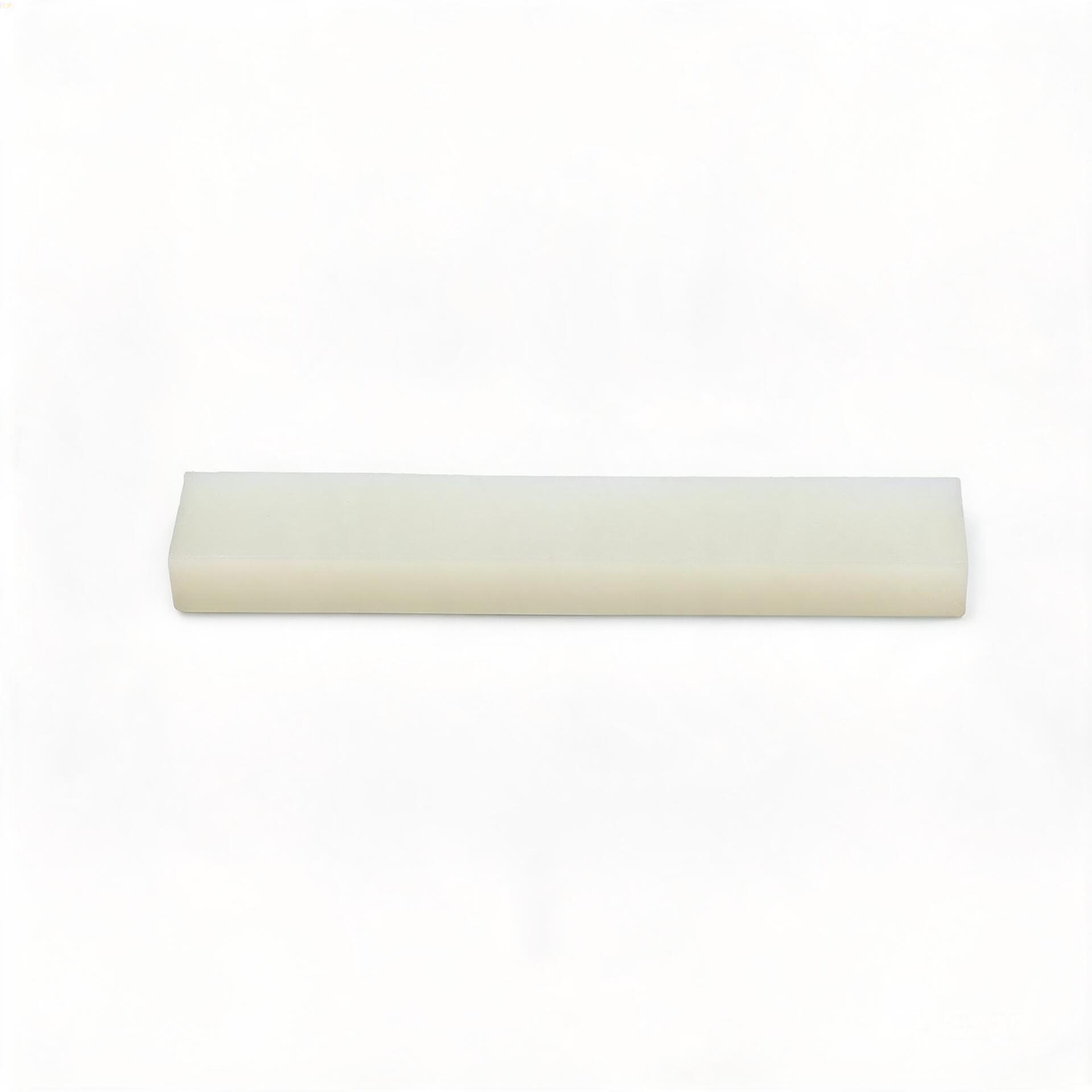
For sliding rather than rolling motion, the same material is supplied as flat wear strips, T-slot guide rails and machined slideways. A T-slot rail is fixed to the frame and the moving carriage runs on its face; a flat strip is bonded or screwed to a support and the guide block slides over it. Both are cut to length, drilled and countersunk to your hole pattern, and can be supplied with a matching pair so the two sides of a track wear at the same rate.
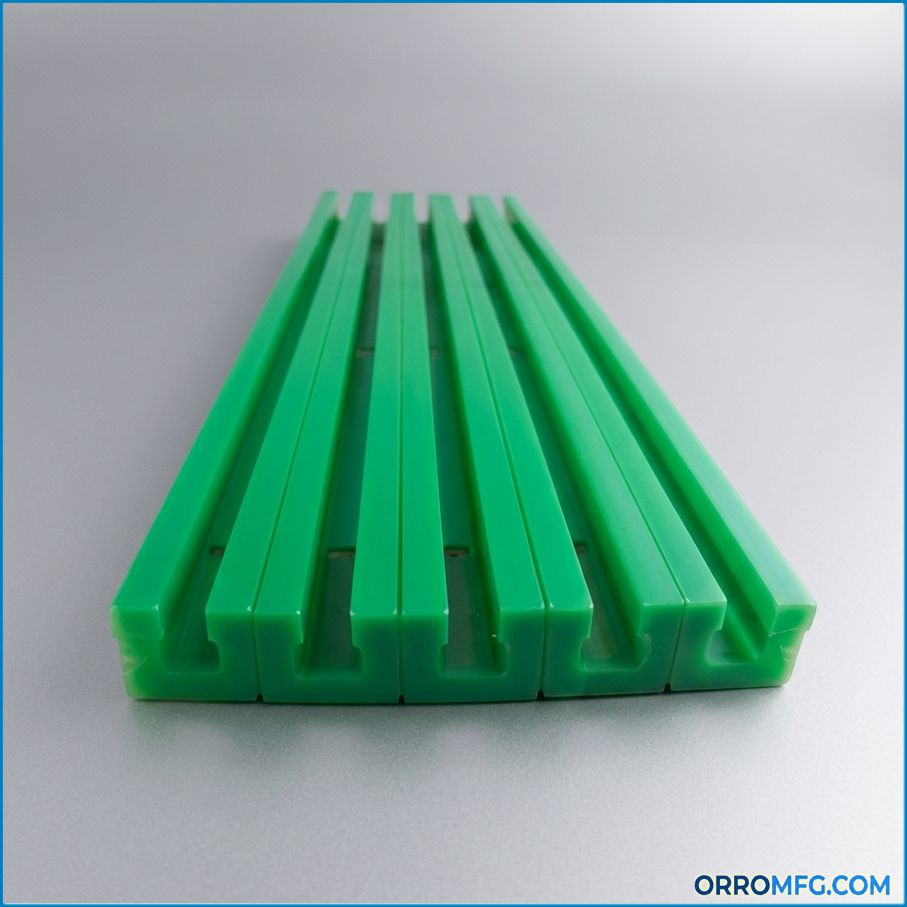
Flat wear strips and conveyor guide rails are covered in more detail on the UHMWPE Wear Strip page; this page focuses on profiled chain rails and curved tracks.
Colours, Grades and Alternative Plastics
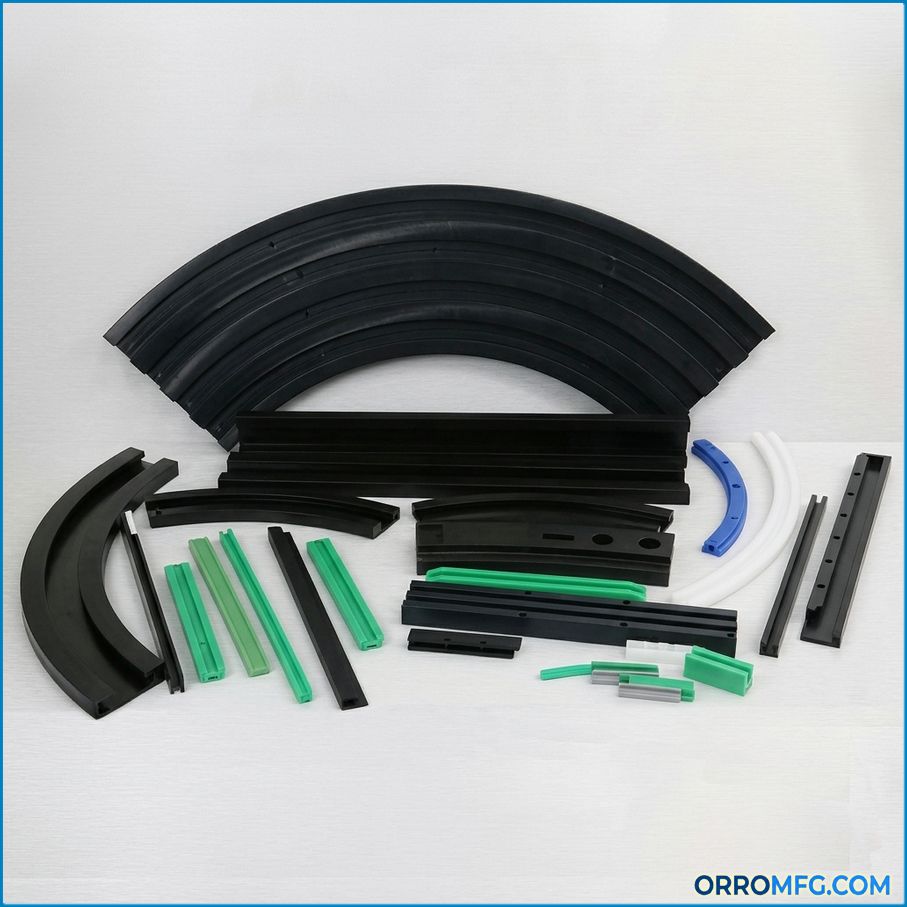
Standard colours are green, blue, black, white and natural. Colour is normally used to identify a rail position or a chain width on the line, and black is the usual choice where the rail is visible or exposed to UV. Custom colours are matched to a sample.
- Virgin UHMWPE — the standard grade for general conveying and guide duty.
- Oil-filled UHMWPE — lower friction and higher PV for high-speed or high-load chain runs.
- Anti-static UHMWPE — for electronics, semiconductor and explosive-risk areas where a static charge on the rail is unacceptable.
- Glass-filled UHMWPE — higher stiffness and a service temperature to about 100°C, where the standard grade would sag.
- POM (acetal) — when the rail must be stiffer or hold tolerance better; POM machines cleanly and is the usual alternative for precision slideways.
- Nylon PA6 — where impact and load are the priority and the moisture-related growth can be allowed for.
Material Specifications
| Property | Virgin UHMWPE | Oil-Filled UHMWPE | Glass-Filled UHMWPE (20%) | Anti-Static UHMWPE |
|---|---|---|---|---|
| Density (g/cm³) | 0.93 - 0.94 | 0.92 - 0.94 | 1.00 - 1.10 | 0.93 - 0.95 |
| Molecular Weight (million g/mol) | 3 - 10 | 3 - 6 | 3 - 6 | 3 - 6 |
| Tensile Strength (MPa) | 35 - 50 | 30 - 45 | 40 - 55 | 30 - 45 |
| Hardness (Shore D) | 60 - 70 | 55 - 65 | 65 - 75 | 60 - 70 |
| Coefficient of Friction | 0.08 - 0.15 | 0.05 - 0.10 | 0.10 - 0.18 | 0.08 - 0.15 |
| PV Limit (bar·m/s) | 1,000 - 2,000 | 2,000 - 3,500 | 800 - 1,500 | 1,000 - 2,000 |
| Continuous Service Temp (°C) | -200 to +80 | -200 to +80 | -200 to +100 | -200 to +80 |
| Water Absorption (%) | < 0.01 | < 0.01 | < 0.02 | < 0.01 |
Values are typical for the grades we stock; confirm against the grade data sheet for a critical duty.
Design and Installation Notes
- Thermal expansion — UHMWPE expands far more than steel (roughly 1.5 × 10⁻⁴ per K). On long continuous runs, leave clearance at the ends or fix the rail in short lengths with expansion gaps, otherwise the rail can bow or lift in a warm plant.
- Chain clearance — the rail supports the chain rollers, not the link plates. Keep the side clearance small enough to centre the chain but loose enough not to bind when the rail warms up.
- Mounting — screw through countersunk holes in the profile; do not overtighten, because a crushed countersink becomes a stress point. Where the rail is removable, a keyed or dovetail section lets the wear piece be replaced without removing the frame.
- Curves — a radius section should be continuous and joint-free through the arc where possible; on long bends, stagger the joints away from the point of maximum chain pull.
- Temperature — standard UHMWPE is limited to about 80°C continuous, so rails near ovens, steam tunnels or hot product need glass-filled or a different material.
- Cleaning — washdown and most cleaning chemicals are acceptable; avoid steam above 80°C and prolonged contact with strong oxidizing agents.
Applications
Food, Beverage and Filling Lines
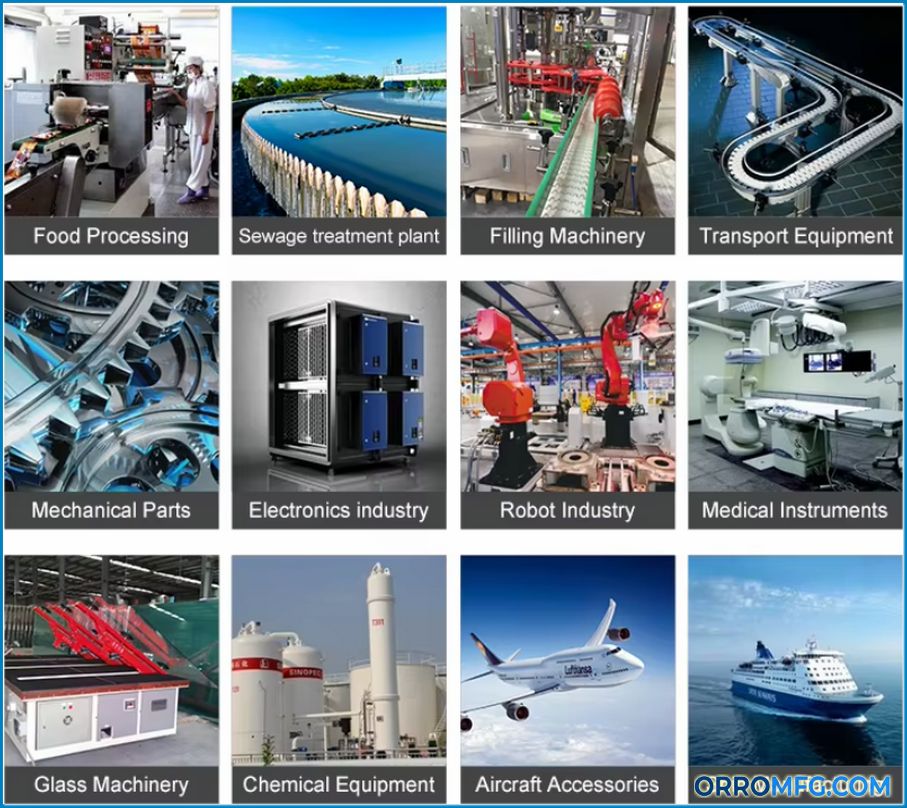
Carry and return rails on filling, capping, labelling and packaging conveyors, where a self-lubricating rail removes the risk of oil reaching the product and survives daily washdown. Food-grade UHMWPE grades are available, with a material declaration supplied for your market on request.
Transport and Logistics
Baggage handling, parcel sorting, pallet conveyors and transfer units use UHMWPE rails on long runs and tight curves, where low friction keeps chain pull and drive power down and quiet operation matters in public buildings.
Industrial Machinery and Robotics
Chain-driven transfer units, machine-tool guards, assembly fixtures and robot cells use profiled rails and T-slot slideways to guide moving carriages without metal-to-metal contact.
Water Treatment, Chemical and Glass
Rails on sludge scrapers, dosing lines and glass-handling conveyors benefit from the material’s corrosion resistance and its ability to run wet without swelling or seizing.
Electronics, Medical and Clean Areas
Anti-static grades are used where a charge on the rail could damage components, and low-outgassing, easily cleaned rails are used in medical instrument and clean-assembly equipment.
Customization Options
- Lengths — cut to order, typically up to 4 m per piece, with longer runs supplied as jointed sections matched to your frame.
- Profiles — standard T, U, K and CKG sections, plus custom profiles machined or extruded to a drawing.
- Curves — radius sections machined from plate or thermoformed, in any radius that fits the bend.
- Holes and features — countersunk mounting holes, slots, notches, chamfers and lead-in ramps machined to your pattern.
- Colour — green, blue, black, white, natural and custom matched.
- Grade — virgin, oil-filled, anti-static, glass-filled, plus POM or nylon for the same section.
- Marking and packing — part number marking, custom labels and logo or packaging to order.
Packing and Lead Times
Rails ship wrapped in bubble film and packed in cartons, with long or heavy sections in wooden cases. Pieces are packed to protect the running face, since a scored rail wears faster than a clean one. Samples are available before production, and machined or cut rails typically ship in 7-10 working days after drawing approval; moulded or extruded profiles depend on the tooling or run schedule.
Quality Assurance
OrroMFG manufactures UHMWPE rails within an ISO 9001:2015 certified quality management system. Incoming resin is checked for grade and density, profile sections are verified against the approved drawing or sample, and machined features are inspected with calibrated gauges. Straightness, section height, slot width and hole position are checked before packing, and each batch carries material and inspection documentation with traceability on the label. First-article inspection reports are available for new profiles or retrofit programmes.
Frequently Asked Questions
What is a UHMWPE chain guide rail?
It is a plastic track, normally made from ultra-high molecular weight polyethylene, that supports and centres a roller chain so the chain does not run directly on steel. It reduces friction and noise, removes the need for chain lubrication, and protects both the chain and the machine frame from wear.
How do I choose between T, U, K and CKG profiles?
The profile follows the way the chain is supported: a T or U section carries the chain from below, a K or CK section guides it on a centre rib, and the CKG variants match specific chain widths for a direct retrofit. Send the chain size, a photo of the existing rail or a short sample, and we will match the section.
Which chain types can these rails guide?
Single-strand (simplex), duplex and triplex roller chains in common metric and inch pitches. Tell us the chain number, the number of strands and the pitch, and we will confirm the rail width and the spacing between carry and return rails.
Should I use UHMWPE, POM or nylon for the rail?
UHMWPE where abrasion resistance and low friction matter most, which is the usual case on conveyors. POM where the rail must be stiffer or hold a tighter tolerance. Nylon where impact and load are the priority and moisture growth can be tolerated. We can quote the same profile in all three materials for comparison.
What tolerance and lengths can you supply?
±0.1 mm is the typical tolerance on machined features such as slot width and hole position, with ±0.05 mm on selected features after a feasibility review. Rails are normally supplied cut to order in lengths up to 4 m; longer runs are supplied as jointed sections.
Can you make curved and radius sections?
Yes. Radius sections are machined from UHMWPE plate or thermoformed to the bend radius, with the profile continuous through the arc. Send the centreline radius, the arc angle and the chain size, and we will confirm whether a single piece or a jointed arc is the better supply.
Is UHMWPE suitable for food contact?
Food-grade UHMWPE grades are available and are widely used on food and beverage conveyors. Whether a specific declaration is needed depends on your market and the application — tell us the requirement and we will supply the material documentation with the quotation.
Can the rail be made anti-static?
Yes. Anti-static UHMWPE is available for electronics, semiconductor and dust-risk areas where a static charge on the rail is a concern. It can be supplied in the same profile as the standard grade, usually in black.
What is the minimum order and lead time?
100 pieces per profile for a trial order, with smaller quantities accepted for machined samples. Machined and cut rails typically ship within 7-10 working days after drawing approval; extruded or moulded profiles follow the tooling schedule. Samples are available before the production run.
Related Products
- UHMWPE Wear Strip — flat strips and conveyor guide rails
- UHMWPE Sheet — plate for machined rails, liners and slideways
- UHMWPE material guide — grades, properties and selection notes
- POM Sheet — a stiffer alternative for precision slideways
- Nylon material guide — where impact and load take priority
- Conveyor Roller — rollers and guide wheels that run with these rails
Send your chain size, rail sample or drawing for a same-day quote. Tell us the chain number, number of strands, rail position, bend radius and the cleaning or static requirement, and our engineering team will confirm the profile, material grade, colour and length.