Overview
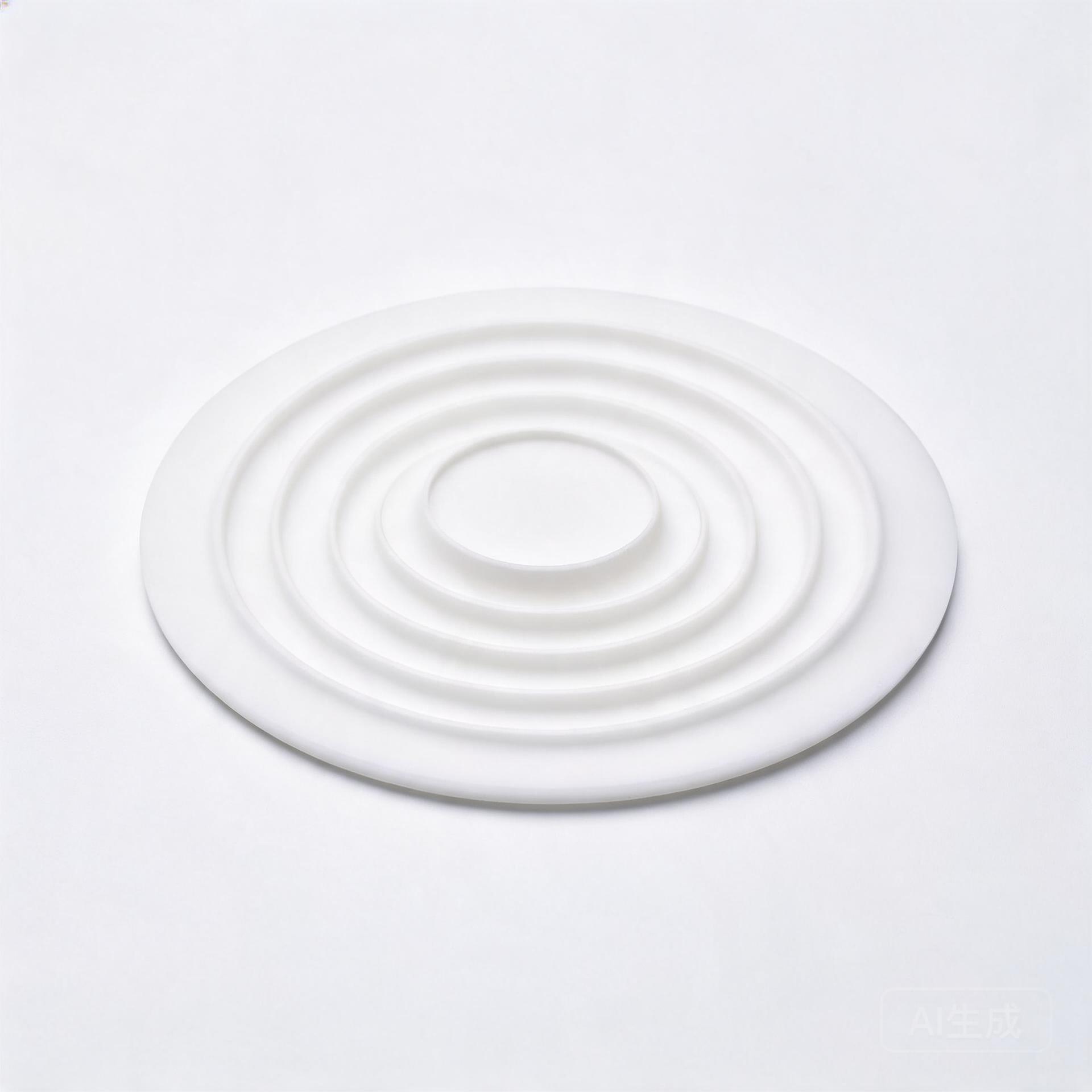
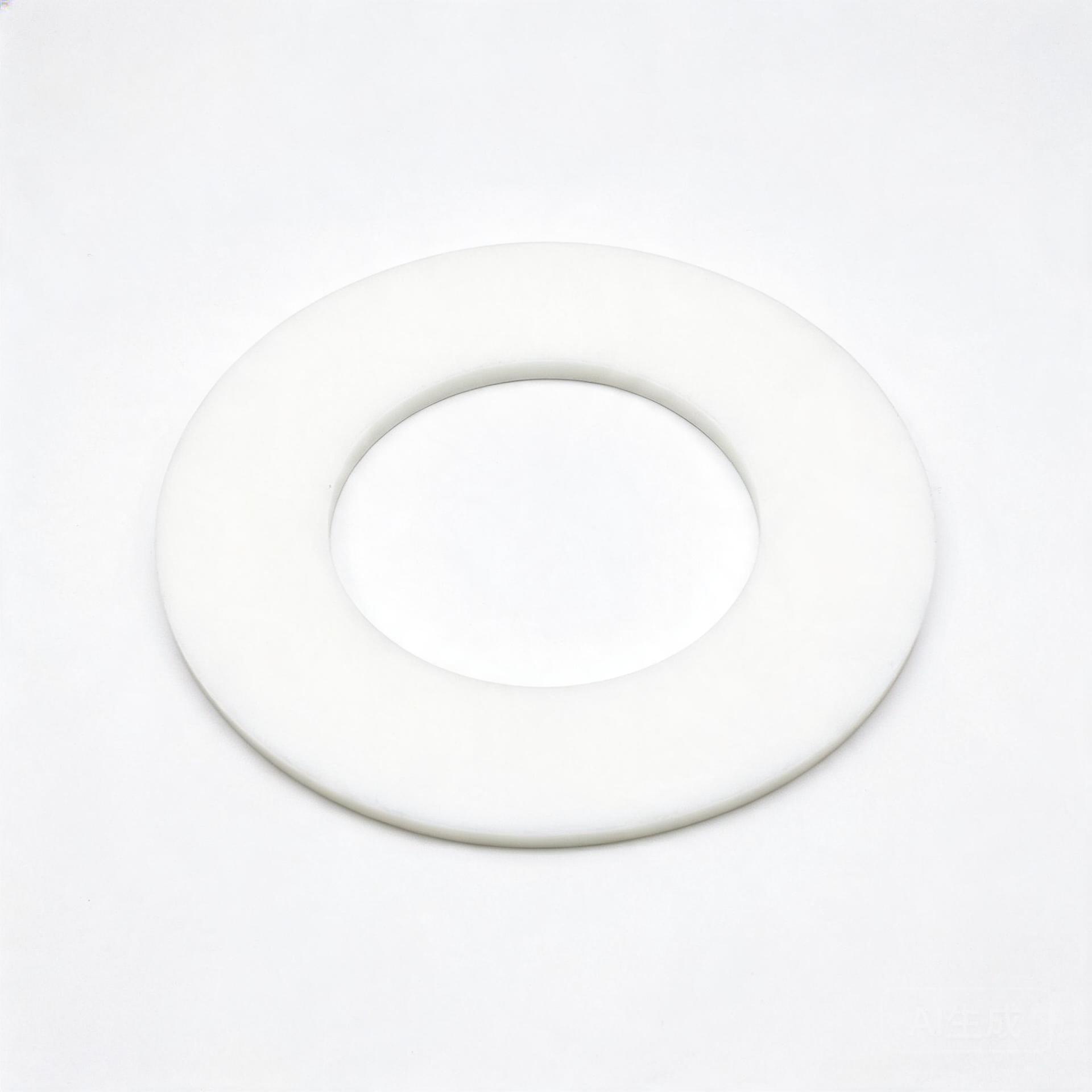
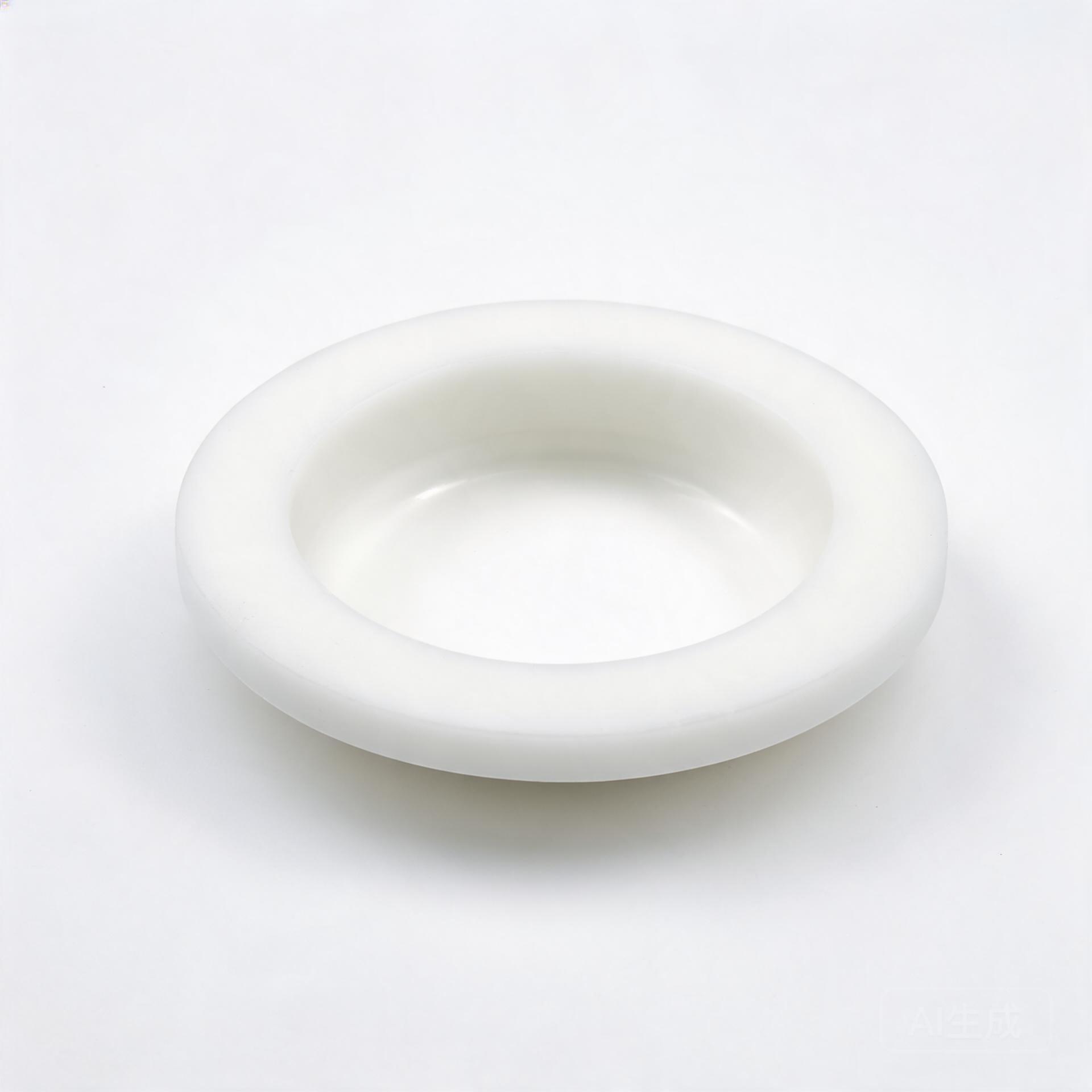
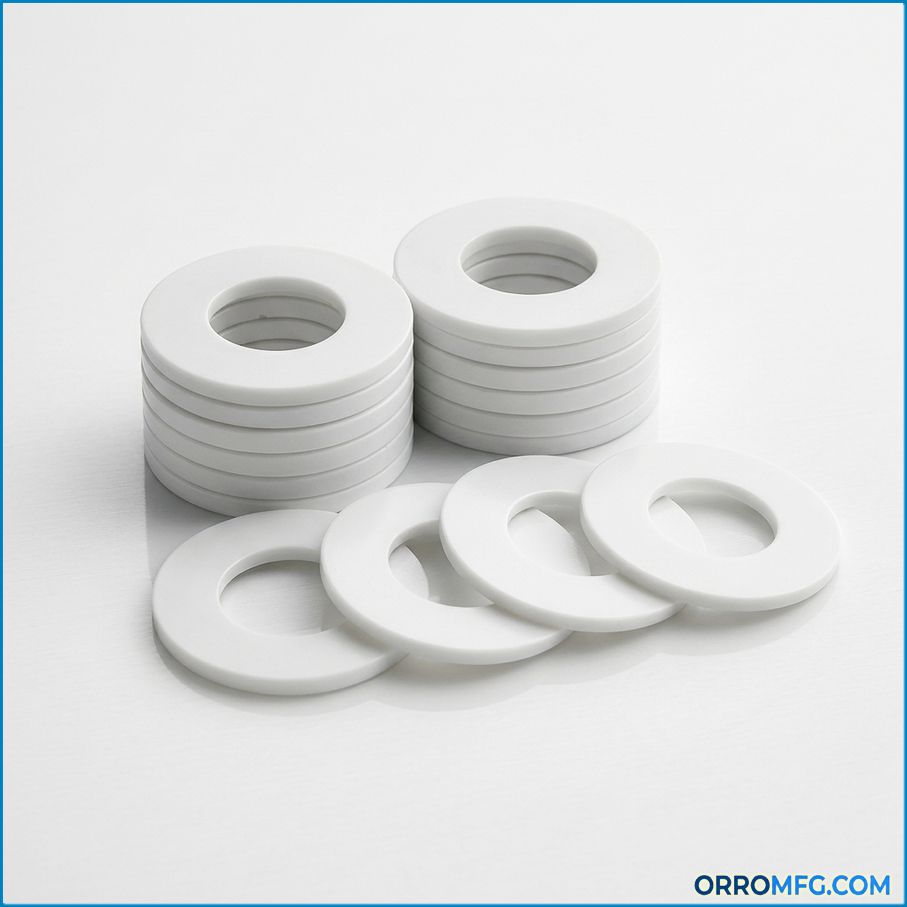
PTFE flat washers are white or black rings cut or machined from polytetrafluoroethylene sheet. They do two different jobs depending on the joint: they seal a flange or port against aggressive chemistry, or they act as a low-friction, electrically insulating shim between two surfaces. Both jobs come from the same set of properties — chemical inertness across the whole pH range, a service range of -200 °C to +260 °C, the lowest friction coefficient of any solid material, and excellent dielectric strength.
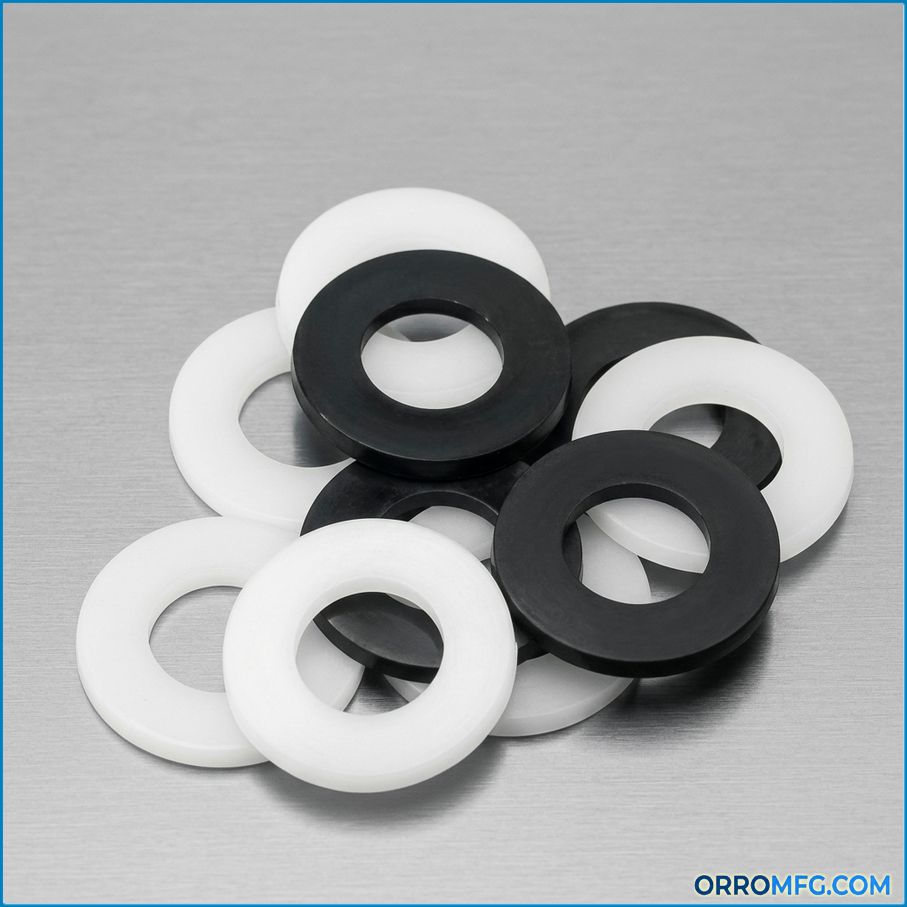
The standard washer is virgin PTFE, natural white, 1.5-3 mm thick, cut from skived sheet. Black washers are usually carbon-filled and brown ones glass- or bronze-filled: the filler raises compressive strength and creep resistance, which matters when the washer seals under pressure rather than just spacing two parts. Choosing between them is the single most important decision on this part, because unfilled PTFE creeps under sustained load.
ORRO supplies PTFE flat washers from 3 mm to 300 mm outside diameter, 0.5 mm to 10 mm thick, punched or CNC machined to your drawing, in virgin, glass-filled, carbon-filled and FDA-compliant grades.
Key Features
- Total Chemical Inertness: Resistant to acids, bases, solvents, oxidisers and process chemicals across pH 0-14 — one washer covers almost every medium in the plant.
- Extreme Temperature Range: -200 °C to +260 °C continuous, from cryogenic service to hot process lines, with no embrittlement at either end.
- Lowest Friction of Any Solid: A friction coefficient around 0.04 makes PTFE washers work as slip shims as well as seals, freeing joints that seize or gall.
- Electrical Insulation: Volume resistivity above 10¹⁸ Ω·cm and dielectric strength of 60 kV/mm make PTFE a standard insulating washer for terminals and busbars.
- Non-Stick and Clean: Nothing adheres to PTFE, so the washer lifts off without residue — important on food, pharma and semiconductor equipment.
- Unlimited Shelf Life: Immune to UV, ozone and atmospheric aging; stock does not degrade in a stores bin.
Material Specifications
| Property | Virgin PTFE | Glass-Filled (25%) | Carbon-Filled (25%) |
|---|---|---|---|
| Colour | Natural white | White / off-white | Black |
| Density (g/cm³) | 2.15 - 2.20 | 2.30 - 2.40 | 2.05 - 2.15 |
| Tensile Strength (MPa) | 20 - 30 | 22 - 28 | 20 - 26 |
| Compressive Strength (MPa) | 12 - 15 | 18 - 22 | 16 - 20 |
| Hardness (Shore D) | 50 - 60 | 60 - 70 | 55 - 65 |
| Continuous Service Temp (°C) | -200 to +260 | -200 to +260 | -200 to +280 |
| Creep / Cold Flow | High | Low | Low |
| Friction Coefficient | 0.04 - 0.10 | 0.10 - 0.20 | 0.10 - 0.20 |
| Dielectric Strength (kV/mm) | 60 | 40 | 25 |
| Volume Resistivity (Ω·cm) | > 10¹⁸ | 10¹⁵ | 10¹² |
| Water Absorption (%) | < 0.01 | < 0.02 | < 0.02 |
| Chemical Resistance | pH 0-14 | pH 0-14 | pH 0-14 |
Sizes and Thickness
| Dimension | Range | Notes |
|---|---|---|
| Outside diameter | 3 - 300 mm | Larger rings available as flange gaskets |
| Bore | 1 - 250 mm | Sized to the bolt, stud or spigot |
| Thickness | 0.5 - 10 mm | 1 mm, 1.5 mm, 2 mm and 3 mm are stock |
| Tolerance | ±0.05 mm on thickness | Machined rings hold ±0.02 mm on request |
| Hardness | 50 - 70 Shore D | Grade dependent |
| Colour | White (virgin), black (carbon), brown (bronze) | Colour identifies the filler |
| Finish | Skived sheet or machined | Machined faces are flatter and seal better |
For a shim, thickness tolerance drives the fit: a PTFE washer that is 0.1 mm thick in one place and 0.15 mm in another will cock the assembly. For a sealing washer, thickness is chosen against the joint gap, and a filled grade is used whenever the joint is pressurised.
Applications
Chemical Processing and Piping
Washers and small flange gaskets on dosing pumps, valve bodies, sensor ports and chemical transfer lines. A single PTFE washer covers acids, caustics and solvents that would destroy a nitrile or EPDM gasket in days.
Food, Beverage and Pharmaceutical
FDA-compliant and USP Class VI grades seal product-contact ports, filler nozzles and sanitary fittings. PTFE is non-contaminating, cleanable and unaffected by CIP chemicals.
Electrical Insulation
Insulating washers under terminals, between busbars, and as spacers in switchgear and battery assemblies, where high dielectric strength and heat resistance are needed together.
Low-Friction Shims
Slip washers between stainless flanges, under gland nuts and in sliding joints. PTFE’s low friction prevents galling and seizure where two stainless surfaces would otherwise cold-weld.
Cryogenic and High-Temperature Service
LNG, nitrogen and oxygen systems at the cold end; steam, heat exchangers and oven equipment at the hot end. Few materials span both.
Semiconductor and Ultra-Pure Systems
High-purity virgin PTFE washers in wet benches, chemical delivery lines and DI-water systems, where trace contamination is the limiting factor.
Operating Conditions
- Temperature: -200 °C to +260 °C; carbon-filled grades to +280 °C. Thermal expansion is high, so allow for it on large diameters.
- Pressure: Virgin PTFE suits static sealing at modest pressure. Under sustained load it creeps — switch to glass- or carbon-filled above roughly 10-15 bar, or where the joint is permanently loaded.
- Media: Nearly all industrial chemicals across pH 0-14, including concentrated acids, caustics and solvents. Not for molten alkali metals or elemental fluorine at high temperature and pressure.
- Flange Faces: PTFE does not conform, so the face must be flat and the bolt load real. On a scored flange it will leak where a soft elastomer would seal.
- Bolt Load: Needs higher torque than an elastomer gasket. Re-torque after the first thermal cycle, because cold flow relaxes the joint.
- Friction: Do not rely on PTFE as a structural load path — it is a shim and a seal, not a bearing under high load.
Material Comparison
| Material | Chemical Resistance | Temp Range | Creep Resistance | Friction | Cost | Best For |
|---|---|---|---|---|---|---|
| PTFE (virgin) | Excellent | -200 to +260 °C | Poor | Very low | Medium | Insulation, slip shims, chemical seals |
| PTFE (filled) | Excellent | -200 to +280 °C | Good | Low | Medium-High | Pressurised chemical joints |
| PEEK | Very good | -60 to +250 °C | Excellent | Low | High | Load-bearing chemical parts |
| NBR | Fair | -40 to +120 °C | Good | Medium | Low | Oil and fuel joints |
| EPDM | Good | -50 to +150 °C | Good | Medium | Low | Water and steam joints |
| Silicone | Fair | -60 to +230 °C | Fair | Medium | Medium | Heat, food contact, insulation |
Choose PTFE flat washers when:
- The medium would destroy a rubber gasket — strong acids, caustics, solvents, oxidisers
- The temperature is outside the range of any elastomer on either end
- The washer must also insulate electrically or act as a low-friction shim
- Cleanliness and non-contamination matter — food, pharma, semiconductor
- The part sits in storage for years before use without aging
Customization Options
- Grades: Virgin PTFE, 15-25% glass-filled, 15-25% carbon-filled, bronze-filled, FDA-compliant and USP Class VI grades
- Size: 3-300 mm outside diameter, 1-250 mm bore, 0.5-10 mm thick; larger rings quoted as flange gaskets
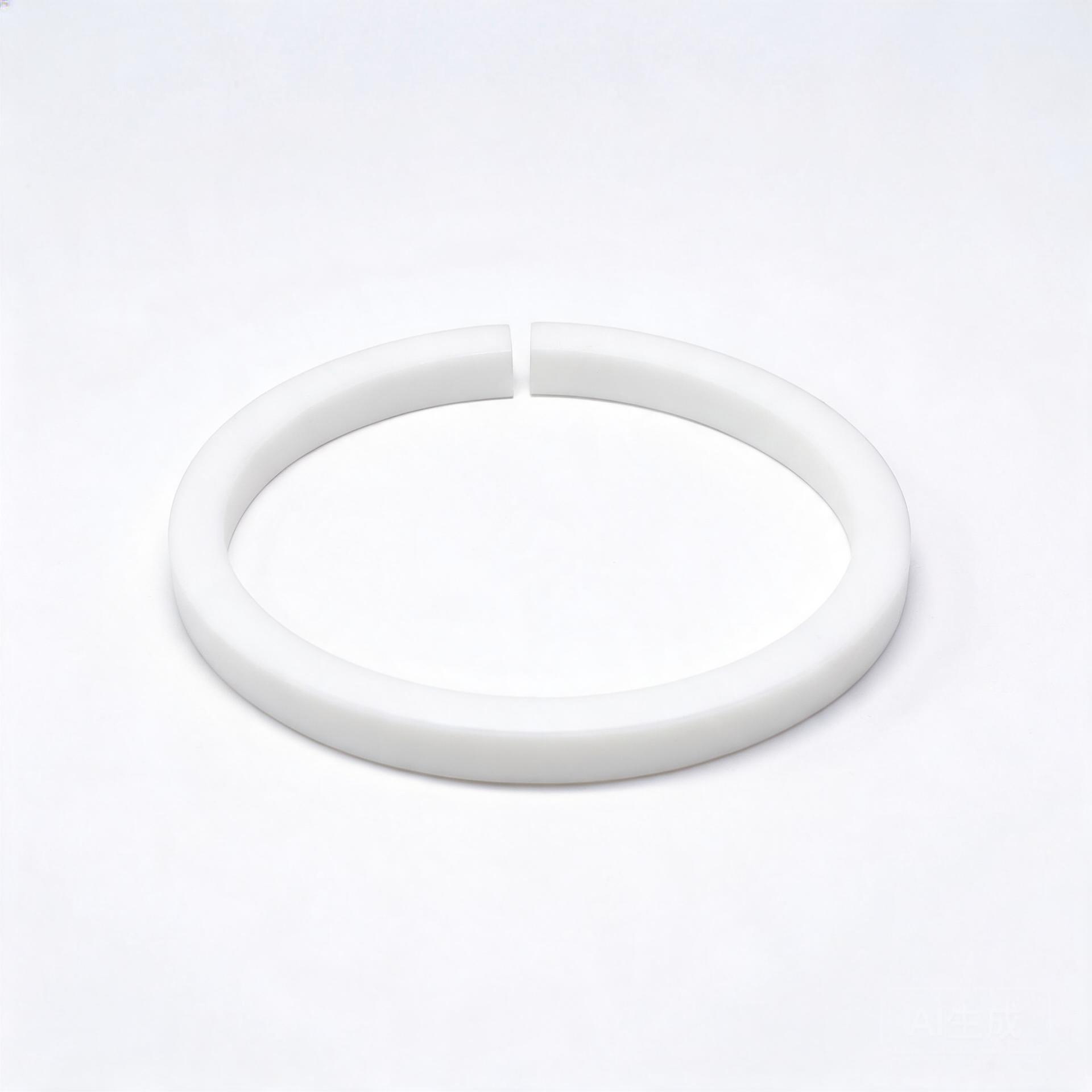
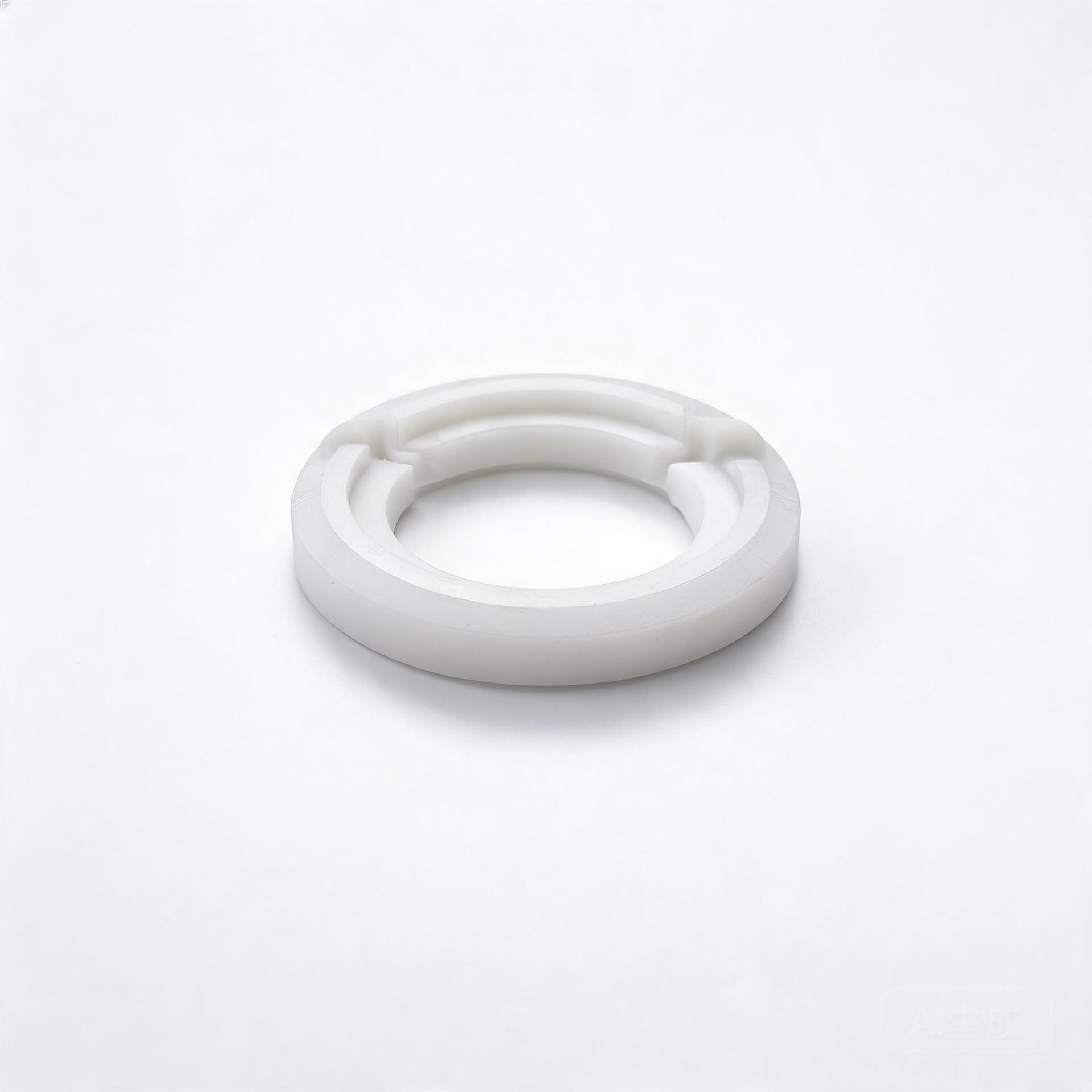
- Shapes: Round, square, rectangular, oval and multi-hole profiles; also split washers for retrofit
- Tolerance: ±0.05 mm standard on thickness; ±0.02 mm machined on request
- Surface: As-skived or machined; etched surfaces available where bonding is required
- Marking: Size, grade and batch marking on request
- Packaging: Bulk bags, clean-room bagging, or individually labelled parts
Quality Assurance
ORRO manufactures PTFE flat washers within an ISO 9001:2015 certified quality management system. Sheet stock is verified on receipt for thickness, density and grade, and each production lot is traceable to its material batch. Washers are inspected for bore, outside diameter, thickness uniformity and flatness, with grade confirmed by colour and, where required, by FTIR.
Dimensional reports accompany production lots, and FDA or USP Class VI declarations can be supplied for food and medical grades. First article inspection is available for new tools.
Ordering Information
- Send a drawing or the bore, outside diameter and thickness you require.
- Tell us the medium, temperature, pressure and whether the washer insulates or seals.
- We confirm grade — virgin or filled — plus thickness tolerance, and quote.
- Stock thicknesses ship quickly; custom outlines and tight-tolerance rings are machined to order.
Frequently Asked Questions
What is the minimum order quantity?
100 pieces per size and grade. Stock thicknesses are punched from sheet; machined rings, split washers and filled grades are quoted at the same 100-piece minimum.
Is a PTFE washer a gasket or a shim?
It can be either. A thin washer between two flat faces with bolt load is a gasket; the same ring used to space, insulate or reduce friction is a shim. Tell us which job it does, because a sealing washer needs a filled grade and a flat face, while a shim needs tight thickness tolerance.
Should I choose white or black PTFE?
White is virgin PTFE: best chemical purity, best dielectric strength, lowest friction, but it creeps under sustained load. Black is usually carbon-filled: better compressive strength and creep resistance for pressurised joints. Brown is glass- or bronze-filled. Choose by load, not by colour.
Can PTFE washers be used at high pressure?
Only filled grades, and only in a properly bolted joint. Unfilled PTFE cold-flows under sustained load — the washer thins, bolt preload drops and the joint leaks. Above roughly 10-15 bar, specify glass- or carbon-filled.
What is the temperature range?
-200 °C to +260 °C for virgin and glass-filled grades, to about +280 °C for carbon-filled. PTFE does not embrittle at low temperature, which is why it is used in cryogenic service.
Can PTFE be used for food contact?
Yes. Virgin and FDA-compliant grades are used on food, beverage and pharmaceutical equipment, and USP Class VI material is available for medical applications. Ask for the compliance declaration with the order.
Why does my PTFE gasket leak on a rough flange?
PTFE does not conform to surface roughness — it seals by clean, flat compression, not by deformation. On a scored or warped flange it will leak where a soft elastomer would seal. Resurface the flange, or use a soft gasket with a PTFE envelope.
What warranty and support do you provide?
12 months against material and dimensional defects under the stated operating conditions, with technical support on grade selection, creep and flange preparation.
Related Products
- PTFE Gasket — full flange gaskets for chemical piping
- PTFE Gasket Ring — ring-style gaskets for raised faces
- PTFE Diaphragm — chemically inert diaphragms
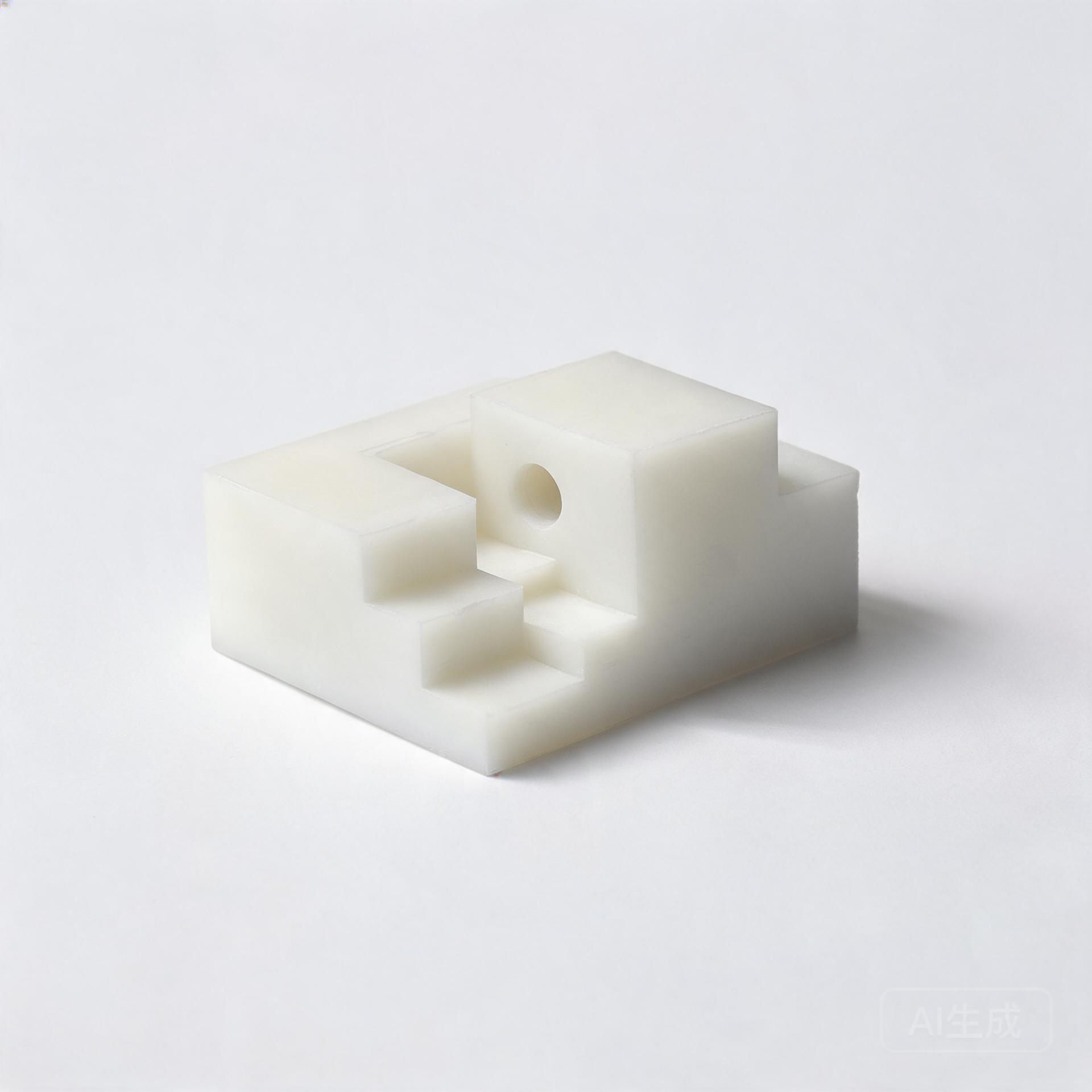
- PTFE Custom Machined Part — machined PTFE components to drawing
- NBR Flat Gasket — oil-resistant rubber washers
- Gasket material guide — soft or hard, and which material for which medium
Send your drawing or the bore and thickness you need for a quote. Tell us the medium, pressure and whether the washer seals or insulates, and we will confirm the grade.