
FKM
Custom FKM Parts We Manufacture
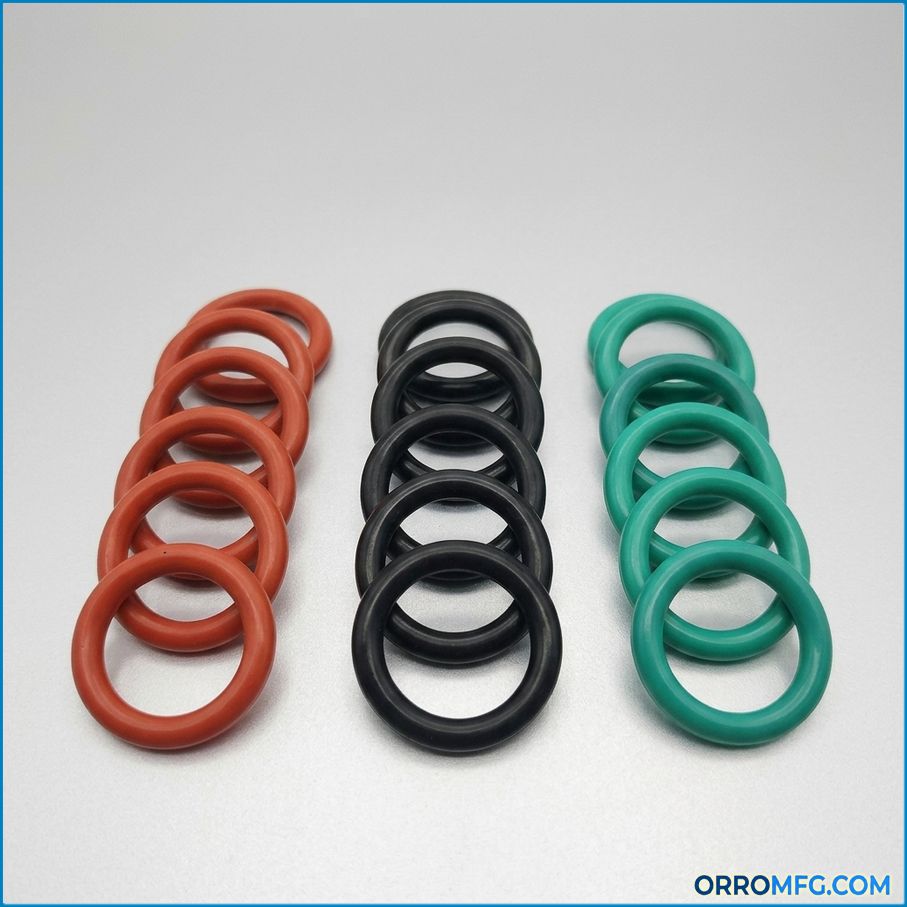
FKM (fluorocarbon rubber, sold under trade names such as Viton) is the high-temperature oil seal material: it holds a seal from −20°C to about +200°C in engine oil, fuel, hydraulic fluid and aromatic solvents, where NBR would harden and crack. It is the default choice for automotive engine and fuel systems, for hydraulic components that run hot, and for chemical equipment handling mineral acids and hydrocarbons.
On this page: 1. What it is · 2. Best/worst at · 3. Core properties · 4. Applications · 5. How to choose · 6. Selection questions · 7. Usage notes · 8. Stock forms · 9. Fit / not fit · 10. FAQ
1. What FKM Is
FKM is a family of fluoroelastomers based on vinylidene fluoride (VDF) copolymerised with hexafluoropropylene (HFP) and, in some grades, tetrafluoroethylene (TFE). The fluorine content — typically 66-70% — is what gives the material its heat, oil and chemical resistance.
- Common names / aliases: FKM (ASTM), FPM (ISO/DIN), fluorocarbon rubber, fluoroelastomer; Chinese: 氟橡胶.
- Trade names: Viton (Chemours), Fluorel (3M), Tecnoflon (Solvay), Dyneon (3M).
- Grade families: standard bisphenol-cured FKM; GLT / GLT-S for better low temperature and steam; GFLT for low temperature plus chemical resistance; FKM-T for improved base resistance; FFKM (perfluoroelastomer) when temperature goes beyond about 230°C.
- What it is not: FKM is not a food-grade rubber by default and not a steam/hot-water rubber in its standard form — specify the compound for those duties.
2. Best at, Worst at a Glance
- Best at: high-temperature sealing against mineral and synthetic oils, fuels, hydraulic fluids, aromatic hydrocarbons and many solvents, with excellent compression-set recovery and ozone/weather resistance.
- Worst at: low temperature (standard grades stiffen below about −20°C), ketones, esters, amines, ammonia, strong bases, and hot water or steam unless a GLT or special compound is specified.
3. Core Properties
| Property | Typical FKM | Notes |
|---|---|---|
| Density (g/cm³) | 1.80 - 1.90 | Higher than NBR or EPDM |
| Hardness (Shore A) | 70 - 90 | 75/80 standard; 90 for extrusion resistance |
| Tensile strength (MPa) | 10 - 20 | Reinforced compounds at the upper end |
| Elongation at break (%) | 150 - 300 | Lower than NBR at the same hardness |
| Compression set (70 h at 200°C) | 15 - 25% | The key advantage over NBR |
| Continuous service temperature | −20 to +200°C | Short excursions to 220-230°C |
| Low-temperature limit | −20°C standard; −40°C special grades | Static service only at the lower limit |
| Compression set at low temperature | Poor below −20°C | Use GLT/GFLT where cold starts matter |
| Gas permeability | Very low | Similar to butyl rubber |
| Ozone / weather | Excellent | No cracking in outdoor service |
| Oil and fuel resistance | Excellent | The main reason FKM is specified |
4. Typical Applications by Industry
- Automotive: engine oil seals, fuel injector and fuel pump seals, turbocharger seals, transmission and EGR components.
- Industrial hydraulics and pneumatics: cylinder rod and piston seals, pump and valve seals running in hot oil.
- Chemical processing: seals for mineral acids, solvents and hydrocarbon streams, where NBR or EPDM would swell or degrade.
- Energy and oil & gas: wellhead and valve seals, downhole components, fuel handling.
- Semiconductor and vacuum: low-outgassing FKM compounds for vacuum seals; FFKM where plasma or aggressive chemistry is involved.
5. How to Choose: FKM vs NBR vs EPDM vs FFKM
| Material | Temperature | Oil / fuel | Water / steam | Weather | Relative cost | Choose when |
|---|---|---|---|---|---|---|
| NBR | −40 to +100°C | Good | Fair | Poor | Low | General oil sealing at moderate temperature |
| FKM | −20 to +200°C | Excellent | Fair (GLT better) | Excellent | Medium-high | Hot oil, fuel, solvents, long service life |
| EPDM | −50 to +150°C | Poor | Excellent | Excellent | Low | Water, steam, coolant, brake fluid, outdoor |
| Silicone (VMQ) | −55 to +200°C | Fair | Fair | Excellent | Medium | Cold flexibility, food and medical, static seals |
| FFKM | −20 to +300°C+ | Excellent | Good | Excellent | Very high | Aggressive chemicals or temperatures above 230°C |
If the duty is hot oil or fuel and the temperature stays under 200°C, FKM is normally the lowest-cost material that will last. If the seal sees hot water, steam or glycol coolant, EPDM is the correct choice regardless of temperature.
6. Five Questions to Answer Before You Specify It
- What is the maximum continuous temperature, and are there peaks? Above 200°C continuous, go to FFKM or a metal seal.
- What is the lowest start-up temperature? Below −20°C, specify a GLT/GFLT compound and confirm it in static service.
- What is the media? Oil and fuel favour FKM; water, steam and brake fluid favour EPDM; ketones and amines rule FKM out.
- Is the seal static or dynamic? Dynamic service needs lower friction and better wear resistance — a 90 Shore A compound or a filled grade.
- What standard and tolerance? AS568 or ISO 3601 sizes with Class A tolerances, or a metric size from a drawing.
7. Design and Usage Notes
- Squeeze — 15-25% for static seals, 10-15% for dynamic seals; too much squeeze raises compression set and makes assembly difficult.
- Groove fill — keep the O-ring cross-section at 70-85% of the groove area so thermal expansion has room.
- Surface finish — 0.8-1.6 µm Ra on the sealing faces; a rough bore cuts the rubber and starts a leak path.
- Installation — lubricate with a compatible grease, avoid twisting, and use a lead-in chamfer so the ring does not catch on a thread or shoulder.
- Storage — cool, dark, dry, away from ozone sources; FKM has a long shelf life but does age.
- Do not substitute — FKM and NBR look similar in black; marking the compound on the bag prevents a wrong-material installation.
8. Stock Forms We Keep
- O-rings: AS568, ISO 3601, JIS B2401, DIN 3771 and metric sizes; 70/75/80/90 Shore A; black, brown and green.
- Sheet: 1-10 mm for cut gaskets and flange seals.
- Cord: 2-20 mm diameter for spliced rings and site-made seals.
- Moulded parts: custom profiles, gaskets, diaphragms and bonded assemblies.
9. Who It Suits, Who It Doesn’t
Suits: engine and fuel systems, hot hydraulic circuits, chemical and hydrocarbon service, outdoor equipment, long-life static seals where rework is expensive.
Doesn’t suit: hot water and steam without a special compound, brake fluid, ketones and esters, ammonia and amines, temperatures below −20°C, and food contact unless an FDA-compliant compound is quoted and approved.
10. FAQ
Is FKM the same as Viton?
Viton is a trade name for FKM made by Chemours; FKM is the generic ASTM designation and FPM the ISO designation. Any Viton part is FKM, but not every FKM part is Viton — the compound and its certificates are what matter.
What temperature can FKM O-rings handle?
−20°C to +200°C continuously, with short excursions to about 220-230°C. Special low-temperature compounds reach −40°C in static service, and FFKM is used above 230°C.
Are FKM O-rings good for steam?
Standard FKM is only fair in steam and hot water. GLT or special steam-resistant compounds improve this, but EPDM is usually the better and cheaper choice for steam service.
Can FKM seal brake fluid?
No. Glycol-based brake fluid attacks FKM; EPDM is the correct material for brake and clutch systems.
What hardness should I order?
70-75 Shore A for most static seals, 80 for general dynamic service, and 90 where the ring must resist extrusion at high pressure or in a wide gap.
Do you supply standard AS568 sizes?
Yes. AS568, ISO 3601, JIS B2401 and DIN 3771 sizes are available, along with metric sizes from a drawing or sample.
Can you make a custom compound?
Yes. We quote low-temperature, steam-resistant, base-resistant and food-contact compounds, and can match a competitor sample by hardness, colour and compression set.
What is the minimum order?
100 pieces per size for production; standard sizes can be supplied in smaller quantities for samples.
How long does delivery take?
Stock sizes typically ship in 3-7 working days; custom moulded or non-standard sizes take about 15-25 working days after sample approval.