Overview
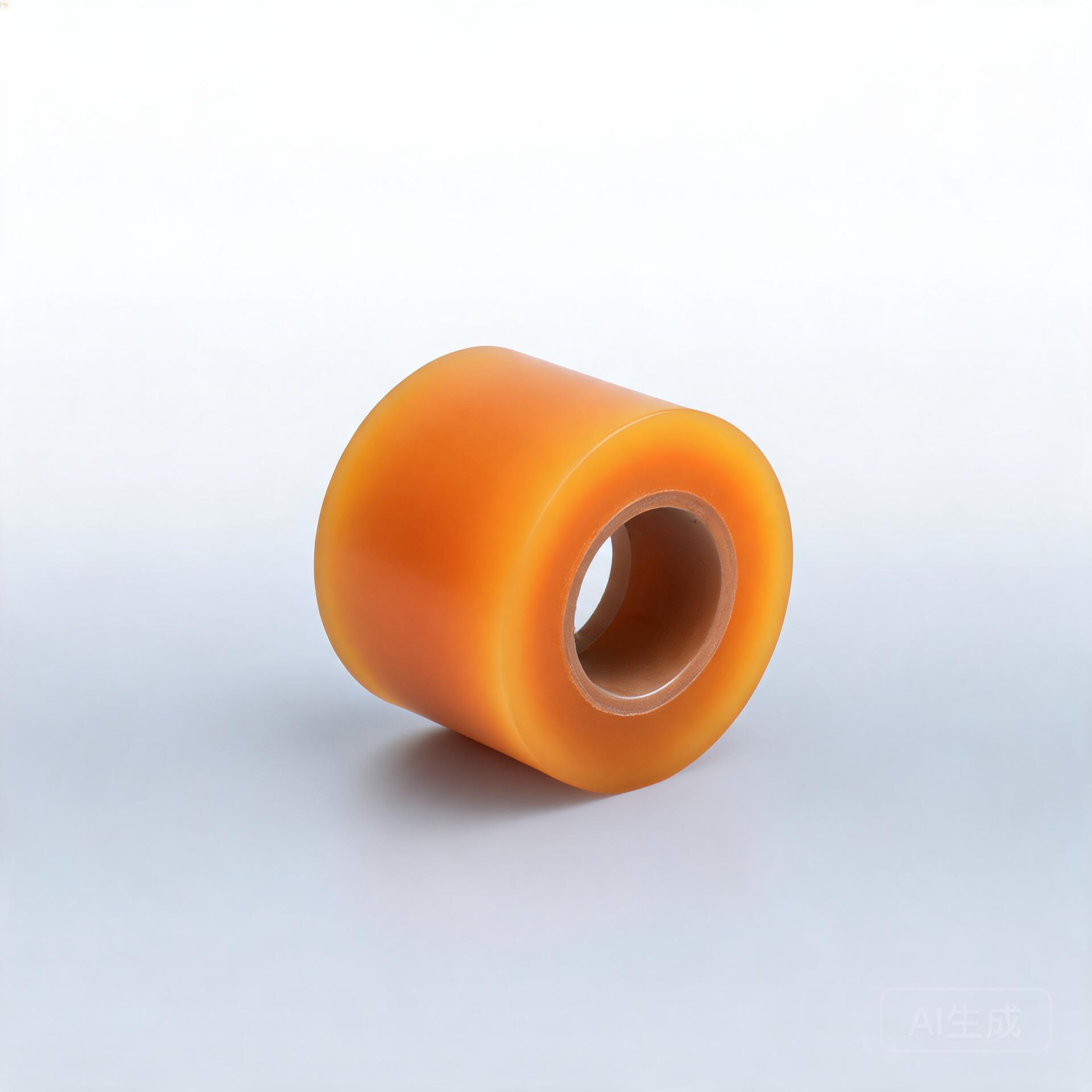
A flexible polyurethane bushing is a resilient sleeve that sits between two moving parts — a shaft and a housing, a pin and a link, a roller and an axle — and takes the punishment instead of them. Where a bronze or acetal bushing is rigid and transmits shock straight into the frame, cast polyurethane deforms under load, absorbs the impact, and springs back. That single behaviour is why PU bushings outlast metal and rubber in vibrating screens, conveyors, mining equipment and linkage pivots.
Polyurethane is the material that closes the gap between rubber and plastic. It has rubber’s elasticity and rebound, but several times rubber’s abrasion and tear resistance, a much higher load capacity, and good resistance to oils, greases and fuels. Against plastics it offers impact absorption and grip that POM, nylon or UHMWPE cannot match. The result is a part that can replace rubber, plastic or metal in one move, cutting maintenance and OEM cost.
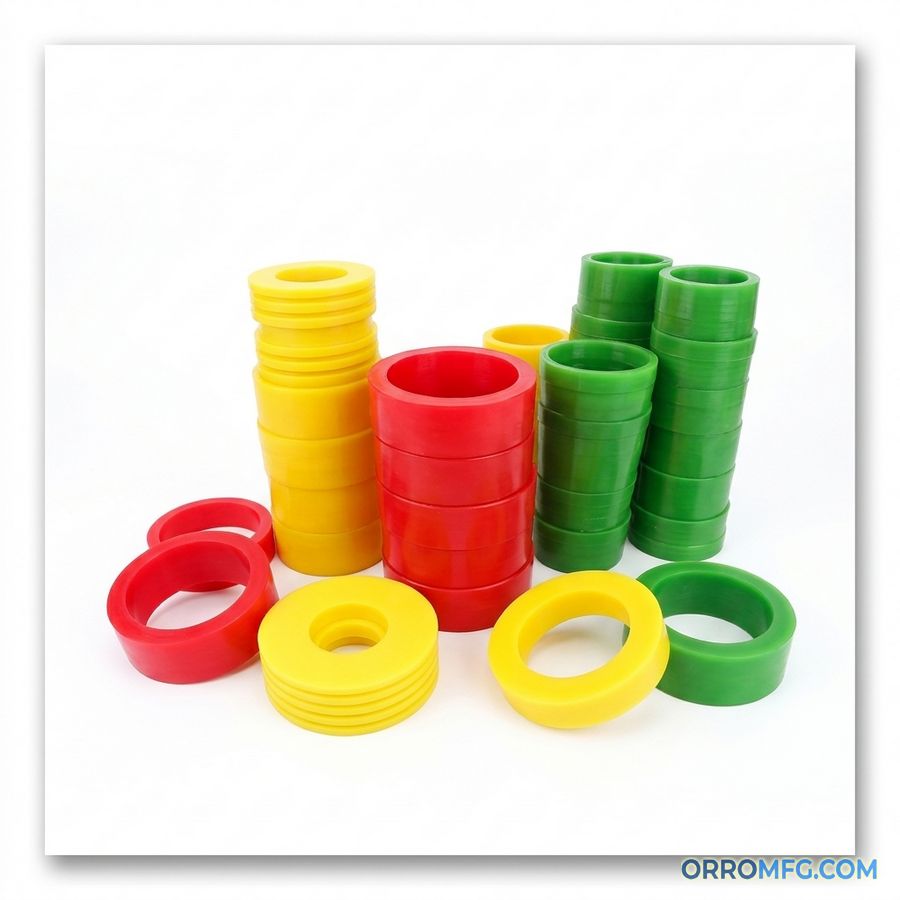
ORRO produces these bushings both by casting and by CNC turning, in hardness from 30 Shore A (soft, for pure damping and cushioning) to 95 Shore A (firm, for load and wear), with colour matching for assembly identification. Tolerances are held to ±0.2 mm on cast parts and tighter on machined parts, and every batch is checked for hardness, bore size and concentricity.
This page covers the compliant variant — softer to medium hardness, specified for shock isolation, vibration damping, misalignment and protective sleeving. Where the part must support a shaft and hold a bore tolerance, use PU Sleeve Bearing instead.
Key Features
- High abrasion resistance — the defining property of cast PU; in sliding and gritty service it outlasts rubber, nylon and most thermoplastics.
- High rebound and shock absorption — impact energy is stored and released instead of being passed into the shaft or housing.
- High load capacity for an elastomer — harder 90A–95A grades carry loads that would crush a rubber bushing.
- Excellent tear strength — resists cutting and chunking when foreign matter enters the joint.
- Oil, grease and fuel resistance — unlike natural rubber, PU does not swell or soften in hydrocarbon contact.
- Adjustable hardness — one geometry can be produced from 30A to 95A, so damping and stiffness are tuned without redesigning the part.
- Custom colour — bushings can be colour-coded by hardness, size or assembly line to prevent wrong-part fitting.
- Light weight, low noise — replaces bronze and steel with a fraction of the mass and far less running noise.
- Corrosion-free — no rust, no galvanic reaction, no plating to fail in wet or washdown areas.
Material Specifications
Typical values for cast polyurethane. The grade datasheet governs final design.
| Property | 60 Shore A | 80 Shore A | 90 Shore A | 95 Shore A |
|---|---|---|---|---|
| Density | 1.10–1.15 g/cm³ | 1.15–1.20 g/cm³ | 1.18–1.22 g/cm³ | 1.20–1.25 g/cm³ |
| Tensile strength | 18–28 MPa | 25–38 MPa | 35–45 MPa | 40–55 MPa |
| Tear strength | 35–50 kN/m | 50–70 kN/m | 60–80 kN/m | 70–95 kN/m |
| Elongation at break | 500–600 % | 400–500 % | 350–450 % | 300–400 % |
| Compression set (22 h, 70 °C) | 25–35 % | 20–30 % | 15–25 % | 10–20 % |
| Rebound resilience | 55–65 % | 45–55 % | 40–50 % | 35–45 % |
| Continuous service temperature | −30 to +70 °C | −30 to +80 °C | −30 to +85 °C | −30 to +90 °C |
| Short-term peak temperature | 90 °C | 95 °C | 100 °C | 100 °C |
| Water absorption (24 h) | 0.3–0.6 % | 0.3–0.5 % | 0.2–0.5 % | 0.2–0.4 % |
Note on hardness: 30A–50A grades are available for pure cushioning and low-stress damping. For bushings that carry a shaft and see sliding wear, 60A–95A is the practical working range — below 60A a bushing deforms too easily to hold a bore true.
Applications
- Material handling and conveyors — roller and pulley bushings, diverting pivots, wear sleeves on guide rails.
- Mining and aggregates — vibrating screen mounts, feeder pivots, slurry pump sleeves, scraper and chute liners where grit destroys metal.
- Industrial machinery — cam followers, linkage pivots, coupling sleeves, press and mixer shaft bushings.
- Automotive and transport — suspension and stabiliser bushings, shock mounts, exhaust hanger sleeves, seat mechanism parts.
- Printing, packaging and film lines — soft nip rollers, web guide sleeves, doctor blade mounts, film-handling tools.
- Pumps, valves and fluid lines — seal rings, impeller sleeves, hose and pipe protection sleeves, U-channel liners.
- Screening and separation — PU screen decks and mesh supports, hydrocyclone and classifier wear parts.
Operating Conditions
- Temperature: −35 °C to +100 °C depending on grade; continuous duty is normally limited to 80–90 °C. Above that, use a heat-stabilised grade or a different elastomer.
- Hydrolysis: ether-based PU resists damp heat and warm water; ester-based PU has the best wear and oil resistance but will hydrolyse in hot, humid service. Tell us the environment and we specify the chemistry, not just the hardness.
- Load: medium radial loads with high shock tolerance. For continuous high load at low speed, a harder 95A grade or a reinforced/inserted design is used.
- Speed: best at low to moderate sliding speeds. High-speed continuous rotation generates heat at the contact patch and shortens life.
- Lubrication: runs dry in most applications; grease or oil extends life where cooling or lower friction is needed.
- Chemical exposure: good against oils, greases, fuels, dilute acids and water; not for concentrated acids, ketones, esters or chlorinated solvents.
Material Comparison
| Property | Flexible PU | NBR Rubber | POM | UHMWPE | Bronze |
|---|---|---|---|---|---|
| Abrasion resistance | Excellent | Good | Very good | Excellent | Good |
| Shock absorption | Excellent | Very good | Poor | Fair | Poor |
| Load capacity | High | Medium | High | Medium | Very high |
| Oil resistance | Excellent | Good | Good | Good | Excellent |
| Noise damping | Excellent | Very good | Poor | Fair | Poor |
| Max continuous temp. | 80–90 °C | 100 °C | 110 °C | 80 °C | 150 °C+ |
| Weight | Light | Light | Light | Light | Heavy |
| Relative cost | Medium | Low | Medium | Medium | Medium–high |
Choose a flexible PU bushing when shock, vibration, abrasion or noise are the failure drivers. Choose bronze or POM instead when the duty is continuous high load at high temperature with tight bore tolerance and no shock.
Customization Options
- Hardness: 30A to 95A Shore, in standard 5-point steps; mixed-durometer designs (soft core, hard shell) on request.
- Chemistry: ether-based for wet and humid service, ester-based for maximum wear and oil resistance.
- Dimensions: bore from 3 mm to 250 mm, wall thickness from 2 mm, length to 500 mm — or to your drawing.
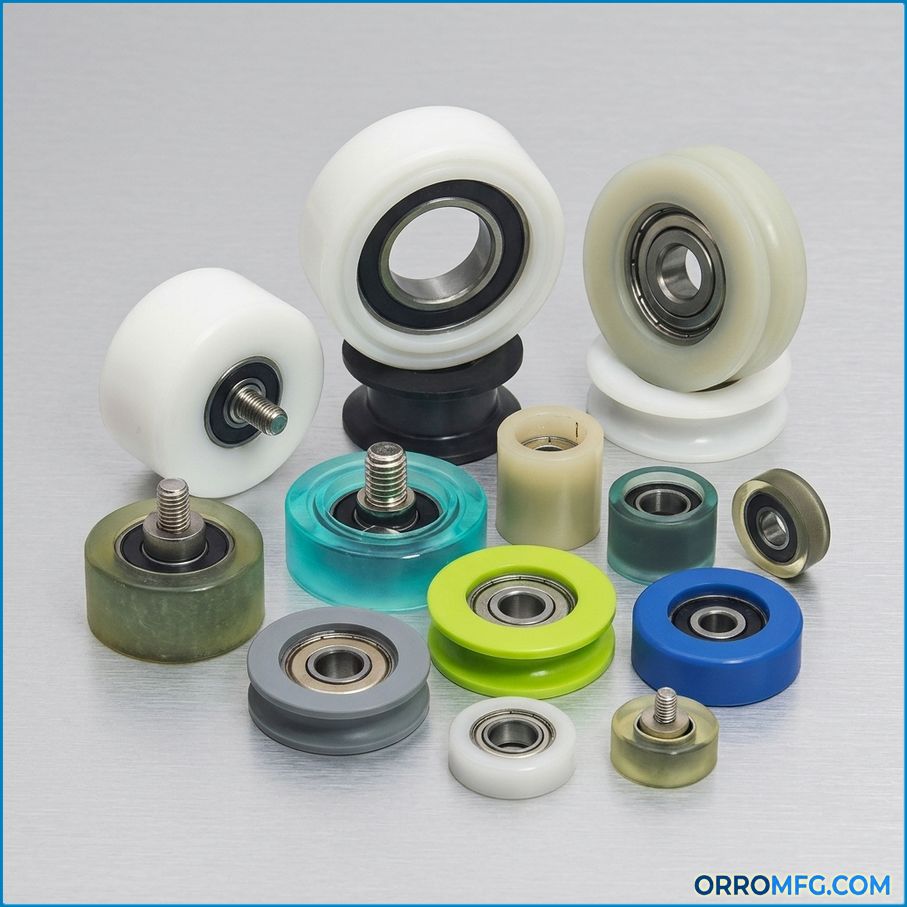
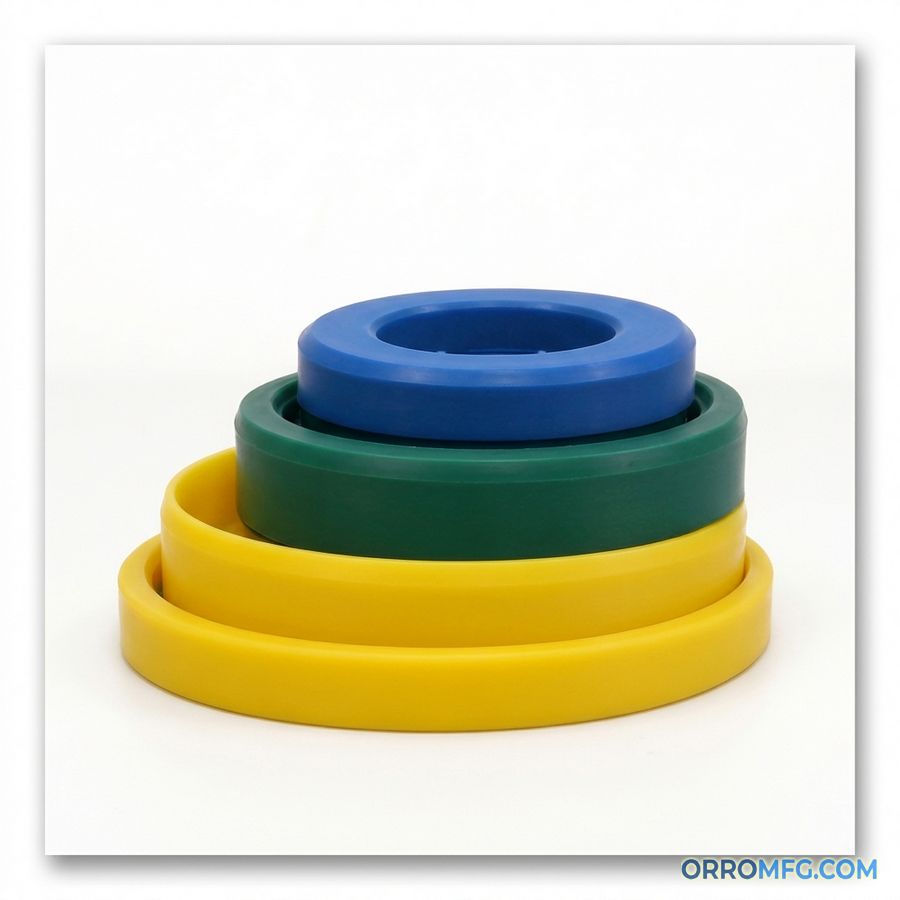
- Geometry: plain, flanged, shouldered, split, grooved bore, ribbed or castellated outside diameter for press-fit grip.
- Tolerance: ±0.2 mm standard on cast parts; ±0.05 mm on machined features where the fit demands it.
- Surface: smooth moulded, machined, or deliberately rough for bonding and grip.
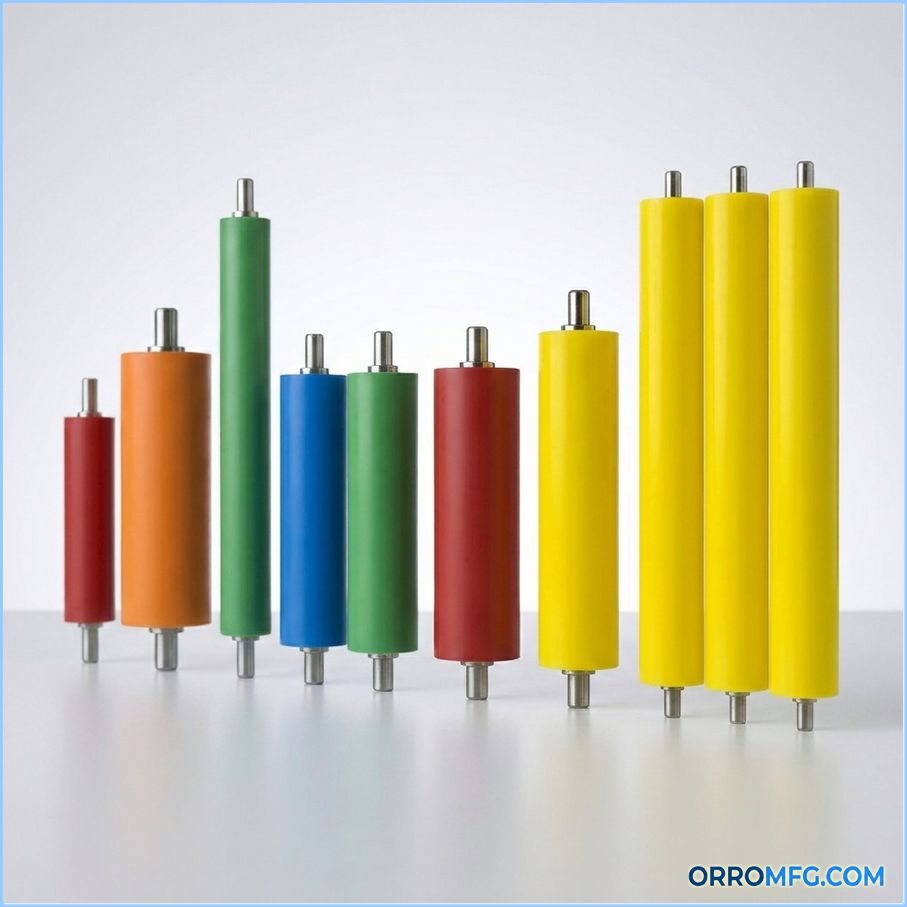
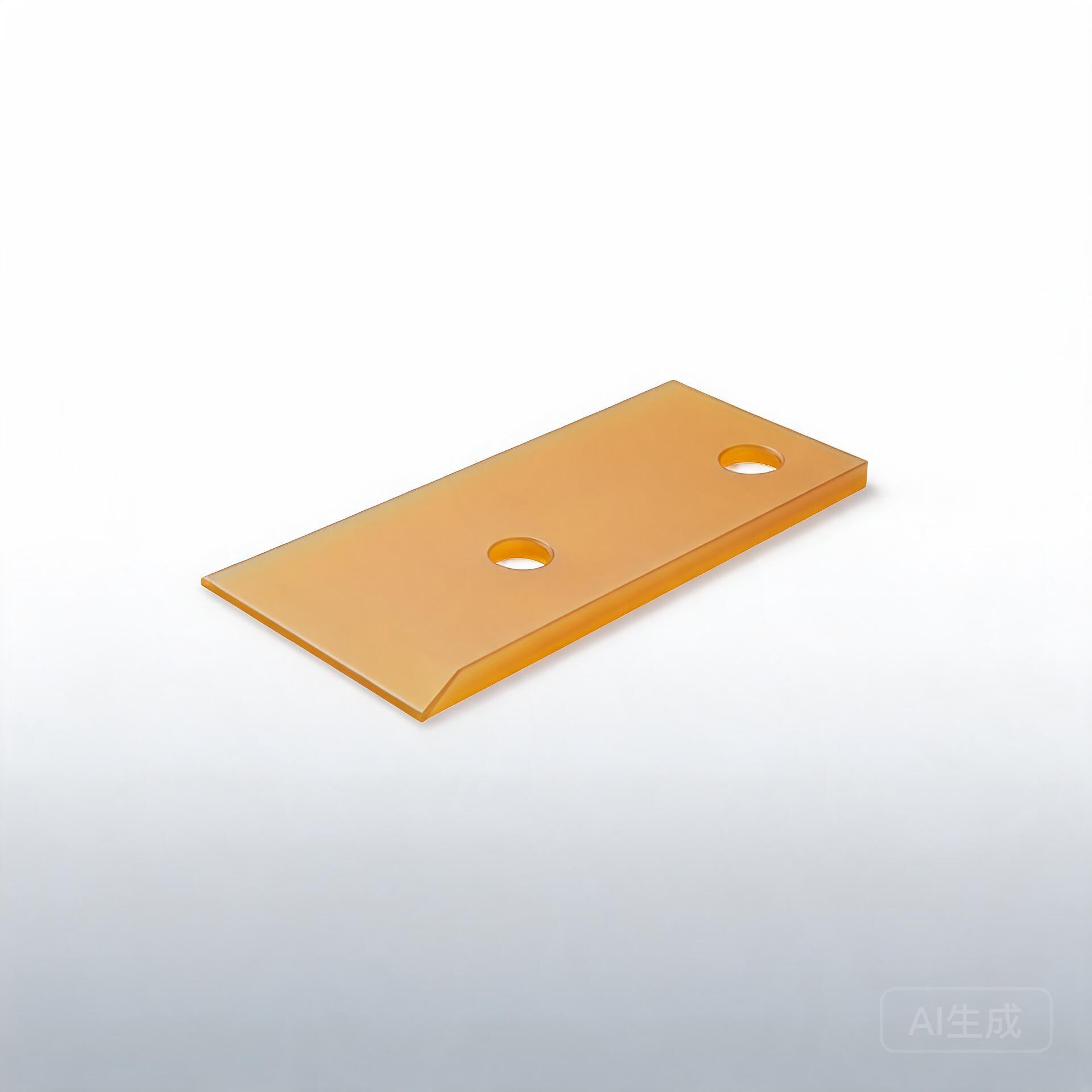
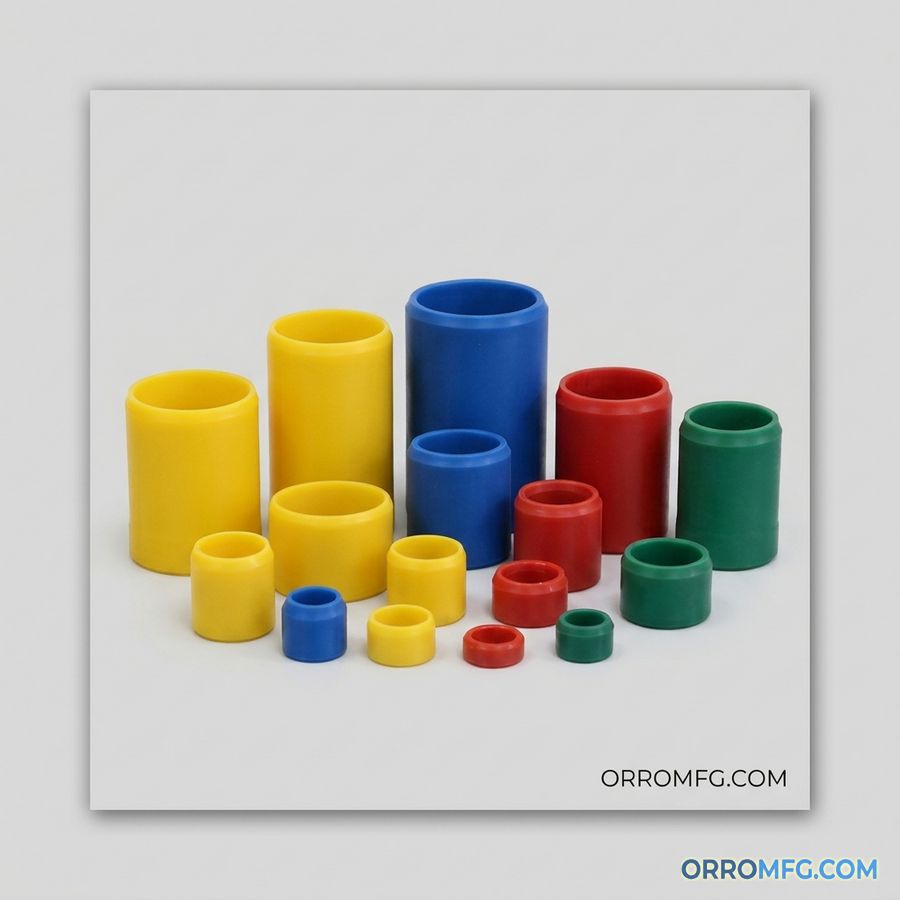
- Colour: transparent/natural amber, white, red, yellow, green, blue and custom colour matching.
- Inserts and bonding: bonded steel or aluminium sleeves, threaded inserts, and composite reinforcement for higher load.
- Branding: laser marking, LOGO moulding, and custom packaging from low minimum order quantities.
- Service model: made to drawing, made to sample, or co-designed. OEM and ODM both supported.
Quality Assurance
ORRO manufactures under an ISO 9001 quality management system and supplies RoHS-compliant material. Incoming PU is verified against the supplier’s data sheet for hardness, density and chemistry. During production, hardness is checked with a durometer on every batch, and dimensions are verified with bore gauges, micrometers and CMM where the drawing requires it. Compression set and rebound are sampled on high-shock applications. Parts ship with material certificates, dimensional reports and batch traceability, and first-article inspection reports are issued before a new part enters mass production.
Frequently Asked Questions
What is the difference between a PU bushing and a PU sleeve bearing?
Mechanically they are the same family. A “sleeve bearing” is specified when the part supports a rotating shaft and load capacity is the main concern; a “flexible bushing” is specified when shock, vibration, misalignment or noise dominate. The geometry usually differs — bushings tend to be shorter and softer, with more radial compliance.
Can polyurethane bushings really replace bronze?
In shock-loaded, dusty or washdown applications, yes — and they usually last longer, run quieter and need no lubrication. In continuous high-load, high-temperature service with tight bore tolerance, bronze or POM remains the better choice. We will tell you which side of that line your application sits on.
Why did my last PU part crack or go sticky?
Almost always hydrolysis: an ester-based PU used in hot, humid conditions, or a part run above its temperature rating. Ether-based PU or a lower-durometer grade usually solves it. This is the single most common PU failure and it is a material selection issue, not a machining issue.
Is standard PU anti-static?
No. Standard cast PU is an electrical insulator. Anti-static and conductive grades are available for electronics, printing and explosive-dust environments — specify at enquiry stage, since these are different formulations, not additives we can mix in later.
Can you match a colour to our existing part?
Yes. Send a physical sample or a Pantone/RAL reference. Colour matching is done at casting, so it does not add machining cost — only a small minimum quantity per colour.
What is the minimum order quantity?
100 pieces per part number for prototypes and replacement parts. Custom colour, LOGO and packaging are available at that quantity, so a trial order does not require a full production run.
Related Products
- PU Sleeve Bearing — load-bearing variant for rotating shafts
- PU Guide Wheel — high-grip wheels for handling systems
- PU Roller — coated rollers for conveyors
- PU Roller Sleeve — replaceable sleeves for roller cores
- PU Scraper Blade — wear-resistant blades for packaging lines
- Polyurethane material guide — hardness, chemistry and selection advice
Send your drawing or sample for a same-day quote. Tell us the load, speed, temperature and chemical exposure, and our engineering team will confirm hardness, chemistry, tolerance and lead time.