Overview
A silicone bolt protection cap is a flexible push-on cover that slips over a threaded stud, bolt end, thread or tube end and protects it — during finishing, during transit, or in service. The two jobs it does best are masking (keeping paint, powder, plating or grit off a surface that must stay clean or conductive) and mechanical protection (stopping damaged threads, injuries and corrosion between the factory and the assembly line).
Silicone rubber is the default material for these caps because it does three things other elastomers cannot do at once. It survives the temperatures inside a powder-coating cure oven; it is genuinely non-stick, so it releases from cured paint without tearing or leaving residue; and it stays flexible at low temperature, so it does not crack when a part comes out of an outdoor store. Its one real weakness — poor resistance to oils, fuels and some solvents — matters for seals but rarely matters for a masking cap, because the cap never sees continuous oil contact. Where it does, we supply fluorosilicone instead.
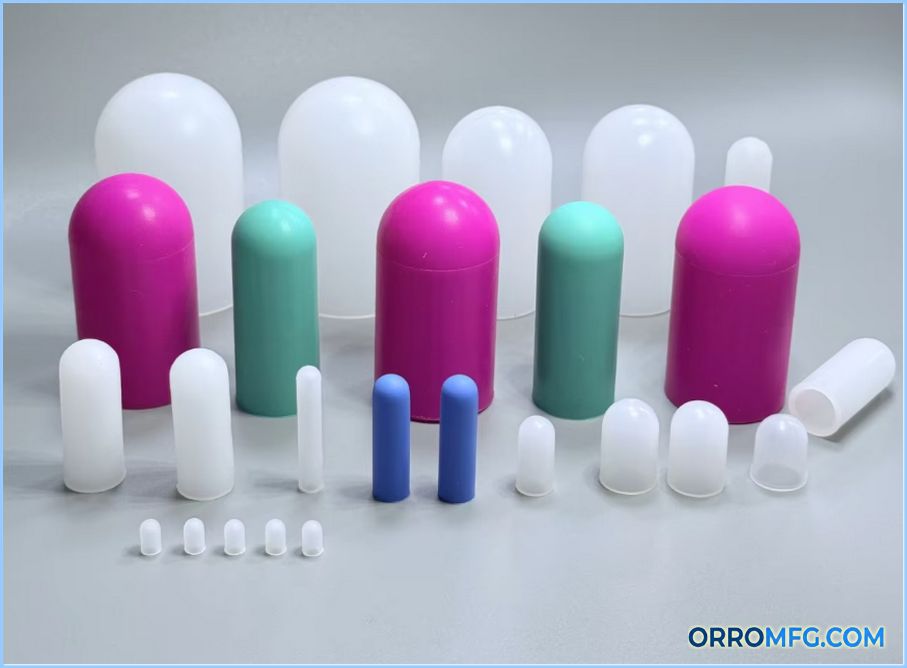
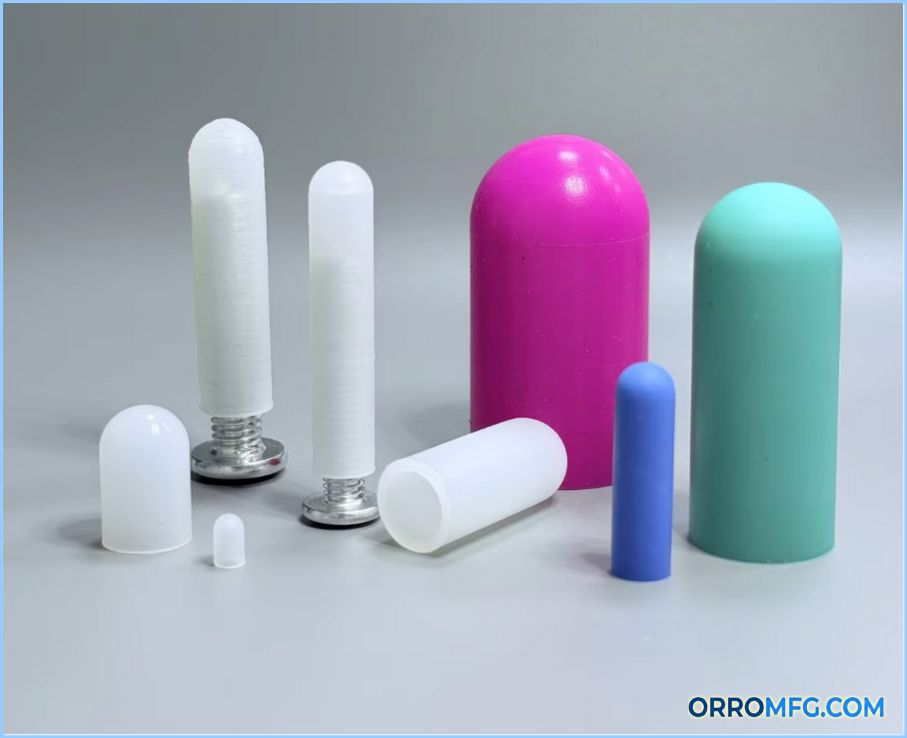
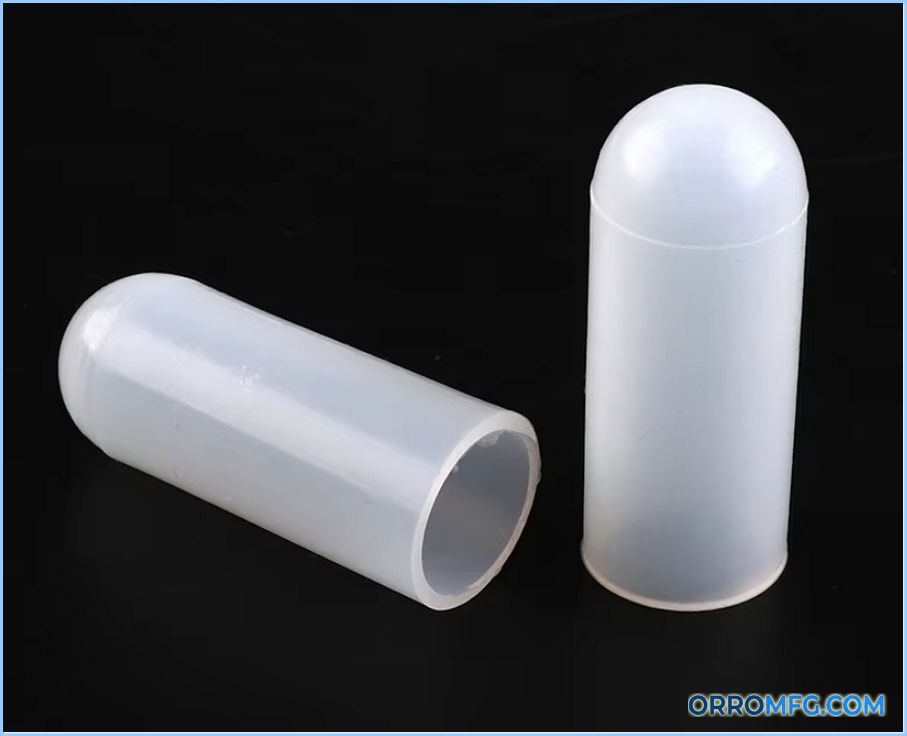
ORRO molds these caps by compression, transfer and LSR injection molding, in any size from roughly 1.5 mm to over 300 mm inner diameter, in natural translucent, opaque colours or custom-matched colour. Caps can be reused across many production cycles, which is why the total cost per part is usually far below a single-use tape or plug.
Key Features
- High-temperature resistance — standard silicone grades work continuously from −60 °C to +200 °C, which covers powder-coating cure ovens, e-coat lines and paint stoving; special grades reach 230–250 °C.
- Non-stick and self-releasing — silicone does not bond to cured powder, wet paint, adhesives or resin, so caps pull off cleanly and can be reused instead of being cut away.
- Soft, flexible and easy to fit and remove — a push-on cap, not a threaded plug; no tools, no masking tape, no labour time per part.
- Snug grip that stays put — high elastic recovery means the cap grips the thread or shank and does not fall off on a vibrating line or in a shipping carton.
- Durable and reusable — high tear-resistance grades and platinum-cured compounds withstand repeated masking cycles, typically dozens of times before replacement.
- Wide chemical and weathering resistance — unaffected by water, ozone, UV, dilute acids and alkalis, and stable in outdoor storage for years.
- Excellent electrical insulation — dielectric strength 15–25 kV/mm, useful for covering live terminals, busbars and connector pins during handling.
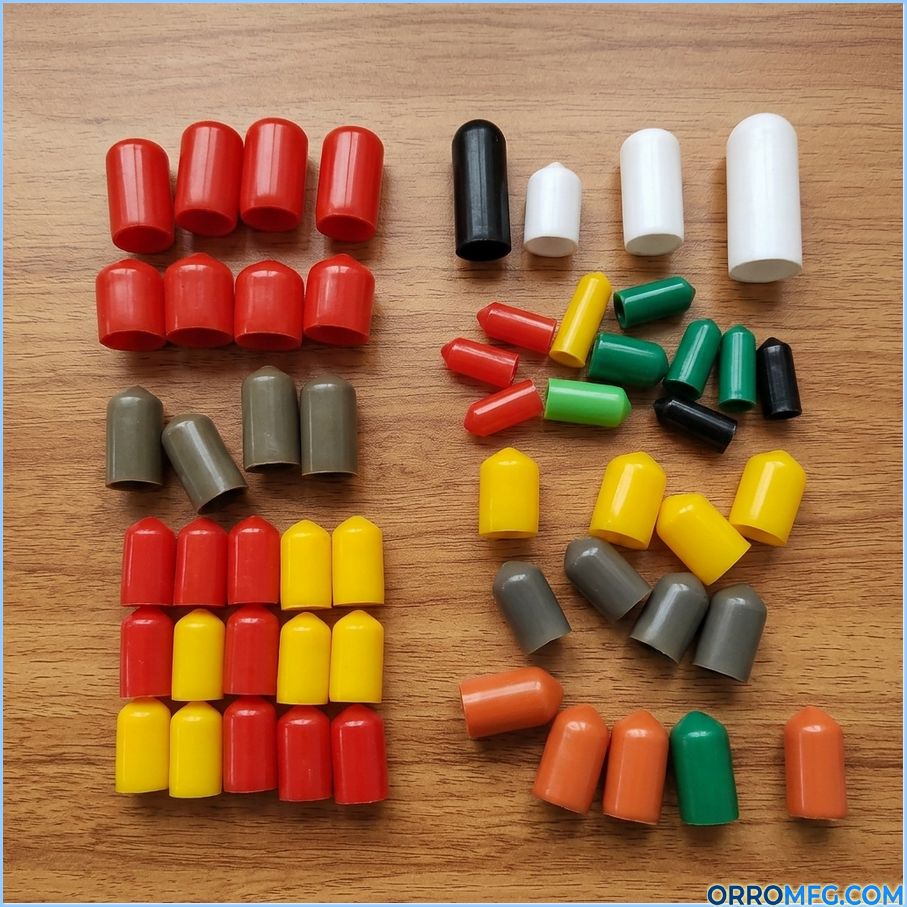
- Colour coding — caps can be colour-matched to a size, thread standard or station, which removes wrong-fit errors and speeds up masking operators.
- No residue, no contamination — platinum-cured food-grade and medical-grade compounds are available where extractables or surface contamination are a concern.
Material Specifications
Typical values for standard silicone rubber (VMQ). The grade datasheet governs the final design.
| Property | Typical value |
|---|---|
| Continuous service temperature | −60 °C to +200 °C (special grades −100 °C / +230–250 °C) |
| Hardness range | 30–80 Shore A (typically 50–70 A for caps) |
| Density | 1.10–1.30 g/cm³ |
| Tensile strength | 5–10 MPa |
| Tear strength | Low to medium (high-tear grades for repeated use) |
| Elongation at break | 200–500 % |
| Compression set (22 h at 175 °C) | 20–40 % |
| Dielectric strength | 15–25 kV/mm |
| Ozone / UV / weathering | Excellent |
| Water and dilute acid/alkali resistance | Good |
| Oil, fuel and solvent resistance | Poor (use fluorosilicone where required) |
| Standard colours | Natural translucent, white, black, red, yellow, blue, green; custom matched |
Grade options: general-purpose HTV silicone for cost-sensitive masking; high-tear silicone where the same cap is reused hundreds of times; platinum-cured silicone for food, medical and low-extractable applications; fluorosilicone (FVMQ) where the cap contacts fuel, oil or aggressive solvent; conductive and flame-retardant (UL94 V-0) grades available on request.
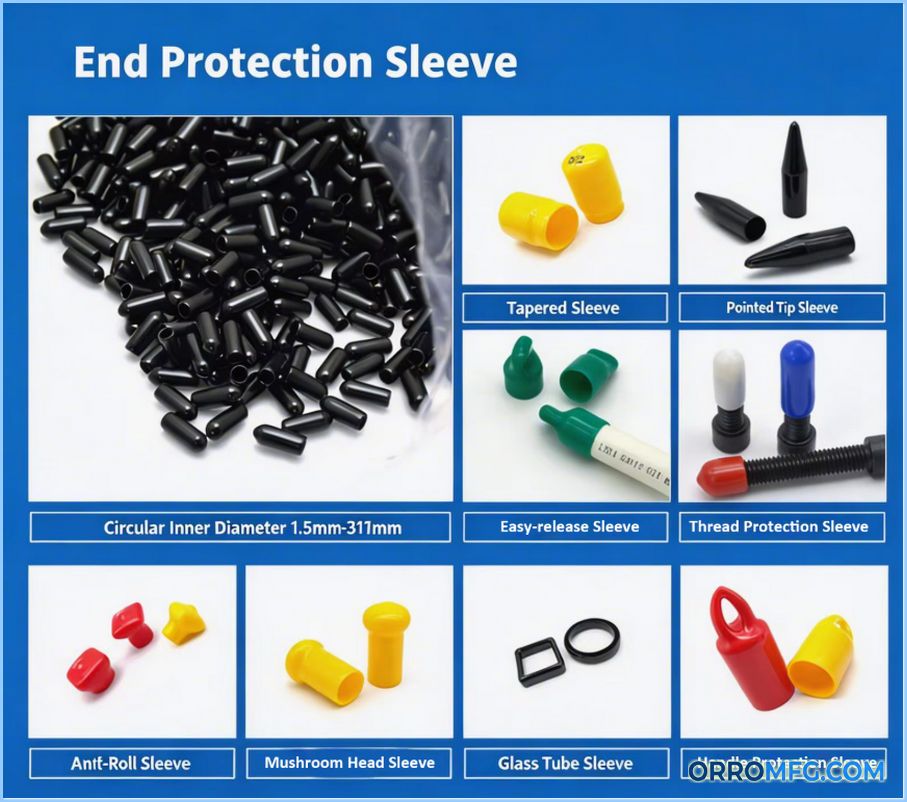
Cap Styles and Sizes
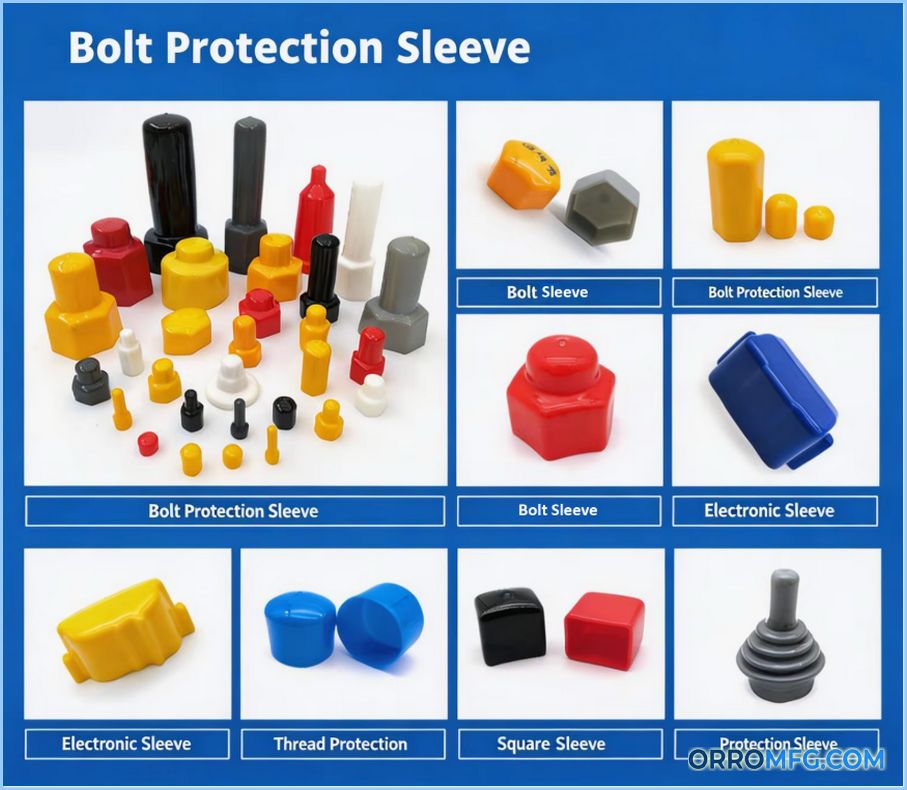
Caps are made to suit the feature being protected. If a standard shape does not fit, we mold to your drawing or sample at low MOQ.
| Style | Typical use |
|---|---|
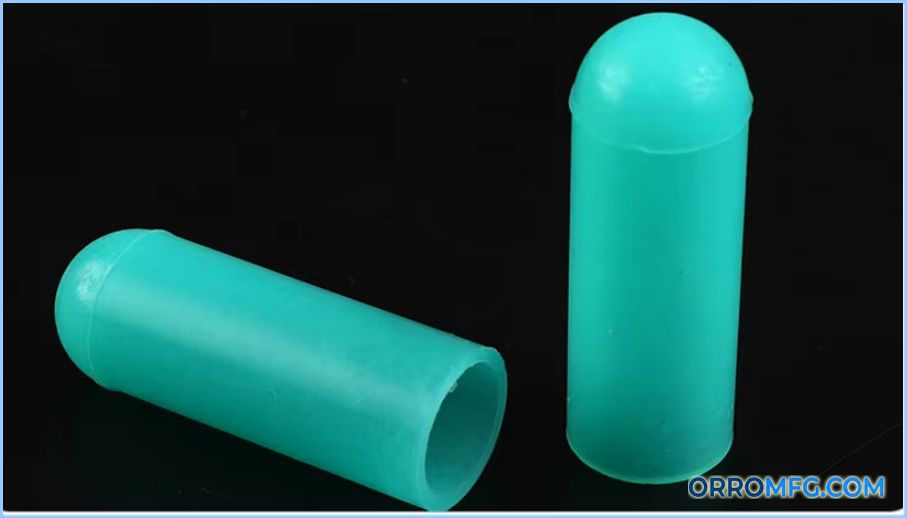
| Round-dome cap | Bolt heads, stud ends, tube and rod ends — the general-purpose shape |
| Flat-end cap | Threaded studs and pins where the cap must sit flush |
| Tapered cap | A range of diameters with one part; easy push-on fit |
| Pointed-tip cap | Tight access points, masking small drilled holes |
| Rectangular / square cap | Square tube, busbar and terminal ends |
| Hex cap | Hex bolts and nuts, matching the wrench flats |
| Mushroom-head cap | Gripping handle plus thread masking in one part |
| Anti-roll cap | Line feeding, where caps must not roll off a rail |
| Pull-tab cap | Fast removal after curing or plating |
| End sleeve / open tube | Long studs, threaded rods and pipe ends |
| Glass-tube and thread plug sleeve | Fragile ends and internal thread masking |
Size range: inner diameter from about 1.5 mm to over 300 mm, in standard walls of 0.8–3 mm. Depth, wall thickness, taper, ribbing, sealing lip and pull-tabs are all molded features, not secondary operations.
Applications
- Powder coating, e-coating and wet paint — masking threads, bores, mating faces, mounting holes and electrical contact points so the finished part still assembles. Silicone is the standard material because it survives the cure oven and releases from cured powder.
- Plating, anodising and chemical finishing — protecting threads, bores and contacts from electrolyte and conversion coatings; fluorosilicone or Viton where the bath chemistry attacks standard silicone.
- Shot blasting and surface preparation — capping threads, ports and seals against grit ingress.
- Automotive — protecting studs, brake and fuel line fittings, wiring harness pins and weld studs during paint shop and transport; masking during underbody coating.
- Electronics and electrical — covering connector pins, terminals and busbars during conformal coating, soldering and wash; insulation caps for live parts in service.
- Appliances and lighting — protective caps on threaded feet, chassis studs and lamp-holder threads; flexible end caps on tubing.
- Construction hardware and tube — end protection for threaded rod, rebar couplers, anchors and handrail tube during storage and shipment.
- Shipping and storage protection — keeping threads clean and undamaged, and removing sharp ends so handling is safe.
Material Comparison for Masking Caps
| Property | Silicone (VMQ) | EPDM | NBR | Viton (FKM) |
|---|---|---|---|---|
| Max continuous temperature | +200 °C (230–250 °C special) | +130 °C | +100 °C | +200 °C |
| Low-temperature flexibility | −60 °C | −45 °C | −30 °C | −20 °C |
| Non-stick / release from paint | Excellent | Fair | Fair | Good |
| Ozone and UV resistance | Excellent | Excellent | Fair | Good |
| Oil, fuel and solvent resistance | Poor | Poor | Good | Excellent |
| Plating / chemical bath resistance | Fair | Fair | Fair | Excellent |
| Typical masking use | Powder coat, e-coat, stoving paint | Water-based wash, general masking | Oil-contact masking | Aggressive chemicals, fuel, plating |
Choose silicone when the cap goes through heat, release matters, or the part is stored outdoors. Choose EPDM where temperature is moderate and cost is the driver. Choose Viton only where chemical resistance is the whole point — it costs several times more.
Customization Options
- Material: general-purpose HTV silicone, high-tear silicone, platinum-cured (food/medical), fluorosilicone, conductive, flame-retardant.
- Hardness: 30–80 Shore A. Softer compounds are easier to fit and grip better on irregular threads; harder compounds resist tearing and hold shape in automated feeding.
- Size: any inner diameter from 1.5 mm to over 300 mm, with wall thickness, depth and taper molded to your requirement.
- Colour: natural translucent, white, black, red, yellow, blue, green, and full custom colour matching against a RAL or Pantone reference.
- Features: ribs, sealing lips, pull-tabs, internal steps for multi-diameter threads, vent holes, and dimpled or textured grip surfaces.
- Branding: LOGO molding, laser marking and custom packaging, all at low minimum order quantities.
- Matching parts: we produce the whole surrounding bill of materials in-house — rubber O-rings, seals, grommets, plugs, gaskets, washers, caps, feet, bumpers, bonded rubber-to-metal parts, and injection-moulded plastic components in PP, PA, PE, POM, PC, PVC, PS, TPE, TPR and TPU. Compounds we mold include NBR, SBR, EPDM, TPU, NR, CR, silicone, FKM and PU.
- Service model: made to drawing, made to sample, or co-designed. OEM and ODM both supported, with free design review before tooling.
Quality Assurance
ORRO manufactures under an ISO 9001 quality management system. Incoming silicone compound is verified against the supplier’s data sheet for hardness, density and curing system before release to production. Process parameters for molding — press time, temperature, pressure and post-cure — are documented and monitored per compound, because cure state is what determines whether a cap tears on removal. Inspection covers dimensional checks on inner diameter, wall thickness and length with gauges and optical measurement, hardness with a Shore durometer, and visual inspection for flash, voids and knit lines. Compression set and tear strength are sampled on high-reuse masking applications. Food-contact and medical-grade caps ship with the corresponding FDA 21 CFR 177.2600 or USP Class VI declaration, and parts are supplied with material certificates and batch traceability.
Frequently Asked Questions
What temperature can these caps withstand?
Standard silicone caps run continuously from −60 °C to +200 °C. That covers powder-coating cure ovens and paint stoving. If your process peaks above 200 °C, tell us — high-temperature grades reach 230–250 °C, but they are a different compound and cost more.
Will the cap leave marks or residue on my painted part?
Standard silicone does not bond to cured powder or paint and releases cleanly. The residue complaints that do occur almost always come from a cap made of the wrong material — EPDM or PVC instead of silicone — or from a badly cured silicone that has started to break down. Platinum-cured grades are the safest choice where surface finish is critical.
Can the caps be reused?
Yes, and that is where the cost case is. In masking operations a well-specified silicone cap is typically reused dozens of times. Choose a high-tear compound and a hardness matched to the thread — a soft cap on a sharp thread tears, a hard cap on an irregular thread leaks paint.
How do I choose the right inner diameter for a threaded stud?
Measure the thread’s outside diameter, then select a cap whose inner diameter is 5–10 % smaller so the wall grips the thread crest. For M6, for example, use roughly 5.5–5.8 mm bore. If the stud has a chamfer or burr, a tapered or ribbed cap seals better than a straight one.
Can you supply caps that survive plating or anodising baths?
Yes, but the compound has to change. Standard silicone is only fair in aggressive electroplating chemistry — fluorosilicone or Viton is the right answer there. Tell us the bath chemistry and temperature and we will specify the compound rather than just quoting the cheapest one.
Do you make these in small quantities?
Yes. Custom colour, custom size and LOGO tooling are available, and the minimum order quantity is 100 pieces. We will confirm the tooling cost and MOQ for your specific shape at quotation.
Related Products
- Silicone O-Rings — high-temperature sealing rings
- Custom Silicone Gasket — molded and die-cut gaskets
- Food-Grade Silicone Seal — FDA-compliant sealing parts
- Seals & Gaskets — general sealing components across materials
- Insulating Parts — electrical insulation components
- Silicone material guide — grades, compounds and selection advice
Send your stud or thread dimensions for a same-day quote. Tell us the process the cap goes through — cure temperature, bath chemistry, blast media or transport — and our engineering team will confirm compound, hardness, fit tolerance and lead time.